Ron's Story
Family History Overview
This section was written for those who enjoy family stories and is not meant to be a treatise. My primary intent is to put in facts and interesting events that Cellie and Al told me or that I documented and/or observed. I have not rewritten family history by omitting unfortunate events which family members have objected to. Detail is generally limited to my great grandparents, grandparents, aunts, uncles, first cousins and my immediate family. A more complete public family tree can be found at the Stoessell Family Tree.
As I write other sections of This Story, family stories from the past come back to mind or are told to me by other family members. As they do, I will be adding them, probably until the day I die.
Much of this history focuses on the Prieto Family and their uncertain past. It was two hundred years ago in 1820 that my great great grandfather was born, on the island of Ibiza, Spain. Some 30 years later the sea captain sailed his schooner across the Atlantic with his wife and their baby boy, my great grandfather. They had eloped and she was disowned by her family. What did they think their future would be? What were their dreams and emotions as they rode the Atlantic swells under sail. Each of us has that time in our life when we dream in excitement of what will be.
For clarification in later sections, some name explanations are useful. My father Al never used his middle name, going by Alfred L Stoessell. Aparently, he did not appreciate the name Leopold. I only learned what the L stood for when I was in high school. My brother Lloyd is also called Alfred L Stoessell. My mother Marcella was usually called Cellie and my sister Marilyn had a daughter also named Marcella. My son David shares the same first and middle names as my maternal first cousin David Michael Moore. The name Ernest was carried by both my maternal grandfather John Ernest Prieto (the central figure in the Prieto family) and my maternal first cousin, an attorney. And the name Clay was carried by both my maternal uncle Clay Prieto and his grandson, a real estate realtor. To distinguish the attorney Ernest and the realtor Clay from my grandfather and uncle, respectively, I will generally call them cousin Ernest and cousin Clay.
I often cite direct ancestors below by generation which is always relative to my gneration, e.g., a 5th generation ancestor would be my great great grandfather or grandmother.
Chapters
Chapters
Paternal Side - Stoessell and Kent Families |
Maternal Side - Prieto and Koop Families |
Paternal Side - Stoessell and Kent Families
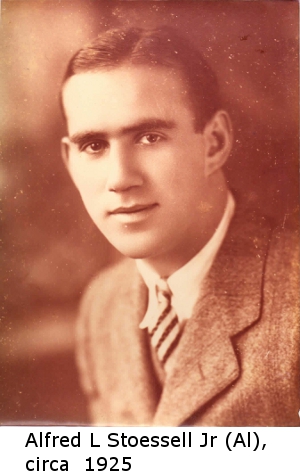
My father Al had attended Tulane from 1924 through 1929. During the early 1930s in the Depression, he shared a New Orleans apartment with Hodding Carter II (later Pulitzer Prize-winning journalist) and Charles Austin (Slew) O'Neill, an attorney like his father who had been Chief Justice of the Louisiana Supreme Court. I'm told the three of them made a lot of bathtub gin during Prohibition. I never met Hodding Carter, and although we corresponded and talked on the phone, I only met Slew once. Slew represented my mother, after Al died, in the 13 year Arnett lawsuit which involved about 3200 acres of Prieto land. We met at the Covington Courthouse in February, 1981 when the case was settled. After walking out of the courthouse together to the parking lot, I pulled out the family checkbook to pay him for years of legal work. He was an old man by then but stood tall and steady, and he looked me in the eyes and said "Ron, I did this for Al." We shook hands, and he got in his car and drove away. I never saw him again. I think Al inspired friendship throughout his life.
Al was the son of a German immigrant, Alfred Leopold Stoessell Sr (1858-1934), who immigrated in 1880 from Stolp in East Prussia (now Poland) and Margaret Irwin Kent (Maggie, 1875-1939) of the large Kent family in Kentwood in Tangipahoa Parish. Al was the youngest child of the family and had three sisters: Hulda Kent (Hulda, 1897-1989), Persis Alma (Persis, 1899-1970), and Margaret Grace (Margaret, 1901-1948).
Maggie's grandfather Amos Kent Jr. (1811-1906) was a Yankee descendant of Richard Kent (1590-1654) who emigrated with his sons James and Richard and daughter Mary on the ship "Mary and John" to the Massachusetts Bay Colony in 1634 from Over/Upper Wallop in Southern England, 14 years after the Mayflower landed at Plymouth Rock. The Kent lineage can be traced back to John Kent (1486-1584). Richard's son James Kent (1618-1681) is the father of the Kent line in Louisiana. This Kent family paternal lineage is described in "Those Fluker Kents" by Gerald Carley and "cousin" Gwynette Carley/Dixon, published in 2006. Of interest is the marriage of Amos Kent Sr. (1774-1824, Maggie's great grandfather) to Abigail Atherton. (1775-1860). Their daughter Abigale Atherton Kent Means (1802-1857) was an aunt by marriage and close childhood friend of Jane Means Pierce. She filled in the duties as First Lady during the first two years of the Franklin Pierce Administration, due to the illness and depression of his wife Jane.
The Kents have some interesting direct ancestors through the maternal lines. Five ancestors in two families arrived in 1620 on the Mayflower and the senior male members William White and Stephen Hopkins were signaturies of the Mayflower Compact. Resolved White (1615-1687), a pilgrim, arrived at age 5 with his parents William (1591-1621) and Susanna (1592-1654) and is a 10th generation ancestor through the Kent/Atherton/Goss/White line. His father died 3 months later in Plymouth, and Susanna remarried to Edward Winslow in 1621 whose wife Elizabeth had also died during the first winter. Resolved's brother Peregrine (1620-1704) was born on the Mayflower in Plymouth Harbor. The grandfather of Resolved's wife (Judith Vassall White, 1619-1670) was Captain Jean John Vassall (1544-1625) who built and owned the Mayflower. However, Judith was not on the first voyage. Jean Vassall was an interesting character who commanded several ships during the battles with the Spanish Armada in 1588 and was also a principal stockholder in the Jamestown Company which founded Jamestown.
The other Mayflower family, is represented by 11th generation ancestor Giles Hopkins (1608-1690) through the Kent/Atherton/Goss/Hopkins line. He was 12 years old when he arrived on the Mayflower with his father Stephen (1581-1644), family members and servants. He had a brother with the appropriate name Oceanus (1620-1627) born during the voyage. Interestingly, Peregrine White and Oceanus Hopkins were the only two infants born on the Mayflower. The Hopkins were not pilgrims and Stephen Hopkins had previously lived in Jamestown, Virginia for 7 years, returning home in 1616 after his first wife Mary died in 1613 in England, on the same ship carrying Pocahontas (Rebecca Rolfe along with her husband John and their son Thomas). During his first trip to America in 1609, his ship, the Sea Venture, was wrecked off Devils Island (Bermuda) during a hurricane. John Rolfe was a shipmate on the Sea Venture. On Bermuda, Stephen was accused of mutiny while questioning the authority of the English leadership. He wanted to stay in Bermuda, because Jamestown already had developed a reputation as a hellhole (LOL). Hopkins argued that since the ship had failed to reach Virginia and they were on their own, they could form a new government, a Democracy! Stephen received a death sentence for this precursor to the American Declaration of Independence, but was pardoned due to his pleas and likeable nature (unlike mine). Stephen is immortalizd as Stephano in The Temphest, Shakespeare's play in 1611 which described him as the Wanta-Be-King of Bermuda. He was the family's first American renegade, soon to be followed by others as described below.
Once in America, the renegade family nature took over. The uncle of a 9th generation ancestor, John "Mad Jack" Oldham (1592-1636) started the first Indian War in New England. He had arrived in Plymouth in 1623 aboard the Anne with his wife and sister. Mad Jack was not a Pilgrim and his nickname reflected both heavy drinking and his temperament. He was banished from Plymouth in 1624, moved to the Connecticut area, co-founding Wethersfield. Mad Jack was both an Indian trader and a ship captain. In 1636, he was murdered by Pequot Indians on his ship off Block Island, Rhode Island, starting the Pequot Indian War (1636-1638). On his ship were two English boys, his nephews Thomas and John Oldham who were captured and later released. Thomas later moved south to Virginia and is my 10th generation ancester through the Kent/Fluker/Oldham line.
Not content with starting an Indian war, some direct ancestors took part in the Salem Witch trials: one as a prosecutor and 4 as accused witches. Three of the accused were through the Kent/Atherton/Wright/Wardwell line and 1 was through the Kent/Hale/Moody/Bradbury line were convicted of witchcraft and sentenced to hang in 1692 in Salem. Samuel Wardwell (1643-1692, 9th generator ancestor) was hung in Salem on Proctor's Ledge in 1692. He was a carpenter and fortune teller (which sealed his fate). He and his wife Sarah (1650-1709), their daughter Mary Mercy Wardwell Wright (1673-1764), and a step daughter Sarah Hawkes (1671-1716) confessed to being baptised by the Devil. Apparently, they confessed thinking they would be spared since everyone who had previously pled not guilty had been sentenced to death. When Samuel realized he was going to be hung anyway, he recanted his confession. The executions of his wife Sarah, daughter Mercy, and step daughter were put off and they stayed together in prison. A second trial reversed Mercy's and her half-sister Sarah's convictions but not that of their mother Sarah who was later released by Governor Phips. A 10th generation ancestor Mary Bradbury (1615-1700) was a member of a prominent family and was accused of being a shape-shifter, changing into a blue boar, an unusual feat in colonial days. She escaped prison apparently through her husband bribing a guard and fleeing in a "speedy" cart. The odds of survival are always increased with being wealthy and having "fast" get-away. Mary later returned after Governor Phips disbanded the Court of Oyer and Terminer in 1692 and ended the executions in 1693. Phips was motivated to end the trials because the crazies were threatening to prosecute his wife for witchcraft. (LOL) On the prosecution side of the witches was 9th generation ancestor blacksmith/puritan pastor Jonathan Hale (1636-1700), through the Kent/Hale line who reversed his views when his wife Sarah Hales was also accused of witchcraft. He is cast as Reverend Hale in Arthur Miller's 1953 play "the Crucible". Knowing that I am a direct descendant of a mutinous Jamestone traveler, a hung warlock, and 3 witches, gives me great satisfaction. No wonder I am a trouble-maker.
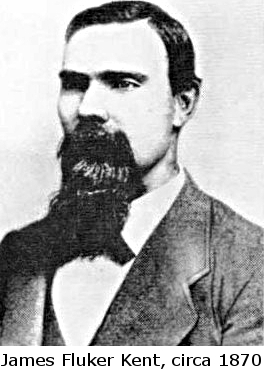
After the death of his father Amos Kent Sr (1774-1824), my great great grandfather Amos Kent Jr moved south from New Hampshire in about 1828 to the Baton Rouge area, at the age of 17, eventually settling with his brother Fredrick (1814-1864 - later killed in action in the Civil War) in the present-day Kentwood area in the mid 1850s in what was then St. Helena Parish, Louisiana. Amos later founded Kentwood in 1888 and served 8 years in the state legislature. Maggie's father was Amos' son, James Fluker Kent (1843-1886), a Civil War veteran. The name Fluker came from Amos's wife Susan Fluker (1823-1906) of Clinton, Louisiana, whose father Colonel Robert Fluker (1783-1864) had fought in the Battle of New Orleans as a private. I'm not sure how he was promoted to Colonel but he was a successful planter. However, I'm sorry to acknowledge that both Amos and the Colonel were slave holders, according to the slave schedules of the US Census. Interestingly, the Kent line, primarily from New England and going back to the Mayflower, is the only line in my ancestry that includes slaveholders. Hence, I can blame the curse of slavery on the Yankees. (LOL)
James Fluker went by the name Fluker. Fluker had been enrolled in 1860 in Pineville in the first class of what was to later become the Louisiana State University. Oddly enough, William Tecumseh Sherman (the well-known Union General in the Civil War) served as the first Superintendent of the school. When the war started in 1861, Fluker resigned from the college and joined the Confederate Army as 4th Sergeant of Company F (St Helena Rebels) 16th La Infantry. In 1862 he became a 2nd Lt. In 1863, at age 20, Fluker was captured by the Union Army at Missionary Ridge and imprisoned on Johnson Island in Lake Erie for the remainder of the war. I have an autograph book that Fluker kept at Johnson's Island (Fluker's POW book) with numerous signatures and several poems. The poems are impressive, showing a grasp of English rarely seen today in America.
Maggie's mother was Delilah (Lilah) Flanagan Amacker (1849-1911), also of Tangipahoa Parish (at that time part of St. Helena Parish). Lilah was the sister of Lt Col Obediah Pearson (OP) Amacker (1838-1910, served in 3rd Regiment La Cavalry) who was captured at Port Hudson and was also a POW with Fluker at Johnson's Island. OP later married Fluker's sister Abigail Means Kent (1841-1910), and Fluker's younger brother George Kent (1846-1883) married Delilah's sister Elizabeth Dean Amacker (1847-1901). The Amacker and Kent families were tied closely together throughout the 19th century. Maggie's great grandfather, John Jacob Amacker (1780-1815, family of Swiss origin from Canton Berne) with his wife Sarah Ann Varnado (1784-1844, family of French origin), had migrated west from Orangeburg, South Carolina in 1800 and moved into St Helena parish in 1813. Judging from the number of Amacker descendants, they bred like rabbits - (LOL).
After the Civil War, Fluker partnered with his father in the Amos Kent Brick and Lumber Yard. Maggie was the 7th of 12 children.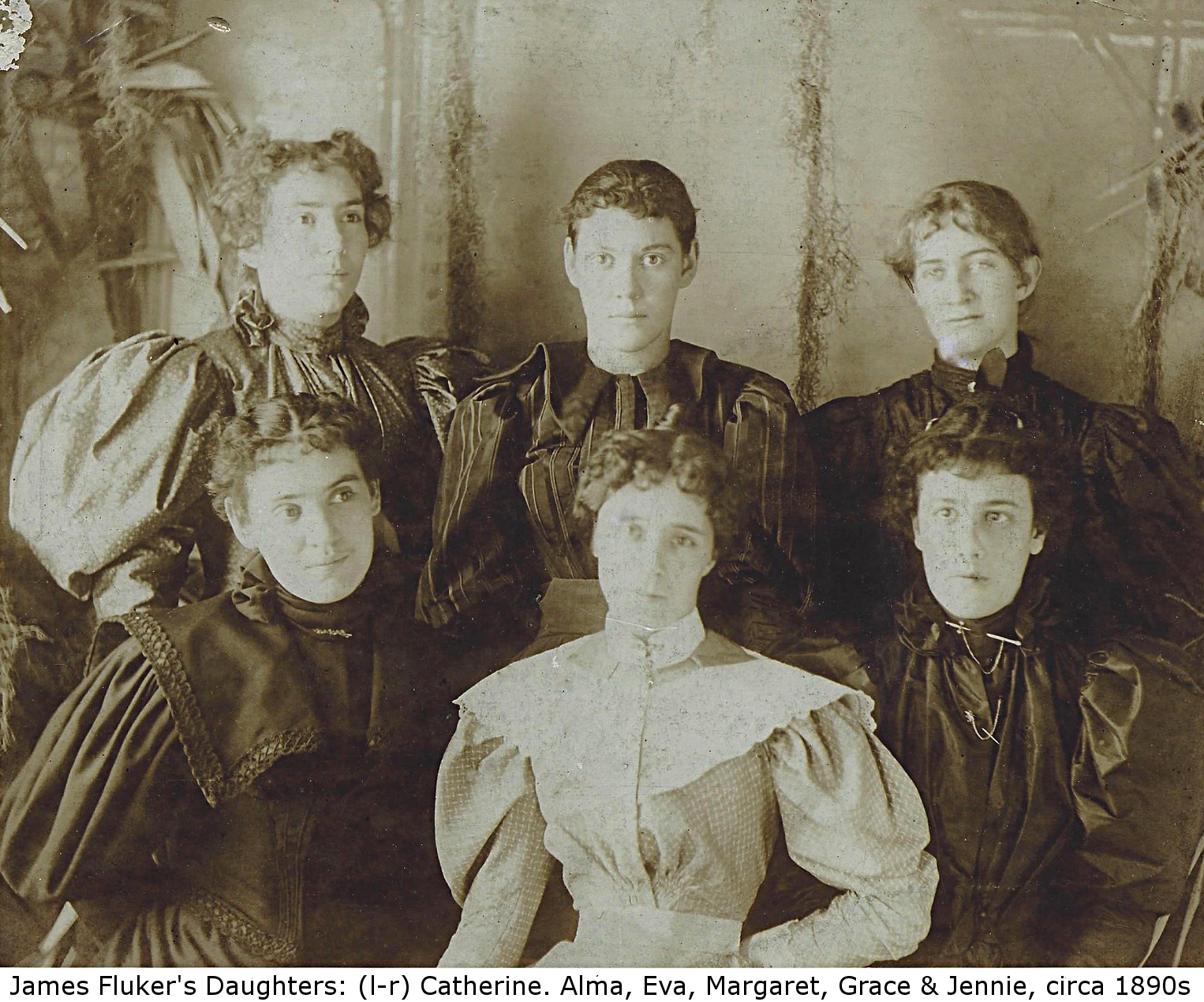
Fluker died young in 1886, in his early 40s, leaving a widow and large family.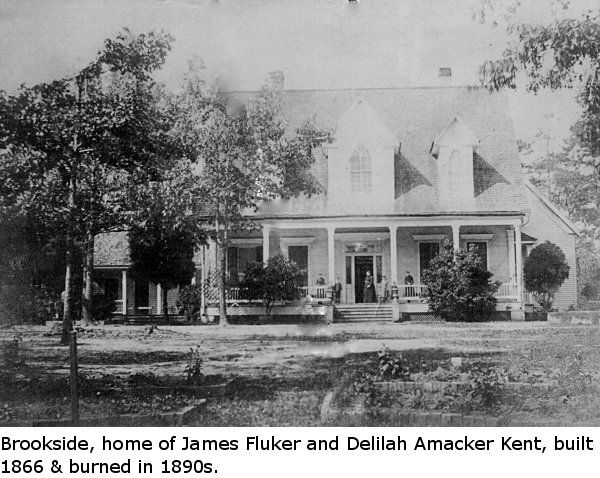
One of his sons, Richard Amacker Kent (1871-1926), 15 years old at the time, gradually took over responsibility for the family. Richard eventually bought thousands of acres of land a few miles south of Kentwood in an area known as Hyde, renamed it Fluker after his father and founded the unincorporated village (about 1890) where he established a lumber yard and brick yard and other prosperous businesses. His wife Susan Freiler Kent (1877-1966) was the matriarch of the Kent family until her death. I remember her as Aunt Suzie.
Alfred Sr's father was Carl Wilheim Heinrich (Henry) Stossel, with an umlaut over the o, (1824-1895),the longest-serving mayor of Stolp from 1866-1890. Prior to being the mayor, he served as th clerk of court and as a judge. Family records say he was the son of Carl Wilhelm Heinrich Stossel and Berta Schroeder. According to famliy lore, his wife Hulda von Dorpowska/Puttkamer (1831-1910) was related to Bismarck's wife (Johanna von Puttkamer) through a grandmother. (Interestingly, Hulda is listed on the 1934 Louisiana death certificate of their son Alfred as Hulda Poutcombie) Family records say Hulda parents were Leo von Dorpowska and ? von Kleist/Puttkamer so where did the Poutcombie come from? Henry possibly owed his position as mayor to Bismarck because he lost it in 1890, the same year that Bismarck was sacked as Germany's Chancellor by Kaiser Wilhelm II. Most of Stolp's records were destroyed in World War II and is now part of Poland, called Slupsk. I have not been able to find more information other than a book that listed Stolp's mayors which included a C. W. Heinrich Stossel as mayor from 1866-1890. Their son Alfred supposely went to the University of Heidelberg (no university records to support this) before arriving (by way of Hamburg and Glasgow) at Ellis Island at age 22 on November 16, 1880, on the Anchoria. His occupation was listed as student/scholastic. As a child I was told he came to America to escape the compulsory Prussian military service (established by Bismarck) and to escape punishment by authorities for his membership in an outlawed Heidelberg dueling club. I have his masonic sword inscribed "IN HOC SIGMO VINCES", and a copy of his 1921 32nd degree Mason paper can be found in Family Papers. He married Margaret (Maggie) Kent in 1895, becoming a naturalized citizen in 1899. I know almost nothing of him other than family stories such as: he had facial scars (covered by his moustache) and lost the tip of his tongue while dueling (never stick your tongue out when sword fighting) at Heidelberg; could speak 7 languages; taught at the University of Texas in Austin (no records have been found); had a brother who was with him at Heidelberg and who went to South America (on his way to Australia) and was killed by a "big constrictor snake". I remember hearing he met his future wife Maggie Kent in St. Lewis.
He ended up in Tangipahoa Parish in Louisiana working in the lumber industry. Alfred Sr died of prostate cancer in 1934 before I was born. There are so many questions I would have liked to have asked him. Al said his father considered himself retired when he was growing up in Hammond, LA. He had been working as a bookkeeper for the Natalbany Lumber Company. Al remembered him tutoring Latin to the local high school students. But much of his spare time was spent drinking beer with his German compatriots. Life was good for them but not financially rewarding. My mother recalled visiting them in Hammond during the Great Depression and being fed only tomatoes.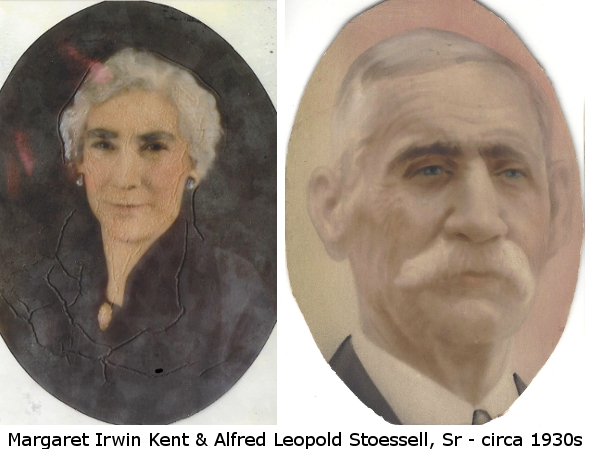
Aunt Hulda married David Chester Boyd (DC, 1882-1961), a Texas Wildcatter who made and lost several fortunes. DC and Hulda visited us for an extended stay in North Crowley in the 1950s. I remember him as an old man, nearly blind, sitting in our back yard, telling me of those "wild" early days of drilling for oil. They had 4 boys: David Cannon (David, 1920-2005), Alfred Kent (Kent, 1925-2011), Lloyd Stoessell (Lloyd, 1927-2015), and Joseph Lyon (Joe, 1933-2020). David was initially married to Georgia Mae White (1921-2016) and had 3 children: David Randolph (Randy), Patricia (Patsy), and Eric. David was also married later to Anna Carolina Waldron and to Betty Jo Hiser. Kent was married to Barbara Jean Benchley (Jean, born 1932) and had 2 children: Melissa and Stephen, along with Jean's two daughters from a previous marriage: Deborah and Candice Laird. Lloyd was married to Darlene Alice Smith (Darlene, 1930-2015) and they had one child: Jo Ellen (Jody). And Joe married Marilyn ? (19??-2011) and they had 5 children: Kirby, Leslie, Allison, Dana, and Christopher. Although the four boys are now gone, this is a large Texas family that I wish I had had more interactions.
DC and Hulda's family lived mostly in Texas and my limited contact with them has left me with few details. I often wondered how my Aunt Hulda in Hammond, Louisiana got hooked up with a Texas Wildcatter. Randy Boyd told me he remembered Hulda as a true family matriarch. Jean Boyd said Hulda taught home economics in the New Orleans area and had a degree from Northwestern State College in Natchitoches. In the 1915 Potpourri Yearbook, Hulda is mentioned as a member of the Choral Society. Jean also said DC had attended Sam Houston State College in Huntsville and studied law. I contacted Joe Boyd who messaged me DC both practiced law and taught in Louisiana where he met Hulda. DC got into the oil business through royalities he obtained doing legal work. I worked at Exxon Production Research Center in Houston in the late 70s and one of the old-timers remembered DC from the early days.
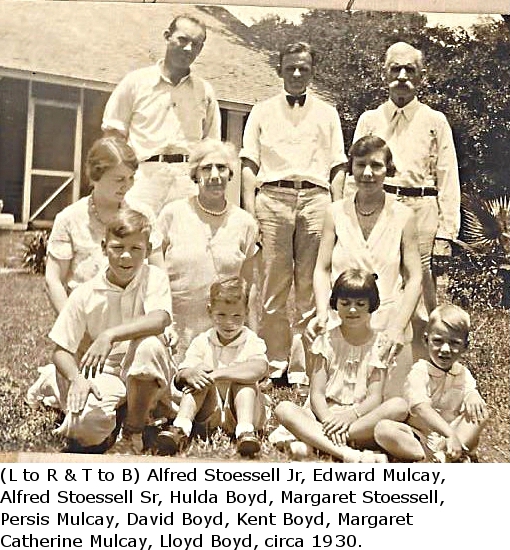
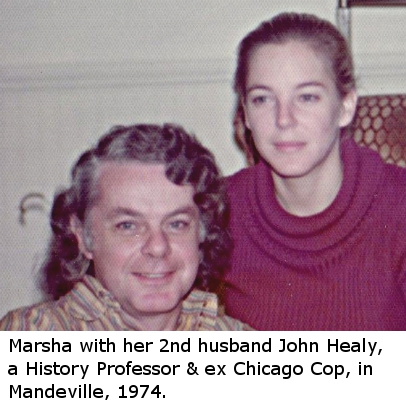
Aunt Persis married Thomas Edward Mulcay (1899-1939) a US Navy man. Their only child Margaret Catherine (1922(?)-2016) married CDR Hugh Benton Burris (1918-2010), a handsome Naval Air Corps officer whose good looks were passed on to their three children: Marsha Anne, Hugh Benton (Bubba), and Sue Ellen. When the kids were growing up, they lived in Bermuda where Hugh was stationed. I remember this because they gave us a large brain coral from Bermuda which fascinated me. After Hugh retired from the military, he worked at the Texas A&M Uiversity campus in Kingsville, Texas. Eventually they moved to Friendswood, Texas, when Hugh retired from the university. Marsha became an attorney in New Orleans and later helped me through a divorce and to settle my mother's estate. When I was a LSU undergraduate, Marsha's portrait, a wedding present painted by Robert Rucker, hung in the main stairwell in the LSU Library. She was (and is) a beautiful woman with a taste for life (four marriages that I know of: Webb, Healy, Higbee, Martin). Her second husband John Healy was an ex-Chicago cop and a History Professor at Southern University near UNO where I taught. John was a great story teller, full of Irish blarney and drank good whiskey. Alan Thompson, a geologist friend of mine, once asked him to bring a piano, in the back of a pickup truck, over from New Orleans. John had to cross the Lake Pontchartrain Causeway to reach Mandeville. When he arrived, there was no piano. So Alan asked where his piano was? John replied "What piano?" Somewhere at the bottom of Lake Pontchartrain is a piano. (LOL) John died, I think, as he would have wanted - a headon collusion on a Spanish coastal road overlooking the Atlantic (or so I remember). Marsha later moved back to Friendswood, Texas to help care for her mother Margaret Catherine. Bubba is a Texas physician with a passion for tennis, worked in Galveston and practices in Webster near Friendswood. Sue Ellen Burris Chapman presently lives in El Lago, Texas. Unfortunately, I haven't been able to keep up with these Texas cousins.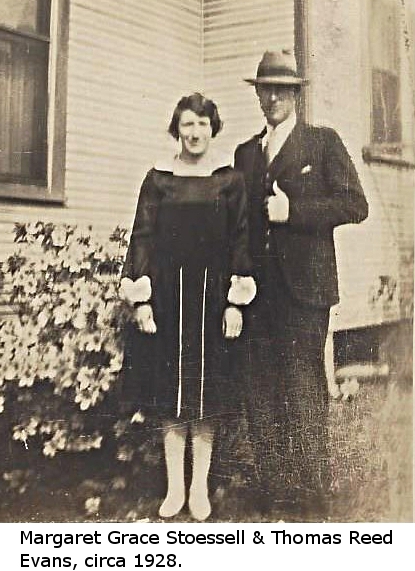
Aunt Margaret married Thomas (Tom) Reed Evans (1903-1960). They met at the Merry Widow Ball at the Oaks Hotel in Hammond. Margaret died young, of a heart attack, and Tom passed 12 years later in 1960. I don't think he ever recovered from Margaret Grace's early death. In the 1950s, we sometimes visited Tom in New Orleans, and he gave my brother Lloyd a 22 rifle that I still have. Their only child Margaret Ann (b. 1931) married Robert (Bob) M Rucker, (1932-2001) the well-known Louisiana landscape painter. Bob and Margaret Ann later lived near Mandeville and Covington and had 3 girls: Kathryn Lynn, Janet Greer, and Yvonne Marie. Bob was from a well-known New Orleans family of Mississippi River boat pilots and turned to art because he had been partially crippled by polio at age 17. In the 1960s, Bob came yearly to Crowley for Al's New Year duck hunt (sponsored by the Acadia Savings and Loan) at Bill Cleveland's Hunting Camp near Pecan Island. There were always good times on those hunts. My last duck hunt in 1971 was that New Year's duck hunt. Aunt Margaret Ann is still alive (2023) and only she, my sister Marilyn, and I remain along with one other first cousin (Joan Prieto Doolittle) of that generation.

When Al was born, the girls were so happy to have a brother that they picked him up and ran up and down the street, yelling the news. He grew up in Hammond, Louisiana, and went to Tulane (1924-1929) in engineering but never finished. I have his 1928 Tulane Jambalaya yearbook and in figure captions he is listed both as a senior and a junior. Cellie said he lacked a course in Spanish to finish his degree. I never heard him talk about engineering so I doubt it was a profession he wanted to pursue. Al was a natural athlete who had been a star football player (fullback and end) at Hammond High School and at Tulane (end and tackle) and the game was his life-long passion. His first year on the varsity football team was in 2025, and Tulane was undefeated and invited to the Rose Bowl to play for the national championship. Tulane University turned the invitation down, saying it interferred with their academic program. Alabama replaced them and won the national championship. Al was a personable, likeable guy, serving as vice president of his freshman class and president of his sophmore class at Tulane. He was a member of Delta Kappa Epsilon (DKE) and supported himself by managing the DKE House and working in the summers on the new Tulane football stadium which was eventually demolished in 1980. As house manager, he was responsible for the meals of the guys in the DKE house. Apparently, they ate a lot of rabbit.
Al met my mother Cellie on a double date in which their dates got drunk and incapacitated, leaving the two of them quality time to know each other. Shortly prior to this event, Dad had been very serious about another girl and, unknown to him, she was dating someone else on the side. She accidently crossed her letters and he received one intended for her other beau (lol), ending that relationship. Al and Cellie married on July 2nd, 1935 at Trinity Episcopal Church in Covington, and took passage on a United Fruit Boat to Puerto Barrios in Guatemala. This was a 7 day honeymoon in Central America that Cellie said Al won the boat tickets in a poker game the night before the wedding. At the dock, his friends persuaded him to down a lot of whiskey, apparently causing him to have a kidney stone attack the next day. On the boat Al and Cellie won the bridge tournament. According to Cellie, she just sat there with the dummy hands while Al doubled and redoubled the bids. He was always lucky in cards, a good card player. Afterwards, they lived for several years in Jackson, Mississippi, where Al repossessed cars for General Motors. Cellie loved living in Jackson but repossessing cars must have been a depressing job. In 1938 on a trip to Havana, Cuba, with Al, Cellie had her first gaul bladder stone attack, and later had to have the gaul bladder removed. During the war, they lived in New Orleans where he became the Director of the Sugar Rationing Program for the Office of Price Administration (OPA). My father (as I do and as did his sister Persis) suffered all his life from kidney stones and had been medically deferred from the military during World War II. Interestingly, during the Vietnam War era, I tried to get a medical release from the US Army when I had my first kidney stone attack at Fort Benning, GA, during AIT training. But times had changed and it didn't work for me!
Return to Top
Al was the son of a German immigrant, Alfred Leopold Stoessell Sr (1858-1934), who immigrated in 1880 from Stolp in East Prussia (now Poland) and Margaret Irwin Kent (Maggie, 1875-1939) of the large Kent family in Kentwood in Tangipahoa Parish. Al was the youngest child of the family and had three sisters: Hulda Kent (Hulda, 1897-1989), Persis Alma (Persis, 1899-1970), and Margaret Grace (Margaret, 1901-1948).
Maggie's grandfather Amos Kent Jr. (1811-1906) was a Yankee descendant of Richard Kent (1590-1654) who emigrated with his sons James and Richard and daughter Mary on the ship "Mary and John" to the Massachusetts Bay Colony in 1634 from Over/Upper Wallop in Southern England, 14 years after the Mayflower landed at Plymouth Rock. The Kent lineage can be traced back to John Kent (1486-1584). Richard's son James Kent (1618-1681) is the father of the Kent line in Louisiana. This Kent family paternal lineage is described in "Those Fluker Kents" by Gerald Carley and "cousin" Gwynette Carley/Dixon, published in 2006. Of interest is the marriage of Amos Kent Sr. (1774-1824, Maggie's great grandfather) to Abigail Atherton. (1775-1860). Their daughter Abigale Atherton Kent Means (1802-1857) was an aunt by marriage and close childhood friend of Jane Means Pierce. She filled in the duties as First Lady during the first two years of the Franklin Pierce Administration, due to the illness and depression of his wife Jane.
The Kents have some interesting direct ancestors through the maternal lines. Five ancestors in two families arrived in 1620 on the Mayflower and the senior male members William White and Stephen Hopkins were signaturies of the Mayflower Compact. Resolved White (1615-1687), a pilgrim, arrived at age 5 with his parents William (1591-1621) and Susanna (1592-1654) and is a 10th generation ancestor through the Kent/Atherton/Goss/White line. His father died 3 months later in Plymouth, and Susanna remarried to Edward Winslow in 1621 whose wife Elizabeth had also died during the first winter. Resolved's brother Peregrine (1620-1704) was born on the Mayflower in Plymouth Harbor. The grandfather of Resolved's wife (Judith Vassall White, 1619-1670) was Captain Jean John Vassall (1544-1625) who built and owned the Mayflower. However, Judith was not on the first voyage. Jean Vassall was an interesting character who commanded several ships during the battles with the Spanish Armada in 1588 and was also a principal stockholder in the Jamestown Company which founded Jamestown.
The other Mayflower family, is represented by 11th generation ancestor Giles Hopkins (1608-1690) through the Kent/Atherton/Goss/Hopkins line. He was 12 years old when he arrived on the Mayflower with his father Stephen (1581-1644), family members and servants. He had a brother with the appropriate name Oceanus (1620-1627) born during the voyage. Interestingly, Peregrine White and Oceanus Hopkins were the only two infants born on the Mayflower. The Hopkins were not pilgrims and Stephen Hopkins had previously lived in Jamestown, Virginia for 7 years, returning home in 1616 after his first wife Mary died in 1613 in England, on the same ship carrying Pocahontas (Rebecca Rolfe along with her husband John and their son Thomas). During his first trip to America in 1609, his ship, the Sea Venture, was wrecked off Devils Island (Bermuda) during a hurricane. John Rolfe was a shipmate on the Sea Venture. On Bermuda, Stephen was accused of mutiny while questioning the authority of the English leadership. He wanted to stay in Bermuda, because Jamestown already had developed a reputation as a hellhole (LOL). Hopkins argued that since the ship had failed to reach Virginia and they were on their own, they could form a new government, a Democracy! Stephen received a death sentence for this precursor to the American Declaration of Independence, but was pardoned due to his pleas and likeable nature (unlike mine). Stephen is immortalizd as Stephano in The Temphest, Shakespeare's play in 1611 which described him as the Wanta-Be-King of Bermuda. He was the family's first American renegade, soon to be followed by others as described below.
Once in America, the renegade family nature took over. The uncle of a 9th generation ancestor, John "Mad Jack" Oldham (1592-1636) started the first Indian War in New England. He had arrived in Plymouth in 1623 aboard the Anne with his wife and sister. Mad Jack was not a Pilgrim and his nickname reflected both heavy drinking and his temperament. He was banished from Plymouth in 1624, moved to the Connecticut area, co-founding Wethersfield. Mad Jack was both an Indian trader and a ship captain. In 1636, he was murdered by Pequot Indians on his ship off Block Island, Rhode Island, starting the Pequot Indian War (1636-1638). On his ship were two English boys, his nephews Thomas and John Oldham who were captured and later released. Thomas later moved south to Virginia and is my 10th generation ancester through the Kent/Fluker/Oldham line.
Not content with starting an Indian war, some direct ancestors took part in the Salem Witch trials: one as a prosecutor and 4 as accused witches. Three of the accused were through the Kent/Atherton/Wright/Wardwell line and 1 was through the Kent/Hale/Moody/Bradbury line were convicted of witchcraft and sentenced to hang in 1692 in Salem. Samuel Wardwell (1643-1692, 9th generator ancestor) was hung in Salem on Proctor's Ledge in 1692. He was a carpenter and fortune teller (which sealed his fate). He and his wife Sarah (1650-1709), their daughter Mary Mercy Wardwell Wright (1673-1764), and a step daughter Sarah Hawkes (1671-1716) confessed to being baptised by the Devil. Apparently, they confessed thinking they would be spared since everyone who had previously pled not guilty had been sentenced to death. When Samuel realized he was going to be hung anyway, he recanted his confession. The executions of his wife Sarah, daughter Mercy, and step daughter were put off and they stayed together in prison. A second trial reversed Mercy's and her half-sister Sarah's convictions but not that of their mother Sarah who was later released by Governor Phips. A 10th generation ancestor Mary Bradbury (1615-1700) was a member of a prominent family and was accused of being a shape-shifter, changing into a blue boar, an unusual feat in colonial days. She escaped prison apparently through her husband bribing a guard and fleeing in a "speedy" cart. The odds of survival are always increased with being wealthy and having "fast" get-away. Mary later returned after Governor Phips disbanded the Court of Oyer and Terminer in 1692 and ended the executions in 1693. Phips was motivated to end the trials because the crazies were threatening to prosecute his wife for witchcraft. (LOL) On the prosecution side of the witches was 9th generation ancestor blacksmith/puritan pastor Jonathan Hale (1636-1700), through the Kent/Hale line who reversed his views when his wife Sarah Hales was also accused of witchcraft. He is cast as Reverend Hale in Arthur Miller's 1953 play "the Crucible". Knowing that I am a direct descendant of a mutinous Jamestone traveler, a hung warlock, and 3 witches, gives me great satisfaction. No wonder I am a trouble-maker.
After the death of his father Amos Kent Sr (1774-1824), my great great grandfather Amos Kent Jr moved south from New Hampshire in about 1828 to the Baton Rouge area, at the age of 17, eventually settling with his brother Fredrick (1814-1864 - later killed in action in the Civil War) in the present-day Kentwood area in the mid 1850s in what was then St. Helena Parish, Louisiana. Amos later founded Kentwood in 1888 and served 8 years in the state legislature. Maggie's father was Amos' son, James Fluker Kent (1843-1886), a Civil War veteran. The name Fluker came from Amos's wife Susan Fluker (1823-1906) of Clinton, Louisiana, whose father Colonel Robert Fluker (1783-1864) had fought in the Battle of New Orleans as a private. I'm not sure how he was promoted to Colonel but he was a successful planter. However, I'm sorry to acknowledge that both Amos and the Colonel were slave holders, according to the slave schedules of the US Census. Interestingly, the Kent line, primarily from New England and going back to the Mayflower, is the only line in my ancestry that includes slaveholders. Hence, I can blame the curse of slavery on the Yankees. (LOL)
James Fluker went by the name Fluker. Fluker had been enrolled in 1860 in Pineville in the first class of what was to later become the Louisiana State University. Oddly enough, William Tecumseh Sherman (the well-known Union General in the Civil War) served as the first Superintendent of the school. When the war started in 1861, Fluker resigned from the college and joined the Confederate Army as 4th Sergeant of Company F (St Helena Rebels) 16th La Infantry. In 1862 he became a 2nd Lt. In 1863, at age 20, Fluker was captured by the Union Army at Missionary Ridge and imprisoned on Johnson Island in Lake Erie for the remainder of the war. I have an autograph book that Fluker kept at Johnson's Island (Fluker's POW book) with numerous signatures and several poems. The poems are impressive, showing a grasp of English rarely seen today in America.
Maggie's mother was Delilah (Lilah) Flanagan Amacker (1849-1911), also of Tangipahoa Parish (at that time part of St. Helena Parish). Lilah was the sister of Lt Col Obediah Pearson (OP) Amacker (1838-1910, served in 3rd Regiment La Cavalry) who was captured at Port Hudson and was also a POW with Fluker at Johnson's Island. OP later married Fluker's sister Abigail Means Kent (1841-1910), and Fluker's younger brother George Kent (1846-1883) married Delilah's sister Elizabeth Dean Amacker (1847-1901). The Amacker and Kent families were tied closely together throughout the 19th century. Maggie's great grandfather, John Jacob Amacker (1780-1815, family of Swiss origin from Canton Berne) with his wife Sarah Ann Varnado (1784-1844, family of French origin), had migrated west from Orangeburg, South Carolina in 1800 and moved into St Helena parish in 1813. Judging from the number of Amacker descendants, they bred like rabbits - (LOL).
After the Civil War, Fluker partnered with his father in the Amos Kent Brick and Lumber Yard. Maggie was the 7th of 12 children.
Alfred Sr's father was Carl Wilheim Heinrich (Henry) Stossel, with an umlaut over the o, (1824-1895),the longest-serving mayor of Stolp from 1866-1890. Prior to being the mayor, he served as th clerk of court and as a judge. Family records say he was the son of Carl Wilhelm Heinrich Stossel and Berta Schroeder. According to famliy lore, his wife Hulda von Dorpowska/Puttkamer (1831-1910) was related to Bismarck's wife (Johanna von Puttkamer) through a grandmother. (Interestingly, Hulda is listed on the 1934 Louisiana death certificate of their son Alfred as Hulda Poutcombie) Family records say Hulda parents were Leo von Dorpowska and ? von Kleist/Puttkamer so where did the Poutcombie come from? Henry possibly owed his position as mayor to Bismarck because he lost it in 1890, the same year that Bismarck was sacked as Germany's Chancellor by Kaiser Wilhelm II. Most of Stolp's records were destroyed in World War II and is now part of Poland, called Slupsk. I have not been able to find more information other than a book that listed Stolp's mayors which included a C. W. Heinrich Stossel as mayor from 1866-1890. Their son Alfred supposely went to the University of Heidelberg (no university records to support this) before arriving (by way of Hamburg and Glasgow) at Ellis Island at age 22 on November 16, 1880, on the Anchoria. His occupation was listed as student/scholastic. As a child I was told he came to America to escape the compulsory Prussian military service (established by Bismarck) and to escape punishment by authorities for his membership in an outlawed Heidelberg dueling club. I have his masonic sword inscribed "IN HOC SIGMO VINCES", and a copy of his 1921 32nd degree Mason paper can be found in Family Papers. He married Margaret (Maggie) Kent in 1895, becoming a naturalized citizen in 1899. I know almost nothing of him other than family stories such as: he had facial scars (covered by his moustache) and lost the tip of his tongue while dueling (never stick your tongue out when sword fighting) at Heidelberg; could speak 7 languages; taught at the University of Texas in Austin (no records have been found); had a brother who was with him at Heidelberg and who went to South America (on his way to Australia) and was killed by a "big constrictor snake". I remember hearing he met his future wife Maggie Kent in St. Lewis.
Aunt Hulda married David Chester Boyd (DC, 1882-1961), a Texas Wildcatter who made and lost several fortunes. DC and Hulda visited us for an extended stay in North Crowley in the 1950s. I remember him as an old man, nearly blind, sitting in our back yard, telling me of those "wild" early days of drilling for oil. They had 4 boys: David Cannon (David, 1920-2005), Alfred Kent (Kent, 1925-2011), Lloyd Stoessell (Lloyd, 1927-2015), and Joseph Lyon (Joe, 1933-2020). David was initially married to Georgia Mae White (1921-2016) and had 3 children: David Randolph (Randy), Patricia (Patsy), and Eric. David was also married later to Anna Carolina Waldron and to Betty Jo Hiser. Kent was married to Barbara Jean Benchley (Jean, born 1932) and had 2 children: Melissa and Stephen, along with Jean's two daughters from a previous marriage: Deborah and Candice Laird. Lloyd was married to Darlene Alice Smith (Darlene, 1930-2015) and they had one child: Jo Ellen (Jody). And Joe married Marilyn ? (19??-2011) and they had 5 children: Kirby, Leslie, Allison, Dana, and Christopher. Although the four boys are now gone, this is a large Texas family that I wish I had had more interactions.
DC and Hulda's family lived mostly in Texas and my limited contact with them has left me with few details. I often wondered how my Aunt Hulda in Hammond, Louisiana got hooked up with a Texas Wildcatter. Randy Boyd told me he remembered Hulda as a true family matriarch. Jean Boyd said Hulda taught home economics in the New Orleans area and had a degree from Northwestern State College in Natchitoches. In the 1915 Potpourri Yearbook, Hulda is mentioned as a member of the Choral Society. Jean also said DC had attended Sam Houston State College in Huntsville and studied law. I contacted Joe Boyd who messaged me DC both practiced law and taught in Louisiana where he met Hulda. DC got into the oil business through royalities he obtained doing legal work. I worked at Exxon Production Research Center in Houston in the late 70s and one of the old-timers remembered DC from the early days.
Aunt Margaret married Thomas (Tom) Reed Evans (1903-1960). They met at the Merry Widow Ball at the Oaks Hotel in Hammond. Margaret died young, of a heart attack, and Tom passed 12 years later in 1960. I don't think he ever recovered from Margaret Grace's early death. In the 1950s, we sometimes visited Tom in New Orleans, and he gave my brother Lloyd a 22 rifle that I still have. Their only child Margaret Ann (b. 1931) married Robert (Bob) M Rucker, (1932-2001) the well-known Louisiana landscape painter. Bob and Margaret Ann later lived near Mandeville and Covington and had 3 girls: Kathryn Lynn, Janet Greer, and Yvonne Marie. Bob was from a well-known New Orleans family of Mississippi River boat pilots and turned to art because he had been partially crippled by polio at age 17. In the 1960s, Bob came yearly to Crowley for Al's New Year duck hunt (sponsored by the Acadia Savings and Loan) at Bill Cleveland's Hunting Camp near Pecan Island. There were always good times on those hunts. My last duck hunt in 1971 was that New Year's duck hunt. Aunt Margaret Ann is still alive (2023) and only she, my sister Marilyn, and I remain along with one other first cousin (Joan Prieto Doolittle) of that generation.
When Al was born, the girls were so happy to have a brother that they picked him up and ran up and down the street, yelling the news. He grew up in Hammond, Louisiana, and went to Tulane (1924-1929) in engineering but never finished. I have his 1928 Tulane Jambalaya yearbook and in figure captions he is listed both as a senior and a junior. Cellie said he lacked a course in Spanish to finish his degree. I never heard him talk about engineering so I doubt it was a profession he wanted to pursue. Al was a natural athlete who had been a star football player (fullback and end) at Hammond High School and at Tulane (end and tackle) and the game was his life-long passion. His first year on the varsity football team was in 2025, and Tulane was undefeated and invited to the Rose Bowl to play for the national championship. Tulane University turned the invitation down, saying it interferred with their academic program. Alabama replaced them and won the national championship. Al was a personable, likeable guy, serving as vice president of his freshman class and president of his sophmore class at Tulane. He was a member of Delta Kappa Epsilon (DKE) and supported himself by managing the DKE House and working in the summers on the new Tulane football stadium which was eventually demolished in 1980. As house manager, he was responsible for the meals of the guys in the DKE house. Apparently, they ate a lot of rabbit.
Al met my mother Cellie on a double date in which their dates got drunk and incapacitated, leaving the two of them quality time to know each other. Shortly prior to this event, Dad had been very serious about another girl and, unknown to him, she was dating someone else on the side. She accidently crossed her letters and he received one intended for her other beau (lol), ending that relationship. Al and Cellie married on July 2nd, 1935 at Trinity Episcopal Church in Covington, and took passage on a United Fruit Boat to Puerto Barrios in Guatemala. This was a 7 day honeymoon in Central America that Cellie said Al won the boat tickets in a poker game the night before the wedding. At the dock, his friends persuaded him to down a lot of whiskey, apparently causing him to have a kidney stone attack the next day. On the boat Al and Cellie won the bridge tournament. According to Cellie, she just sat there with the dummy hands while Al doubled and redoubled the bids. He was always lucky in cards, a good card player. Afterwards, they lived for several years in Jackson, Mississippi, where Al repossessed cars for General Motors. Cellie loved living in Jackson but repossessing cars must have been a depressing job. In 1938 on a trip to Havana, Cuba, with Al, Cellie had her first gaul bladder stone attack, and later had to have the gaul bladder removed. During the war, they lived in New Orleans where he became the Director of the Sugar Rationing Program for the Office of Price Administration (OPA). My father (as I do and as did his sister Persis) suffered all his life from kidney stones and had been medically deferred from the military during World War II. Interestingly, during the Vietnam War era, I tried to get a medical release from the US Army when I had my first kidney stone attack at Fort Benning, GA, during AIT training. But times had changed and it didn't work for me!
Maternal Side - Prieto and Koop Families
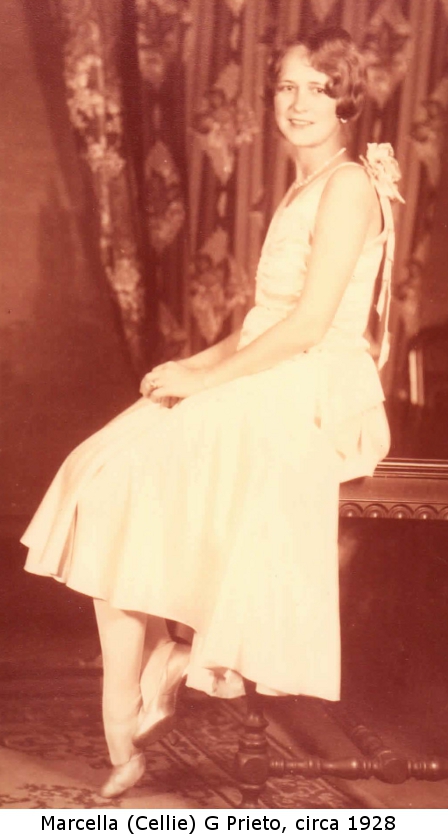
After graduation from LSU in 1930, my mother Cellie spent several years in the early 1930s as a high school teacher of Spanish and typing, and she was also the girls' basketball coach at Hammond High School. She humorously recounted this story to me of her first game as coach. The game was in Mississippi. The Mississippi girls were big and mean and told her team they would beat them up if they scored any points. They didn't and the final score was like 50 to zero (lol). In Hammond, Cellie roomed in the home of family friend Jimmy Morrison who later became a long-time US Congressman. She enjoyed teaching, as I did years later. Cellie came from a wealthy family background but she did not take herself seriously and was unpretentious in her dealings with others. She continually inspired me to do my best and to keep trying.
Cellie was from Mandeville, Louisiana which sits across Lake Pontchartrain from New Orleans. She was the youngest child of John Ernest Prieto (Ernest (Popsy, aka Tuce), 1877-1944) and Maria (Mary) Hedwig (Hattie) Koop (1880-1955). Within the family, Maria was called May and she was Mumsy to me. Cellie had three older siblings: Preston Thomas Sharp (Preston (aka Little Tuce), 1905-1972), John Clay Francis (Clay, 1907-1987), and Marion May (Marion, 1908-1985). My Grandfather Popsy went by his middle name Ernest. On census forms his education level is listed as 5 which I assume means the 5th grade. He was a self-made man, an accumulator of land and businesses to the extent that the next two and three family generations could, if they wanted, largely live off the wealth that he created. In my retirement, I often joke "I earned my money the old-fashioned way. I inherited it!" I say that in gratitude because it has enabled me to fund good causes, to help others and fund animal rescues.
Cellie's mother May was from New Orleans. Her mother Sophie Ebel (1847-1924), immigrated in 1867, was from Mutzenhausen in Alsace Lorraine (born in Strasbourg, France) and her father Frank Koop (1838-1932), immigrated in 1860, was from Lubeck and Berlin (born in Leipsig, Germany). Sophia was 15 generations removed as a direct descendant of Charles V Le Sage, King of France (1372-1407) through the illegitimate daughter Souveraine d'Angouleme (1487-1551) of his great grandson Charles de Valois Duke of Orleans (1459-1496). Souveraine was also the half sister of Francis I, King of France (1494-1547). That family line extends back through Charles Martel (688-741), the grandfather of Charlemagne. I have lately given some thought to landing in France and attempting to claim my kingdom; however, my French is awful, and I prefer California wine.
Sophia and Frank Koop married in 1869 in New Orleans. Frank had come to America just in time to be caught up in the Civil War.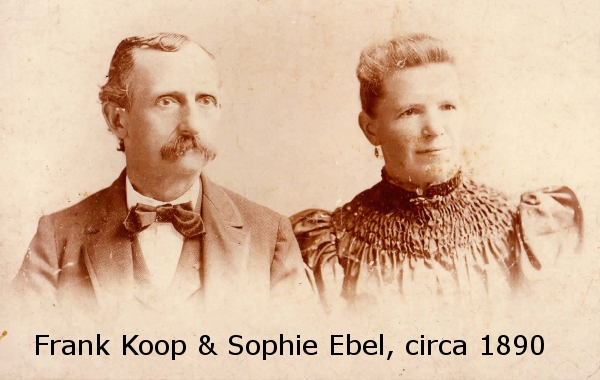
I know that - in spite of "solid" German upbringing, he became a "rascally Yankee," because his Civil War discharge paper in December, 1863 was as a seaman from the US Navy. He must have been wounded since the discharge was from the US Naval Hospital in Norfolk, Virginia. I remember seeing a paper saying he was a tin smith but I have not been able to relocate that paper.
Cellie's father Ernest (Popsy) was the grandson of Vicente Prieto Pavias, (Vincent, 1820-1891) a Spanish sea captain. Captain Vicente eloped with Senorita Josefa Costa Navarro (Josephine, 1829-1914), from the island of Ibiza in Baleares Islands in the Mediterranean Sea. Vicente was the son of a carpenter Vicente Prieto Ferrer (1790-1841) and Margarita Pavias Balanzat (1789-?) on Ibiza. The Balanzat family has been prominent on Ibiza for centuries. Josefa was the daughter of Josefa Navarro Gavara (1803-?) and Lucas Costa Ferrer (1797-?), a mariner in Ibiza. And she was disinherited for her elopement. Family lore was that Josefa Navarro Gavara was a Contessa; however, this is not supported by church records in Ibiza.The Captain's grandfather Marcos Prieto Rodriguez was born in the Diocese of Asturias, in San Miguel de Laciana (now in the Diocese de León) and moved by way of Madrid to Ibiza where he married Francisca Ferrer in 1784. Both died around 1794. In 1761, he and a sibling were living with their parents (Pedro Prieto-Lastre and Maria Rodrigues) in the village of Rabanal de Arriba. So the Prieto (Aprieto, Apreto) family is from the mountainous north Atlantic coastal region of Spain - the one area never conquered by the Moors. I have a DNA connection with the Volpe family tree through one of the Captain's 4 siblings, his sister Magdalena Prieto Pavias (1823-?) born in Ibiza who married José Ramón Bonmatí Baibé.
We do not know when Vicente Prieto Sr first crossed the Atlantic to Louisiana, probably in 1851 or 1852. However, their first child Vicente Prieto Jr (Ernest's father and my great grandfather) was born in 1849 in Ibiza. I can imagine their excitement and apprehension while sailing the Atlantic to a new life. The schooner probably entered Lake Pontchartrain through the Rigolets and landed in Mandeville. Why they settled in Mandeville is not known. The town had been founded by Barnard de Marigny in 1834 and was only incorporated in 1840. In Mandeville, Josephine was called Madame Vincent (prounced Becent) by the French and Spanish town folks. Captain Prieto installed her in a house on the Lakefront, at the east corner of Marigny Ave, complete with a widow's walk on the roof so she could watch for the return of his ship. Vincent Sr then sailed off back to Spain on a trading mission, returning 7 years later, presumably in 1858 or 1859. That widow's walk must have been well worn. The sea captain became a naturalized citizen in 1864 before a judge in New Orleans. This was during the Civil War and New Orleans had been captured earlier in 1862. They had 5 children: Vincent (1849-1886), married to Pauline Sharp; Marguerita (Maggie, 1860-1922, married to John Manuel Cuni; Joseph Lucas, (Lucas, 1862-1937), married to Mary Madeline Vezien; Josephine, (Pepita, 1864-1883), who died on her wedding day; and Magdeleine Josephine (Lena, 1866-1934), married first to Ernest Brinkman and then to David Treadway. Interestingly, church baptismal records have Lucas and Josephine Costa as the God parents of their granddaughter Magdeleine. Were they standins or actually in New Orleans in 1866? Family lore says Josephine (Pepita) was buried in her wedding dress along with an infant daughter of Vincenti Jr., who died a day later. There is confusion in the birthdate of Josephine Prieto. Her tombstone says 1861 but church record and census indicate 1864. The Captain's Lakefront house on Lakeshore Drive burned July 31, 1914. At the time of her death on August 24, 1914, the Captain's widow was living in a cottage that Popsy (John Ernest Prieto) had built just behind the Lakeshore House location. Her eyesight must have gradually deteriorated, because Cellie said she let in a stray cat one evening, only to discover the cat was a possum the next morning.

The Prieto family has had the sea in their blood down to Ernest. Maritime Records indicate the old Sea Captain Vincent Sr owned schooners in the 1860s, including the 22 ton Republic in 1862 which was built in 1859 and later confiscated by Union forces and the 29 ton Quincy in 1869 (originally 25 tons when built in 1857). Family lore has him also owning the Emily, The Surprise, the Three Sisters, and other schooners. He had a chestful of Confederate money in the attic of his home after the Civil War which I think he probably made as a blockade runner. Newspaper accounts also show him as the plaintiff in a civil suit with A J Thomas in New Orleans which resulted in the Josephine 2, one of his schooners, being sold at auction in 1875. His son Vincent Prieto Jr was also a sea captain, and Jr's son Ernest (my grandfather) later maintained several schooners on Lake Pontchartrain for coastal trade purposes. In 1872 Vincenti Prieto Jr married Pauline Caroline Sharp (1855 or 1857-1882), daughter of Margaret Connor (O'Connor, O'Conoly, ?, 1830-1888, born in Ireland) and Aaron Plum Sharp (1827-1906). If born in 1857, Pauline married at the young age of 15! It was through this union that the Prietos became linked with the extensive Sharp and Spell families in St. Tammany Parish. Plum's mother was Sarah H. Spell (1791-1851) and his father was Joseph Sharp (1794-1866). Vincent Jr. and Pauline both died young. Pauline died from childbirth in 1882 at age 25 when Ernest was only 5 years old. She had four children: Vincent Anthony (Tony, 1875-1939) and my grandfather Ernest and two later children who died shortly after birth. We believe Vincenti Jr. died 4 years later in 1886. Family lore says he went to New Orleans on a trip, possibly caught yellow fever, and passed without returning to Mandeville. We do not even know the location of his grave. A more likely story from Cellie was that he died of a leg injury; however, there is no grave in the Mandeville Cemetery where Pauline is buried. But, in support of Cellie's version, I have an old hand-written power of attorney from Vincenti Prieto Jr to Vincenti Prieto Sr, dated August 20, 1886, asking his father to take over all his affairs and clearly written in anticipation of death. There is no mention of Pauline in this document since she had already died. Ernest was about 9 years old at the time of his father's death.
I do not know much about Ernest's uncle Lucas and aunts Maggie and Lena on his father's side. However Lucas Prieto is frequntly mentioned in early 20th century newspaper accounts of parish civic and political affairs. His son Paul was tragically shot and killed by his brother-in-law in a family dispute in 1926. And Lucas's mule is credited with being used in 1903 to carry the stolen printing press for The Mandeille Wave to the harbor where it was dumped. This ended its short-lived publication, much to the chagrine of the editor Louis Rosenthal. The story is that Louis's son orchestrated the theft so he wouldn't have to work in the print shop. (lol) My first cousin Joan Doolittle tells me that Lucas died in her father's arms (Clay Prieto) in front the E. Prieto and Sons family store, suffering from a medical emergency.
The following information was related to me by Cellie. Ernest and his older brother Tony were raised by their maternal grandfather Plum Sharp. As a young man, Ernest ran away several times and was sent to live in New Orleans with Aunt Duffy (Margaret Sharp Duffy, sister of his Mother Pauline). But he wasn't content there either and ran away again, spending his youth riding trains across the country and doing odd jobs to support himself. During this time, he shipped out on a cattle boat to Spain but was so seasick (according to Cellie), he never went ashore. Eventually Ernest came back to Mandeville and New Orleans, taking a job as a waiter at the old Cosmopolitian Hotel, working alongside his young friend Leon Bertrand Arnaud Cazenave who later founded Arnaud's restaurant. Family lore has Arnaud offering Ernest a partnership in starting Arnaud's restaurant which he declined. Ernest started his business in Mandeville by pooling his money with lifelong friend Lewis Morgan (Cellie's Godfather and later US Congressman) to purchase a building from James Band (a relative of Lewis Morgan) on the corner of Jefferson and Gerard (Girod) Streets, starting the family mercantile store in Mandeville. He met his future wife Mary Koop at a Masonic Ball in New Orleans and they were married in 1903.
Mandeville was a small, picturesque, rural town for much of the 20th century. The town was a vacation resort for people from New Orleans on the south side of Lake Pontchartrain. In the early days, the public would take steamboats for the 24 mile trip back and forth across the lake, disembarking on wharves built out from the lakefront. A railroad started from the lakefront and they could ride north to the Covington area and the resort town of Abita Springs. Mandeville reminded me of the Sausalito I knew as a graduate student at UC Berkeley in the 1970s, across the Golden Gate Bridge from San Francisco. The lakefront and the old homes provided the same atmosphere as the waterfront on San Francisco Bay. This was a really cool town, and only now in the 21st century is it losing its charm with the urbanization of the North Shore.
The family home of Ernest was on the west side of Gerard (now called Girod) Street in the second block off the Lakeshore. Within the center of the block, he kept a small pasture to hold calves that needed care and two barns: one for horses and cattle and one, behind the town post office built by Ernest on Jefferson Street, that contained chickens, etc. I remember the "vat", a deep concrete pit by the horse barn used for curing cattle hides. Cellie had her own horse, named Jingles. The horses, used by the cowboys with the family's free-range cattle, were sometimes brought in to Mandeville for the night. Mack Richardson, the cattle foreman and butcher, lived next door to the Post Office, and the horses were transported in the back of an old deuce and a half ton truck. The family kids and their friends could sometimes ride them on the lakefront. And Ernest would use them for foxhunts that started from his home at daybreak. I still have one of Popsy's (Ernest's) short barrel saddle rifles, a 32-20 Marlin, model 1894, that he used on those fox hunts. Cellie said that often when the rest of the family was walking back home on Sunday from church, they would meet Popsy and the other fox hunters returning on horseback with a pack of dogs coming down the street.
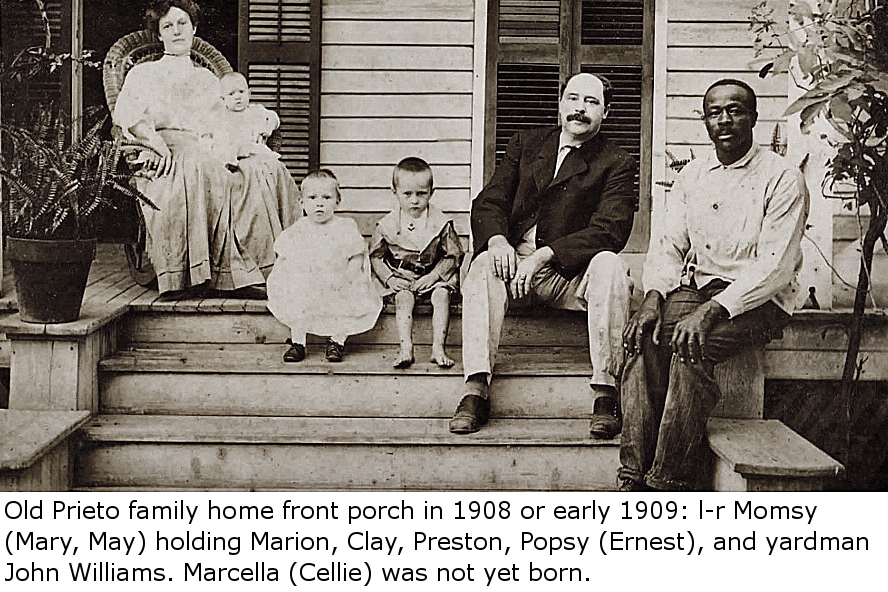
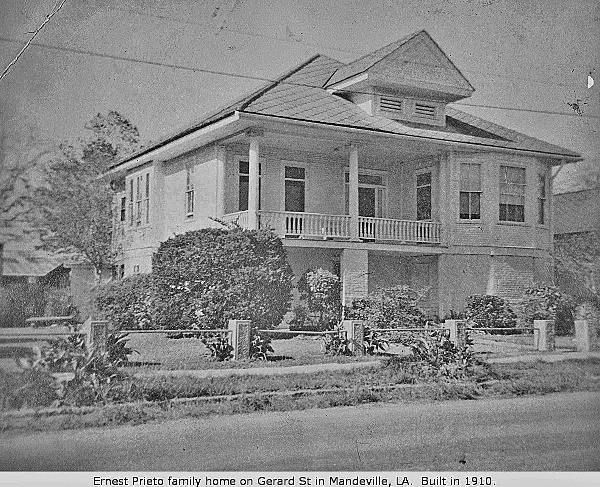
The two-story family home with its cistern and water well fronted Gerard Street, and adjacent to it was the brick general store (Ernest Prieto and Sons) with a bar. During Prohibition, the family still had a lot of unsold liquor in the cellar of the general store and could legally drink it, just not sell it. Cellie related that the alcohol consumption with family friends there drove the Federal Liquor Agents nuts. The Boston Globe reported Ernest was arrested on September 22, 1924, for having thousands of bottles of wine (LOL) in the basement of his store under suspicion of planning to distribute across the nation. They said the brains of the plot, a Mr. J. B. Hemmingway was arrested leaving the Prieto yard. I don't know how this ended but it must have been an interesting scene! The store formed the SW Gerard Street corner with Jefferson Street, and next to it on Jefferson Street was a small post office that Ernest built for the town. Mack's house was adjacent to the Post Office. Along Jefferson and Gerard Streets were homes built by the family for rental income, for their workers, and for family members, e.g., Preston's home on Gerard Street which connected to the family pasture in the center of the block. And within the surrounding blocks were more rental homes built by Ernest. He was an accumulator, not a seller of property.
The family slaughter house was located outside Mandeville, on land off highway 1088 across from the main barn which we called the "Old Place". I've heard there was a smaller slaughter house located on family property north of Lacombe but it was gone by the mid 1950s. The cattle were free-range bush cattle. There was a 10 mile stretch of connected parcels of family land that ran from the "Old Place", staying north of present day Fontainebleau State Park to just west of Fish Hatchery Road, north of Lacombe. Ernest owned about 6,000 head of cattle and 7,000 acres of land, mostly outside of Mandeville, but these were generally woodlands, not pasture, in different and often disconnected and unfenced parcels. There just wasn't enough forage for thousands of head of cattle so they roamed freely along with the cattle of other cattle owners. Once, while driving cattle in the woods in 1925, Ernest's horse slipped while crossing a deep ditch, and fell on him, breaking his leg and putting him in a New Orleans hospital for 8 months. The big cattle roundup occurred in the spring. Cowboys branded the calves for the different cattle owners with ownership based on the brand of each calf's mother. The Prieto brand was V7. My brother Lloyd participated in cattle roundups in the 1950s taking place at the "Old Place" and on the old Stagecoach Road to Lacombe near the "big Oaks" at the corner of Rapatel and Labarre Streets. During the year the cattle were selectively caught to be taken to auction or slaughtered for meat for the store. These were mixtures of Texas Longhorn and Brahmin, tough and mean cattle that could take the Louisiana heat and insects. It was fun to watch them chase the auctioneers around the pit when being sold. When I met them on foot or on horseback in the woods, I moved aside to let them by. And they were impressive, running in groups in nearshore waters of Lake Pontchartrain with big V shaped water sprays following them thundering across the shallow flats.
Uncle Clay told me of the time Ernest learned his cattle were going to be rustled by outlaws in Lacombe. Outlaws were a general name applied to those who hunted illegally as well as stole property, and Lacombe was known for its outlaws. Ernest and Clay and the men working for the Prieto family got their rifles and went in trucks out to the land. Clay later told me he was pissing in his pants when they climbed out to confront the outlaws. The two groups of men stared hard at each other for a few minutes. Then the outlaws stood down, saying "Mr. Prieto, we'll leave your cattle alone." The lesson of this story is you don't really own something if you are not willing to fight for it.
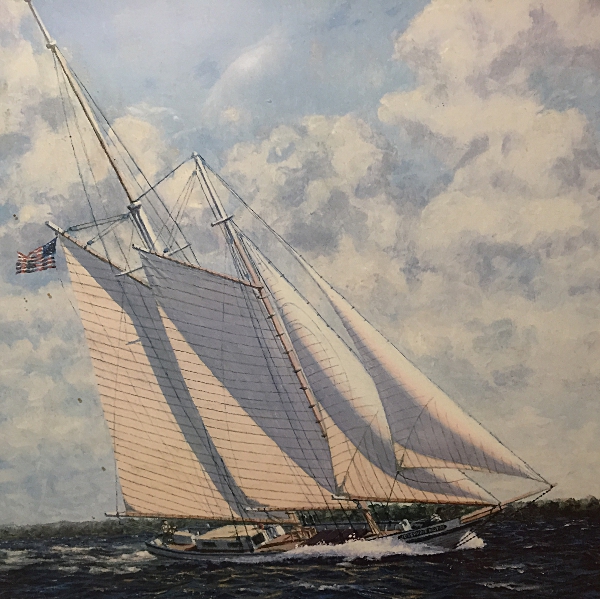
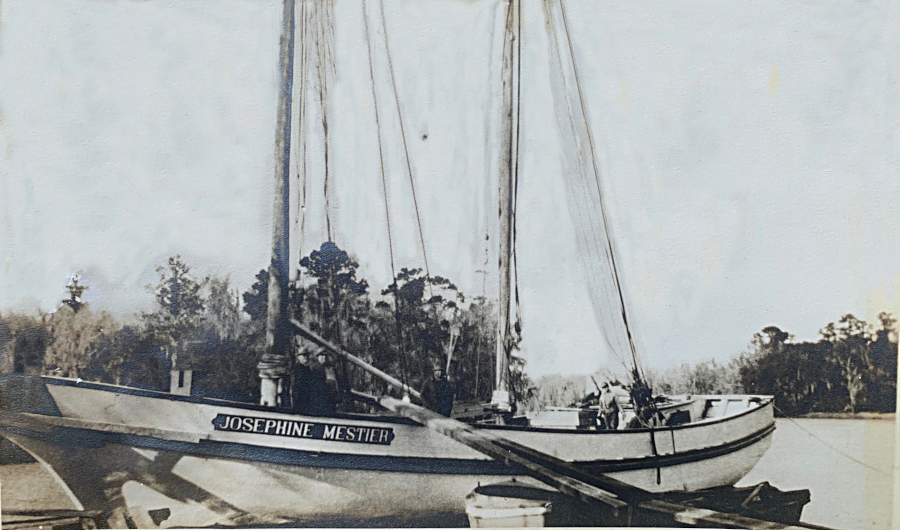
Ernest had other businesses, including a hotel and a funeral home. Cellie used to play in the coffins, causing her mother psychological distress, resulting in Ernest getting out of that particular business. The family's lumber mill and boatyards were located further east along Bayou Castine (means flea in Choctaw). The family schooners were used for trade with New Orleans but there were many tales of taking a schooner out on the lake for an afternoon of partying, one of Clay being tied to the mast. Cellie often talked of Captain Reed (Jimmy Reed), an African American seaman, who skippered the Josephine Mestier for 30 years (1913-1943), the prize 70 ft schooner of the family, and he was a valued family friend. One of the pictures (left) is a Don Scafidi painting of his representation of the Josephine under full sail, done for the 1997 Madisonville Boat Festival and the other picture (right) is an old photo of the Josephine at dock in the bayou.
By the end of the 1930s, use of the schooners was no longer economical for trade with New Orleans. The Josephine was sold in 1943. The remaining boats had been built of cypress and the family sank them in the Tchefuncta River, above Madisonville, so they would not rot. As a child, I remember seeing the hulls near the bank, just below the water surface, but I do not remember the location. I used to dream of raising one and setting it sailing again on the lake, i.e., being Captain Ron.
Grandfather Ernest was a strong supporter of the Longs. Huey was assassinated in 1935 and Ernest subsequently lost property through political retaliation by eminent domain taking within what is now Fontainebleau State Park, established in 1939. Ernest's best friend was Lewis Lovering Morgan (Cellie's godfather) who headed the 1944 "Long" Ticket for governor. Morgan's defeat by Jimmy Davis in the run-off contributed to Ernest's death by heart attack in 1944. Morgan was ridiculed as that "old man" and Ernest took it personally. As young men, they were business partners in the Mandeville mercantile store which Ernest managed and the proceeds paid for Morgan's Tulane Law School education. In return Lewis Morgan provided free legal work for Ernest for the rest of his life. This arrangement wasn't a great deal for the Prieto family because the legal work was sloppy and led later to many lawsuits over land titles. One of these was the horrific Arnett lawsuit which began in 1968, involving thousands of acres of Prieto land, that lasted 13 years. But Lewis was a good family friend, and he was Cellie's Godfather. He died in 1950, 6 years after Ernest.
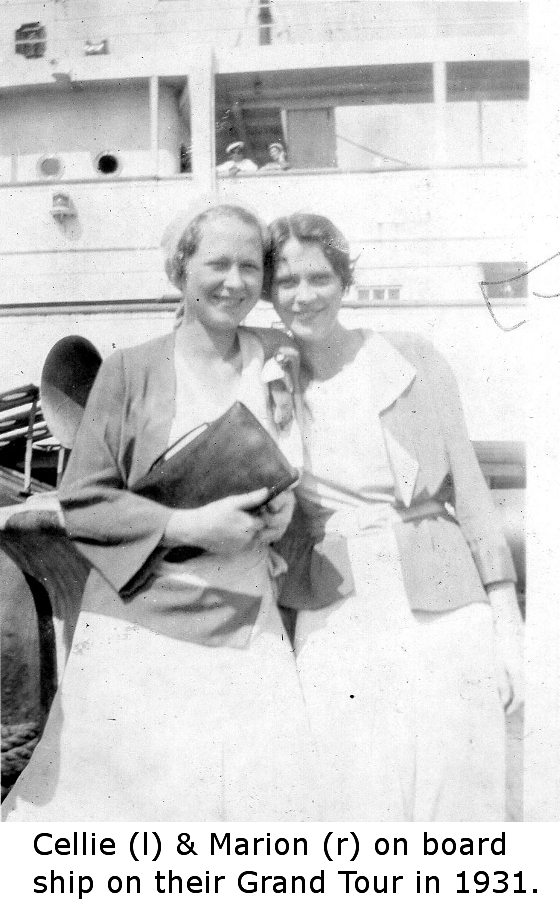
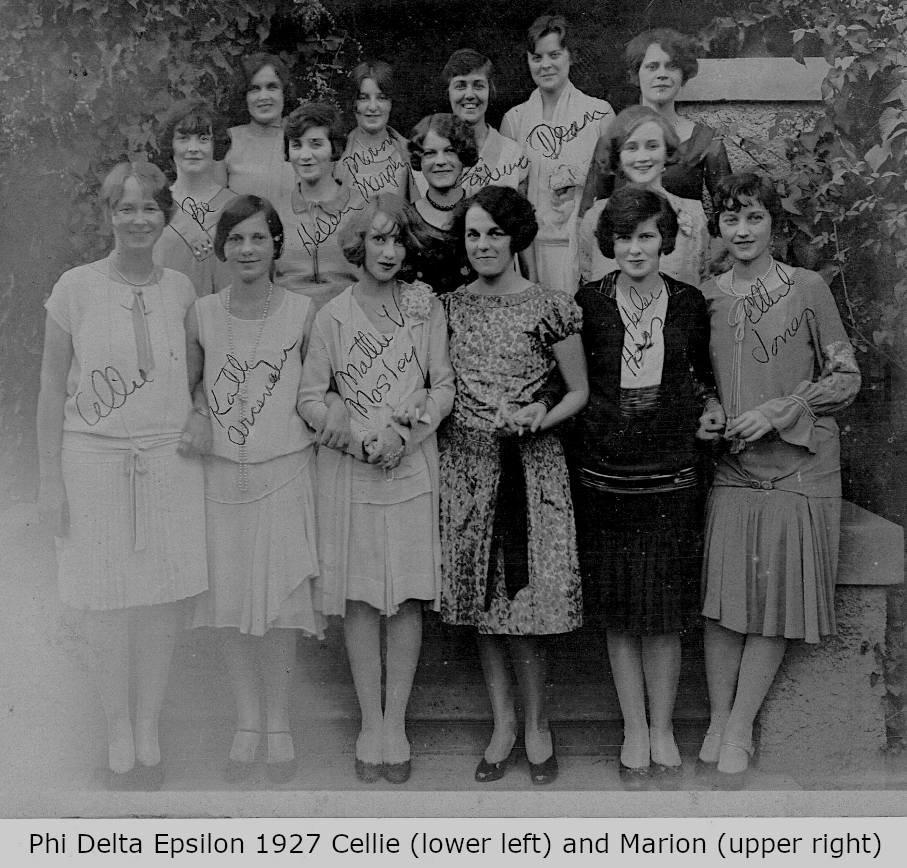 Cellie and Marion were very close friends throughout their lives. Aunt Marion graduated from high school in 1924, two years ahead of Cellie and attended Southwest Louisiana College in Lafayette, graduating in 1928. Cellie joined her there in 1926 and then transferred (after Marion's graduation) in 1928 to Louisiana State University in Baton Rouge at the Old State Capital Campus (old U.S. Arsenal site). She was a Delta Zeta at LSU. She and Marion had a great time in college, belonging to the same "local" soriety Phi Delta Epsilon and working with the college newspaper at Southwest Louisiana College. Marion was a gifted writer and should have been a journalist. After Cellie graduated from LSU with a BA in 1930, she and Marion did the Grand Tour together in Europe, the summer of the following year. In 1933, they went together to the Chicago World's Fair. Meanwhile, Cellie taught high school in Hammond, rooming with the James (Jimmy) Morrison family, until she married Al in 1935. James Morrison was later a congressman from Hammond. Before marrying Al, Cellie did one more trip with Marion, spending the summer in Mexico City in 1934, where they attended the National University of Mexico. Cellie kept copious notes of those years after graduation and before being married. She was a party girl which I never realized when growing up. At LSU she wanted to major in Geology which is what I later did, certainly influenced by her love of the subject. At that time, women were only allowed to take the freshman geology courses which she took in college. Education was Southern Society's preferred career for women in the first half of the 20th century, and she later received a teaching certificate.
While the girls went off to college, Uncles Preston and Clay stayed home to help their father Ernest with his various businesses. Ernest compensated them somewhat by giving them land and building their homes. Years later I came to understand the resentment they felt because they had been forced to work at an early age for the family, feeling the girls had a care-free existence and then showed up for their share of the inheritance in 1955 on the death of my grandmother Momsy (May). (Years later I felt similar emotions when I came back to Louisiana after graduate school to help Cellie and look after the family interests because Marilyn and Lloyd were generally absent after the late 1960s.) But Momsy had lived with us in New Orleans and Crowley in winter for the last 11 years of her life and she depended upon Cellie. My mother felt like she was doing her share for the family. The resentment was an open wound in the late 1950s with the issues of the family cattle, the lumber mill, and the family land partitions. But I always liked Uncle Preston and eventually became good friends with Uncle Clay.
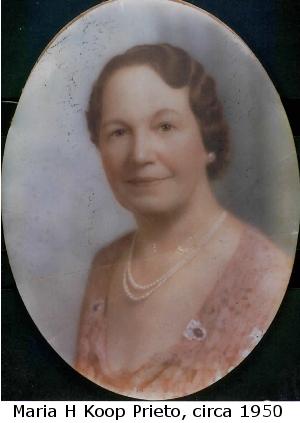
In the late 1950s, on receiving a tip, my mother went to a cattle sale in Slidel and discovered family cattle being sold. She confronted Uncle Preston. Both had tears in their eyes, and there were never again problems between our two families. In February of 1957, Cellie and Marion received a letter from C. E. Corry, the bookkeeper at the family lumber mill, saying proceeds from lumber sales were not being reported to the family. I still have that letter, and those were volatile times. One afternoon Uncle Clay came bursting into the old family home to confront my mother. She retreated to her Mom's bedroom, closed and locked the door, reached under a seat cushion and picked up a revolver, a 5 shooter, as I recall from playing with it as a child. Uncle Clay was banging on the bedroom door. She yelled out for him to leave or she would use the gun to protect herself. Clay left. Clay was a rough, tough guy who was Mayor of Mandeville at the time but Cellie was not to be pushed around. But by the early 1960s, the family interests were split up, eliminating problems except those related to real estate partitions. The timber on the family lands was sold. The general store and family house went to Uncle Preston. The lumber mill was dismantled with the equipment sold to the Kent family (Stoessell relatives) in Fluker, and the remaining family cattle were purchased by Uncle Clay. For a few years Clay still played games with Cellie's interest. He surreptitously dismantled the "Old Place" barn which was now on her property and rebuilt it as part of a new barn further east on highway 1088 on his property. He moved a building on her property within the lumber mill square, without her permission, to his property on the bayou to use in his boatyard. As I look back, I understand Clay's feelings. After his father Ernest died in 1944, Clay had supervised building more rental houses for the family, ran the family lumber mill and cut and sold timber for the family, and (with Preston) looked after the family cattle. He had built both the "Old Place" barn and also the building on the lumber mill square. Cellie was not going to keep livestock and the barn would have rotted away from disuse. Nevertheless, he should have paid Cellie for the building on the lumber mill square, and it was a life-long source of irritation with her.
During this time, my father Al was generally in Crowley running the Moore-Stoessell Studebaker dealership with Jimmy Moore, then managing the Crowley Chamber of Commerce and later managing the Acadia Savings & Loan. Al enjoyed hanging with Preston but he did not enjoy the family discord in Mandeville. Marilyn and I were too young to be of much help for my mother in dealing with Uncle Clay, and her support came from my older brother Lloyd. I remember standing outside in the yard one afternoon when Clay came out of a meeting with Cellie and Marion. Apparently Lloyd had pointed out to him why Cellie and Marion should not do what he wanted. Clay complained about Lloyd and Marion said thank God he had been there. In the early 1960s, Lloyd went to graduate school in solid state physics at Cornell and in 1964 married his first wife, Carolyn Bergen, a pretty red-haired Cornell graduate student in Fine Arts from Coos Bay, Oregon. After receiving a MS Degree, he went into the US Air Force and never came back to Louisiana permanently. He first lived in Albuquerque working at the Sandia National Laboratories and then moved permanently to the Washington DC area, working in the Pentagon as an Air Force Captain and later as a civilian. He and Carolyn were divorced in Albuquerque and Lloyd later married Pamela Becker, a future professor in Fashion Design at Marymount Univeristy. Marilyn had a passion for Europe, having been an American Field Service exchange student to Kitzbuhl, Austria as a high school student. She left permanently in the late 1960s, after graduate school at LSU, receiving MA Degrees in German and Spanish. While in graduate school she had attended the University of Munich on a Deutscher Akademischer Austauschdienst fellowship. She met her future husband Karl Seifert, a German living in Wiesloch, West Germany, while hiking in the Alps. They married in 1970, but she came back for yearly visits and helped with some of the family real estate problems. And after 2010 when I had left Mandeville permanently, Marilyn took over the major share of handling problems in the family properties. Like her mother Cellie, she is not a woman who shies away from discord or responsibility.
Uncle Clay was a larger than life figure. He was a big man, broad in the shoulders, bowlegged and walked with a pronounced roll which could have been from years spent on horseback and/or on the decks of schooners or perhaps from childhood rickets (?). He was mayor of Mandeville for twenty years, from 1944 to 1964. Uncle Clay made efforts to befriend me when I was a child, taking me to eat ice cream, to cattle auctions on the NorthShore, and to the New Orleans Athletic Club to swim. In late 1971, we went out with the Air Force to a crash site near our land. A fighter jet had crashed and the rescue operation had damaged our properties in recovering the plane. We were there to make sure that the family was repaid for the damage and I was representing Cellie's interest. I listened while he told the military personnel stories of the history of the property (like the one already recounted of cattle rustling) and made friends with them. Later that afternoon, he and I talked about the family. Clay's daughter Joan had married Robert Doolittle (Bob) earlier that year in Europe, and Marilyn had managed the wedding and acted as tour guide for Clay and his wife Elizabeth in Germany. We had no resentment towards each other and from then on we were good friends. Clay and his wife Mary Elizabeth Molloy (Elizabeth, 1913-1972) had three children: John Ernest (Ernest, 1935-2014), Mary Elizabeth (Mary, 1939-2016) and Joan Clay (Joan, b. 1945). Cousin Ernest, a basketball star in high school and college, and a 1968 graduate of Loyola Law School, was an attorney who also worked as a real estate agent as did Mary. Both Mary and Joan had run military Service Clubs in Europe in the 60s and early 70s where they met their future husbands. Ernest had three children with his first wife Marietta Hansbrough: Marie Elise (Malise, attorney and Clerk of Court for St. Tammany Parish), Clay Carl (Clay, real estate agent), and John Ernest (Ernie, a Road Scholar, according to his Dad). Mary had two children with her husband Thomas Larry Golden: Lauren Browning (Lauren, runs family businesses) and Molloy Caldwell (Molloy, artist); and Joan had two children with her husband Robert Thomas (Bob) Doolittle: Robert Thomas (Bob, forester) and Benjamin Vincent (Ben, restaurant chef). But Cousin Ernest, Cousin Mary and Ernest's son Clay resented the Stoessells throughout their lives, producing 50 years of backdoor legal fights over ownership of Prieto land inherited by my mother Cellie. These disputes thankfully ended with their deaths in 2014, 2016, and 2020, respectively.
Uncle Preston (Little Tuce) was a tall man, the most likable guy I ever met, other than his son Preston Thomas Prieto Jr (Tommy, 1938-2010). He ran the Ernest Prieto and Sons General Store and used to give us candy and play practical jokes on me. He once sent me to a competitor's (Band's) grocery store a block away, to get some additional stock, telling me that this was his storehouse. I still have some of the family tokens redeemable at the store which were used to pay the family workers.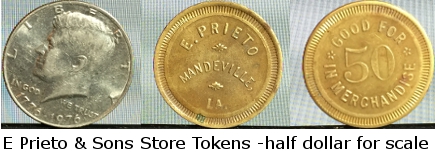
Preston called me Boy, the same as he called Troy Jackson Jr, his son-in-law. Preston would jokingly refer to Troy as "that Boy who married my daughter and I can't remember his name." Troy was actually a beloved school principal in Covington who was loved by the family. My recollections of Preston are sitting on his back porch with my Dad and the two of them drinking whiskey, retelling old stories. Al and Preston were great friends. I could have had my first shot of whiskey with them on that back porch. Although in retrospect, that probably wasn't true because in Louisiana, we start young.
According to Cellie, Governor Huey Long paved Gerard (now called Girod) Street as a wedding present to Preston and his wife Dorothy Vernon Burns, (Dolly, 1905-1982). It was the first paved street in Mandeville. One weekend Huey was visiting Ernest and asked Dolly what he could give as a wedding present for them. She replied that the street was awfully dusty. The next Monday, state workers showed up to pave the street. They had two children: Tommy and Jerry Dean (Jerry, 1932-2003). Jerry, like her husband Troy Jackson, was a school teacher, and they had two children: James Kent (Kent, jack of all trades) and Janet Ruth (Janet, secretary in the school system). Tommy never really had a career. I remember he ran the Mandeville Ice House and the old Lakefront Theater in the 1960s and later looked after his family properties. He had two children: Carrie Deane (Carrie, runs family businesses) and Don Scot (Don, builder, jack of all trades) with his wife Sarah Lewis but the marriage didn't last. In later years, Tommy became somewhat of a recluse, living in a house he built in the woods south of Abita Springs and occasionally traveling to Australia, a country he identified with. His long time girl friend and companion was the sister of cousin Ernest's wife Marietta Hansbrough. Tommy always had a twinkle in his eye and a good word for everyone. After Uncle Preston's death in 1972, his extended family would gather at his family home on Gerard Street on Wednesday evenings to eat supper, drink whiskey, and share gossip and family tales. I attended a few of those meetings, and I treasure those memories.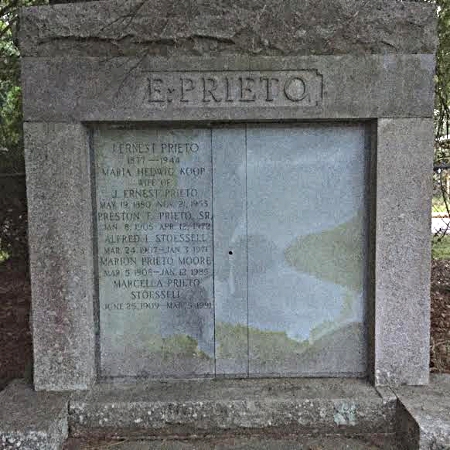
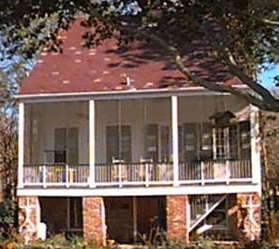 Aunt Marion was the most articulate and opinionated member of the family. She and her husband James P Moore (Jimmy, 1909-1978) lived in Crowley when Jimmy and Al were business partners. Jimmy was a very handsome likeable guy. Cellie said that he and his brother Tommy had played in the Schilling's Society Serenaders, a jazz band in New Orleans. Jimmy skippered a PT boat in the Pacific during World War II, and had graduated from Tulane Law School. I don't think he ever practiced law. His family had run the New Orleans Mint in the latter part of the 19th century and had donated the land for the Our Lady of the Lake Catholic Church and Catholic School in Mandeville, adjacent to their family home. After the Crowley Studebaker Dealership failed, Jimmy did legal abstracting for a few years in Crowley. A relative of my first wife Louise Baenninger told me that he was abstracting with Jimmy in the Crowley Courthouse when Jimmy stood up and announced "Life is too short to make a living this way." and walked out. He never went back to work. They settled back on their inheritances from the Moore and Prieto families, living in Mandeville, in a beautiful 19th century raised Lakeshore Dr home in the 1700 block that they named "High Tide" (see pictue on the left). As a child I remember that place as the old Si Hickey house. Marion was known for her sharp tongue and clever replies. She delighted in taunting me that someday I would be just like her, an assertion I vigorously disputed and deny (lol) to this day. Jimmy died of a heart attack in a Beirut Hotel on a vacation in Lebanon. Years later, I asked his son David why they buried Marion separately in the Prieto Family Tomb, away from Jimmy. He replied that his father deserved a break.
Jimmy and Marion had two children: Margery M. (Marge, 1940-2021) and David Michael (David, 1944-2019). Marge was beautiful, serving as the Crowley International Rice Festival Queen in 1956. Like Tommy, David was a handsome guy who never really had a career. Uncle Clay used to say that David was the image of my grandfather Ernest. David was a Ph.D. candidate in English at Tulane but did not finish his dissertation. He had a love of antique guns and fast cars. For a while, he ran a black powder gun shop in Mandeville and then retired to Covington, living on his inheritance while looking after his family's properties. David married twice, the last to Naomi Leininger (b. 1944) but had no children.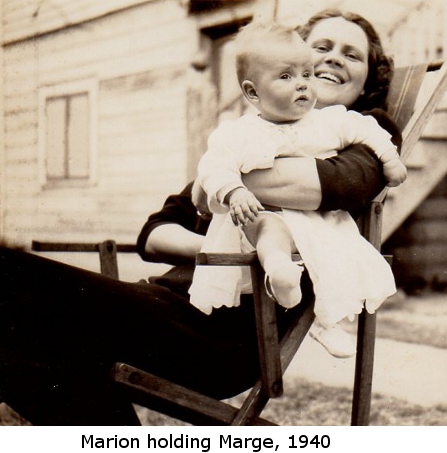
Marge was a very talented, dynamic woman who ran the Head Start Program in St. Tammany Parish and later had a jewelry and art shop in Taos, New Mexico. Her first husband Robert (Bob) Hanisee from Crowley was a great guy who taught English at the University of New Orleans and at Southeastern Louisiana University in Hammond. Leaving academia, Bob served as a state department head supervising state parks in an early administration of Governor Edwin Edwards in Baton Rouge, before eventually moving his family to Taos, New Mexico in 1986. He was a triathlon athlete who died tragically in New Mexico, struck by a drunk driver, as he trained by running along a highway shoulder one snowy morning in February, 1987. They had two children, a daughter Erin (married name Smith) living in Albuquerque and a son Miles, a judge on the New Mexico Court of Appeals. Marge died early in 2021, and we lost a wonderful spirit.
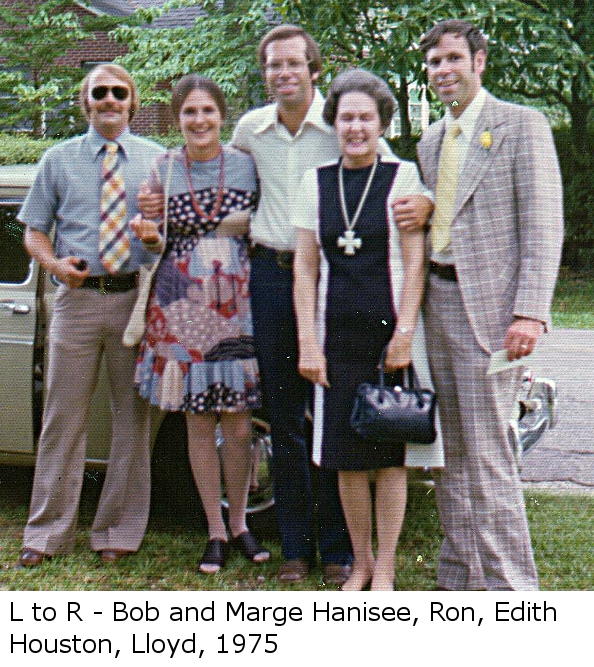
This last story about the Prietos concerns the Lemieux Brothers. They were partners with Ernest in the first 20 years of the 20th century in numerous land dealings, including buying the Jackson Lane Subdivision north of Mandeville. This was a bankrupt subdivision with about 5,000 small lots, laid out on paper with only a few hundred lots subsequently sold to spectators and absentee land owners in New Orleans. The abandoned titles to those lot sellouts, along with those in other subdivisions (Birg Boulevard, Helenbirg Lots and Farms, and Glendale Heights Farms), obtained through the Arnett Tax Sale were the subject of many family lawsuits in the last half of the 20th century. Eventually Ernest bought out the Lemieux Brother's interest in their joint properties. The Lemieuxs lived on the Mandeville Lakefront in a cottage that later survived the tidal surge of Hurricane Katrina in 2005. The external symmetry of the cottage makes it (in my opinion), the most beautiful home on Lakeshore Drive. Mrs. Lemieux died in this home. My mother said she was found standing up, leaning against the fireplace mantle with her dog lying at her feet. Rigor Mortis had set in and held her in a standing position. I can never look at that cottage without having the vision of an elderly woman standing inside, leaning against the mantle of the fireplace, her dog at her feet.
The rest of my narrative deals with my life and it will cover my own siblings, but for the sake of my sanity, let me dispense some with these two overachievers. However, I will spare you their high school achievements. At LSU, Lloyd triple majored in chemisty, physics, and math and graduated with a 3.84, receiving an active commission in the Air Force from being in ROTC. He then went to graduate school at Cornell, receiving a MS in Solid State Physics and then began active duty with the Air Force. His career path led from the Sandia National Labratories in Albuquerque to being one of the project managers at the Pentagon in Washington in developing the strategic missle defense system. Lloyd lived in Falls Church until his death in 2021 with his second wife Pamela Becker, a Fashion Design Professor and later Dean at Marymount University. Marilyn was Mortar Board Outstanding Freshman Woman and Outstanding Junior Woman at LSU, AWS President and she double majored in Spanish and German. She received a MA in both subjects at LSU before marrying Karl Seifert in 1970 and disappearing into the European landscape to help him run Firma Wettstein, a hardware and gift shop in Wiesloch, Germany. Below is a picture of the three of us, with our spouses, taken around 2000 in Mandeville. We're sitting under my raised Lakeshore house (1623 Lakeshore) which we called the Tree House. (This house was built as a rental house by my grandfather Ernest in the 1930s.) And yes - my second wife Londi (Yolanda Harrington Moore, b. 1958) is sitting on Karl's lap (have to keep my eye on the Germans - lol). We're drinking the good stuff: Domaine Carneros champagne and Heitz Martha's Vineyard cabarnet. Lake Pontchartrain and Uncle Clay's Breakwater are in the background.
(L to R) Lloyd, Pam, Marilyn, Karl, Londi, and Ron, circa 2000
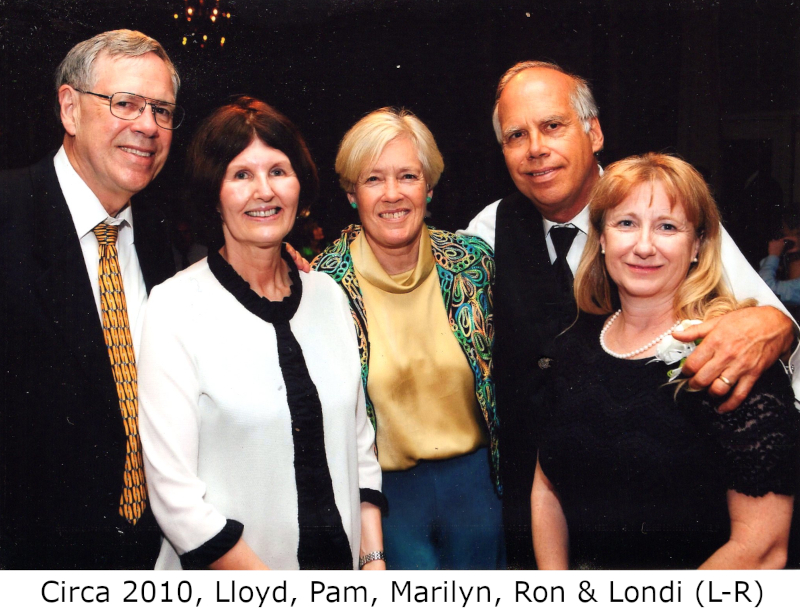
In closing this section, please note that some family papers are available as pdf files, reached from the link marked Family Papers in the menu at the top of the page.
Return to Top
Cellie was from Mandeville, Louisiana which sits across Lake Pontchartrain from New Orleans. She was the youngest child of John Ernest Prieto (Ernest (Popsy, aka Tuce), 1877-1944) and Maria (Mary) Hedwig (Hattie) Koop (1880-1955). Within the family, Maria was called May and she was Mumsy to me. Cellie had three older siblings: Preston Thomas Sharp (Preston (aka Little Tuce), 1905-1972), John Clay Francis (Clay, 1907-1987), and Marion May (Marion, 1908-1985). My Grandfather Popsy went by his middle name Ernest. On census forms his education level is listed as 5 which I assume means the 5th grade. He was a self-made man, an accumulator of land and businesses to the extent that the next two and three family generations could, if they wanted, largely live off the wealth that he created. In my retirement, I often joke "I earned my money the old-fashioned way. I inherited it!" I say that in gratitude because it has enabled me to fund good causes, to help others and fund animal rescues.
Cellie's mother May was from New Orleans. Her mother Sophie Ebel (1847-1924), immigrated in 1867, was from Mutzenhausen in Alsace Lorraine (born in Strasbourg, France) and her father Frank Koop (1838-1932), immigrated in 1860, was from Lubeck and Berlin (born in Leipsig, Germany). Sophia was 15 generations removed as a direct descendant of Charles V Le Sage, King of France (1372-1407) through the illegitimate daughter Souveraine d'Angouleme (1487-1551) of his great grandson Charles de Valois Duke of Orleans (1459-1496). Souveraine was also the half sister of Francis I, King of France (1494-1547). That family line extends back through Charles Martel (688-741), the grandfather of Charlemagne. I have lately given some thought to landing in France and attempting to claim my kingdom; however, my French is awful, and I prefer California wine.
Sophia and Frank Koop married in 1869 in New Orleans. Frank had come to America just in time to be caught up in the Civil War.
Cellie's father Ernest (Popsy) was the grandson of Vicente Prieto Pavias, (Vincent, 1820-1891) a Spanish sea captain. Captain Vicente eloped with Senorita Josefa Costa Navarro (Josephine, 1829-1914), from the island of Ibiza in Baleares Islands in the Mediterranean Sea. Vicente was the son of a carpenter Vicente Prieto Ferrer (1790-1841) and Margarita Pavias Balanzat (1789-?) on Ibiza. The Balanzat family has been prominent on Ibiza for centuries. Josefa was the daughter of Josefa Navarro Gavara (1803-?) and Lucas Costa Ferrer (1797-?), a mariner in Ibiza. And she was disinherited for her elopement. Family lore was that Josefa Navarro Gavara was a Contessa; however, this is not supported by church records in Ibiza.The Captain's grandfather Marcos Prieto Rodriguez was born in the Diocese of Asturias, in San Miguel de Laciana (now in the Diocese de León) and moved by way of Madrid to Ibiza where he married Francisca Ferrer in 1784. Both died around 1794. In 1761, he and a sibling were living with their parents (Pedro Prieto-Lastre and Maria Rodrigues) in the village of Rabanal de Arriba. So the Prieto (Aprieto, Apreto) family is from the mountainous north Atlantic coastal region of Spain - the one area never conquered by the Moors. I have a DNA connection with the Volpe family tree through one of the Captain's 4 siblings, his sister Magdalena Prieto Pavias (1823-?) born in Ibiza who married José Ramón Bonmatí Baibé.
We do not know when Vicente Prieto Sr first crossed the Atlantic to Louisiana, probably in 1851 or 1852. However, their first child Vicente Prieto Jr (Ernest's father and my great grandfather) was born in 1849 in Ibiza. I can imagine their excitement and apprehension while sailing the Atlantic to a new life. The schooner probably entered Lake Pontchartrain through the Rigolets and landed in Mandeville. Why they settled in Mandeville is not known. The town had been founded by Barnard de Marigny in 1834 and was only incorporated in 1840. In Mandeville, Josephine was called Madame Vincent (prounced Becent) by the French and Spanish town folks. Captain Prieto installed her in a house on the Lakefront, at the east corner of Marigny Ave, complete with a widow's walk on the roof so she could watch for the return of his ship. Vincent Sr then sailed off back to Spain on a trading mission, returning 7 years later, presumably in 1858 or 1859. That widow's walk must have been well worn. The sea captain became a naturalized citizen in 1864 before a judge in New Orleans. This was during the Civil War and New Orleans had been captured earlier in 1862. They had 5 children: Vincent (1849-1886), married to Pauline Sharp; Marguerita (Maggie, 1860-1922, married to John Manuel Cuni; Joseph Lucas, (Lucas, 1862-1937), married to Mary Madeline Vezien; Josephine, (Pepita, 1864-1883), who died on her wedding day; and Magdeleine Josephine (Lena, 1866-1934), married first to Ernest Brinkman and then to David Treadway. Interestingly, church baptismal records have Lucas and Josephine Costa as the God parents of their granddaughter Magdeleine. Were they standins or actually in New Orleans in 1866? Family lore says Josephine (Pepita) was buried in her wedding dress along with an infant daughter of Vincenti Jr., who died a day later. There is confusion in the birthdate of Josephine Prieto. Her tombstone says 1861 but church record and census indicate 1864. The Captain's Lakefront house on Lakeshore Drive burned July 31, 1914. At the time of her death on August 24, 1914, the Captain's widow was living in a cottage that Popsy (John Ernest Prieto) had built just behind the Lakeshore House location. Her eyesight must have gradually deteriorated, because Cellie said she let in a stray cat one evening, only to discover the cat was a possum the next morning.
I do not know much about Ernest's uncle Lucas and aunts Maggie and Lena on his father's side. However Lucas Prieto is frequntly mentioned in early 20th century newspaper accounts of parish civic and political affairs. His son Paul was tragically shot and killed by his brother-in-law in a family dispute in 1926. And Lucas's mule is credited with being used in 1903 to carry the stolen printing press for The Mandeille Wave to the harbor where it was dumped. This ended its short-lived publication, much to the chagrine of the editor Louis Rosenthal. The story is that Louis's son orchestrated the theft so he wouldn't have to work in the print shop. (lol) My first cousin Joan Doolittle tells me that Lucas died in her father's arms (Clay Prieto) in front the E. Prieto and Sons family store, suffering from a medical emergency.
The following information was related to me by Cellie. Ernest and his older brother Tony were raised by their maternal grandfather Plum Sharp. As a young man, Ernest ran away several times and was sent to live in New Orleans with Aunt Duffy (Margaret Sharp Duffy, sister of his Mother Pauline). But he wasn't content there either and ran away again, spending his youth riding trains across the country and doing odd jobs to support himself. During this time, he shipped out on a cattle boat to Spain but was so seasick (according to Cellie), he never went ashore. Eventually Ernest came back to Mandeville and New Orleans, taking a job as a waiter at the old Cosmopolitian Hotel, working alongside his young friend Leon Bertrand Arnaud Cazenave who later founded Arnaud's restaurant. Family lore has Arnaud offering Ernest a partnership in starting Arnaud's restaurant which he declined. Ernest started his business in Mandeville by pooling his money with lifelong friend Lewis Morgan (Cellie's Godfather and later US Congressman) to purchase a building from James Band (a relative of Lewis Morgan) on the corner of Jefferson and Gerard (Girod) Streets, starting the family mercantile store in Mandeville. He met his future wife Mary Koop at a Masonic Ball in New Orleans and they were married in 1903.
Mandeville was a small, picturesque, rural town for much of the 20th century. The town was a vacation resort for people from New Orleans on the south side of Lake Pontchartrain. In the early days, the public would take steamboats for the 24 mile trip back and forth across the lake, disembarking on wharves built out from the lakefront. A railroad started from the lakefront and they could ride north to the Covington area and the resort town of Abita Springs. Mandeville reminded me of the Sausalito I knew as a graduate student at UC Berkeley in the 1970s, across the Golden Gate Bridge from San Francisco. The lakefront and the old homes provided the same atmosphere as the waterfront on San Francisco Bay. This was a really cool town, and only now in the 21st century is it losing its charm with the urbanization of the North Shore.
The family home of Ernest was on the west side of Gerard (now called Girod) Street in the second block off the Lakeshore. Within the center of the block, he kept a small pasture to hold calves that needed care and two barns: one for horses and cattle and one, behind the town post office built by Ernest on Jefferson Street, that contained chickens, etc. I remember the "vat", a deep concrete pit by the horse barn used for curing cattle hides. Cellie had her own horse, named Jingles. The horses, used by the cowboys with the family's free-range cattle, were sometimes brought in to Mandeville for the night. Mack Richardson, the cattle foreman and butcher, lived next door to the Post Office, and the horses were transported in the back of an old deuce and a half ton truck. The family kids and their friends could sometimes ride them on the lakefront. And Ernest would use them for foxhunts that started from his home at daybreak. I still have one of Popsy's (Ernest's) short barrel saddle rifles, a 32-20 Marlin, model 1894, that he used on those fox hunts. Cellie said that often when the rest of the family was walking back home on Sunday from church, they would meet Popsy and the other fox hunters returning on horseback with a pack of dogs coming down the street.
Uncle Clay told me of the time Ernest learned his cattle were going to be rustled by outlaws in Lacombe. Outlaws were a general name applied to those who hunted illegally as well as stole property, and Lacombe was known for its outlaws. Ernest and Clay and the men working for the Prieto family got their rifles and went in trucks out to the land. Clay later told me he was pissing in his pants when they climbed out to confront the outlaws. The two groups of men stared hard at each other for a few minutes. Then the outlaws stood down, saying "Mr. Prieto, we'll leave your cattle alone." The lesson of this story is you don't really own something if you are not willing to fight for it.
Ernest had other businesses, including a hotel and a funeral home. Cellie used to play in the coffins, causing her mother psychological distress, resulting in Ernest getting out of that particular business. The family's lumber mill and boatyards were located further east along Bayou Castine (means flea in Choctaw). The family schooners were used for trade with New Orleans but there were many tales of taking a schooner out on the lake for an afternoon of partying, one of Clay being tied to the mast. Cellie often talked of Captain Reed (Jimmy Reed), an African American seaman, who skippered the Josephine Mestier for 30 years (1913-1943), the prize 70 ft schooner of the family, and he was a valued family friend. One of the pictures (left) is a Don Scafidi painting of his representation of the Josephine under full sail, done for the 1997 Madisonville Boat Festival and the other picture (right) is an old photo of the Josephine at dock in the bayou.
By the end of the 1930s, use of the schooners was no longer economical for trade with New Orleans. The Josephine was sold in 1943. The remaining boats had been built of cypress and the family sank them in the Tchefuncta River, above Madisonville, so they would not rot. As a child, I remember seeing the hulls near the bank, just below the water surface, but I do not remember the location. I used to dream of raising one and setting it sailing again on the lake, i.e., being Captain Ron.
Grandfather Ernest was a strong supporter of the Longs. Huey was assassinated in 1935 and Ernest subsequently lost property through political retaliation by eminent domain taking within what is now Fontainebleau State Park, established in 1939. Ernest's best friend was Lewis Lovering Morgan (Cellie's godfather) who headed the 1944 "Long" Ticket for governor. Morgan's defeat by Jimmy Davis in the run-off contributed to Ernest's death by heart attack in 1944. Morgan was ridiculed as that "old man" and Ernest took it personally. As young men, they were business partners in the Mandeville mercantile store which Ernest managed and the proceeds paid for Morgan's Tulane Law School education. In return Lewis Morgan provided free legal work for Ernest for the rest of his life. This arrangement wasn't a great deal for the Prieto family because the legal work was sloppy and led later to many lawsuits over land titles. One of these was the horrific Arnett lawsuit which began in 1968, involving thousands of acres of Prieto land, that lasted 13 years. But Lewis was a good family friend, and he was Cellie's Godfather. He died in 1950, 6 years after Ernest.
Cellie and Marion were very close friends throughout their lives. Aunt Marion graduated from high school in 1924, two years ahead of Cellie and attended Southwest Louisiana College in Lafayette, graduating in 1928. Cellie joined her there in 1926 and then transferred (after Marion's graduation) in 1928 to Louisiana State University in Baton Rouge at the Old State Capital Campus (old U.S. Arsenal site). She was a Delta Zeta at LSU. She and Marion had a great time in college, belonging to the same "local" soriety Phi Delta Epsilon and working with the college newspaper at Southwest Louisiana College. Marion was a gifted writer and should have been a journalist. After Cellie graduated from LSU with a BA in 1930, she and Marion did the Grand Tour together in Europe, the summer of the following year. In 1933, they went together to the Chicago World's Fair. Meanwhile, Cellie taught high school in Hammond, rooming with the James (Jimmy) Morrison family, until she married Al in 1935. James Morrison was later a congressman from Hammond. Before marrying Al, Cellie did one more trip with Marion, spending the summer in Mexico City in 1934, where they attended the National University of Mexico. Cellie kept copious notes of those years after graduation and before being married. She was a party girl which I never realized when growing up. At LSU she wanted to major in Geology which is what I later did, certainly influenced by her love of the subject. At that time, women were only allowed to take the freshman geology courses which she took in college. Education was Southern Society's preferred career for women in the first half of the 20th century, and she later received a teaching certificate.During this time, my father Al was generally in Crowley running the Moore-Stoessell Studebaker dealership with Jimmy Moore, then managing the Crowley Chamber of Commerce and later managing the Acadia Savings & Loan. Al enjoyed hanging with Preston but he did not enjoy the family discord in Mandeville. Marilyn and I were too young to be of much help for my mother in dealing with Uncle Clay, and her support came from my older brother Lloyd. I remember standing outside in the yard one afternoon when Clay came out of a meeting with Cellie and Marion. Apparently Lloyd had pointed out to him why Cellie and Marion should not do what he wanted. Clay complained about Lloyd and Marion said thank God he had been there. In the early 1960s, Lloyd went to graduate school in solid state physics at Cornell and in 1964 married his first wife, Carolyn Bergen, a pretty red-haired Cornell graduate student in Fine Arts from Coos Bay, Oregon. After receiving a MS Degree, he went into the US Air Force and never came back to Louisiana permanently. He first lived in Albuquerque working at the Sandia National Laboratories and then moved permanently to the Washington DC area, working in the Pentagon as an Air Force Captain and later as a civilian. He and Carolyn were divorced in Albuquerque and Lloyd later married Pamela Becker, a future professor in Fashion Design at Marymount Univeristy. Marilyn had a passion for Europe, having been an American Field Service exchange student to Kitzbuhl, Austria as a high school student. She left permanently in the late 1960s, after graduate school at LSU, receiving MA Degrees in German and Spanish. While in graduate school she had attended the University of Munich on a Deutscher Akademischer Austauschdienst fellowship. She met her future husband Karl Seifert, a German living in Wiesloch, West Germany, while hiking in the Alps. They married in 1970, but she came back for yearly visits and helped with some of the family real estate problems. And after 2010 when I had left Mandeville permanently, Marilyn took over the major share of handling problems in the family properties. Like her mother Cellie, she is not a woman who shies away from discord or responsibility.
Uncle Clay was a larger than life figure. He was a big man, broad in the shoulders, bowlegged and walked with a pronounced roll which could have been from years spent on horseback and/or on the decks of schooners or perhaps from childhood rickets (?). He was mayor of Mandeville for twenty years, from 1944 to 1964. Uncle Clay made efforts to befriend me when I was a child, taking me to eat ice cream, to cattle auctions on the NorthShore, and to the New Orleans Athletic Club to swim. In late 1971, we went out with the Air Force to a crash site near our land. A fighter jet had crashed and the rescue operation had damaged our properties in recovering the plane. We were there to make sure that the family was repaid for the damage and I was representing Cellie's interest. I listened while he told the military personnel stories of the history of the property (like the one already recounted of cattle rustling) and made friends with them. Later that afternoon, he and I talked about the family. Clay's daughter Joan had married Robert Doolittle (Bob) earlier that year in Europe, and Marilyn had managed the wedding and acted as tour guide for Clay and his wife Elizabeth in Germany. We had no resentment towards each other and from then on we were good friends. Clay and his wife Mary Elizabeth Molloy (Elizabeth, 1913-1972) had three children: John Ernest (Ernest, 1935-2014), Mary Elizabeth (Mary, 1939-2016) and Joan Clay (Joan, b. 1945). Cousin Ernest, a basketball star in high school and college, and a 1968 graduate of Loyola Law School, was an attorney who also worked as a real estate agent as did Mary. Both Mary and Joan had run military Service Clubs in Europe in the 60s and early 70s where they met their future husbands. Ernest had three children with his first wife Marietta Hansbrough: Marie Elise (Malise, attorney and Clerk of Court for St. Tammany Parish), Clay Carl (Clay, real estate agent), and John Ernest (Ernie, a Road Scholar, according to his Dad). Mary had two children with her husband Thomas Larry Golden: Lauren Browning (Lauren, runs family businesses) and Molloy Caldwell (Molloy, artist); and Joan had two children with her husband Robert Thomas (Bob) Doolittle: Robert Thomas (Bob, forester) and Benjamin Vincent (Ben, restaurant chef). But Cousin Ernest, Cousin Mary and Ernest's son Clay resented the Stoessells throughout their lives, producing 50 years of backdoor legal fights over ownership of Prieto land inherited by my mother Cellie. These disputes thankfully ended with their deaths in 2014, 2016, and 2020, respectively.
Uncle Preston (Little Tuce) was a tall man, the most likable guy I ever met, other than his son Preston Thomas Prieto Jr (Tommy, 1938-2010). He ran the Ernest Prieto and Sons General Store and used to give us candy and play practical jokes on me. He once sent me to a competitor's (Band's) grocery store a block away, to get some additional stock, telling me that this was his storehouse. I still have some of the family tokens redeemable at the store which were used to pay the family workers.
According to Cellie, Governor Huey Long paved Gerard (now called Girod) Street as a wedding present to Preston and his wife Dorothy Vernon Burns, (Dolly, 1905-1982). It was the first paved street in Mandeville. One weekend Huey was visiting Ernest and asked Dolly what he could give as a wedding present for them. She replied that the street was awfully dusty. The next Monday, state workers showed up to pave the street. They had two children: Tommy and Jerry Dean (Jerry, 1932-2003). Jerry, like her husband Troy Jackson, was a school teacher, and they had two children: James Kent (Kent, jack of all trades) and Janet Ruth (Janet, secretary in the school system). Tommy never really had a career. I remember he ran the Mandeville Ice House and the old Lakefront Theater in the 1960s and later looked after his family properties. He had two children: Carrie Deane (Carrie, runs family businesses) and Don Scot (Don, builder, jack of all trades) with his wife Sarah Lewis but the marriage didn't last. In later years, Tommy became somewhat of a recluse, living in a house he built in the woods south of Abita Springs and occasionally traveling to Australia, a country he identified with. His long time girl friend and companion was the sister of cousin Ernest's wife Marietta Hansbrough. Tommy always had a twinkle in his eye and a good word for everyone. After Uncle Preston's death in 1972, his extended family would gather at his family home on Gerard Street on Wednesday evenings to eat supper, drink whiskey, and share gossip and family tales. I attended a few of those meetings, and I treasure those memories.
Aunt Marion was the most articulate and opinionated member of the family. She and her husband James P Moore (Jimmy, 1909-1978) lived in Crowley when Jimmy and Al were business partners. Jimmy was a very handsome likeable guy. Cellie said that he and his brother Tommy had played in the Schilling's Society Serenaders, a jazz band in New Orleans. Jimmy skippered a PT boat in the Pacific during World War II, and had graduated from Tulane Law School. I don't think he ever practiced law. His family had run the New Orleans Mint in the latter part of the 19th century and had donated the land for the Our Lady of the Lake Catholic Church and Catholic School in Mandeville, adjacent to their family home. After the Crowley Studebaker Dealership failed, Jimmy did legal abstracting for a few years in Crowley. A relative of my first wife Louise Baenninger told me that he was abstracting with Jimmy in the Crowley Courthouse when Jimmy stood up and announced "Life is too short to make a living this way." and walked out. He never went back to work. They settled back on their inheritances from the Moore and Prieto families, living in Mandeville, in a beautiful 19th century raised Lakeshore Dr home in the 1700 block that they named "High Tide" (see pictue on the left). As a child I remember that place as the old Si Hickey house. Marion was known for her sharp tongue and clever replies. She delighted in taunting me that someday I would be just like her, an assertion I vigorously disputed and deny (lol) to this day. Jimmy died of a heart attack in a Beirut Hotel on a vacation in Lebanon. Years later, I asked his son David why they buried Marion separately in the Prieto Family Tomb, away from Jimmy. He replied that his father deserved a break.Jimmy and Marion had two children: Margery M. (Marge, 1940-2021) and David Michael (David, 1944-2019). Marge was beautiful, serving as the Crowley International Rice Festival Queen in 1956. Like Tommy, David was a handsome guy who never really had a career. Uncle Clay used to say that David was the image of my grandfather Ernest. David was a Ph.D. candidate in English at Tulane but did not finish his dissertation. He had a love of antique guns and fast cars. For a while, he ran a black powder gun shop in Mandeville and then retired to Covington, living on his inheritance while looking after his family's properties. David married twice, the last to Naomi Leininger (b. 1944) but had no children.
The rest of my narrative deals with my life and it will cover my own siblings, but for the sake of my sanity, let me dispense some with these two overachievers. However, I will spare you their high school achievements. At LSU, Lloyd triple majored in chemisty, physics, and math and graduated with a 3.84, receiving an active commission in the Air Force from being in ROTC. He then went to graduate school at Cornell, receiving a MS in Solid State Physics and then began active duty with the Air Force. His career path led from the Sandia National Labratories in Albuquerque to being one of the project managers at the Pentagon in Washington in developing the strategic missle defense system. Lloyd lived in Falls Church until his death in 2021 with his second wife Pamela Becker, a Fashion Design Professor and later Dean at Marymount University. Marilyn was Mortar Board Outstanding Freshman Woman and Outstanding Junior Woman at LSU, AWS President and she double majored in Spanish and German. She received a MA in both subjects at LSU before marrying Karl Seifert in 1970 and disappearing into the European landscape to help him run Firma Wettstein, a hardware and gift shop in Wiesloch, Germany. Below is a picture of the three of us, with our spouses, taken around 2000 in Mandeville. We're sitting under my raised Lakeshore house (1623 Lakeshore) which we called the Tree House. (This house was built as a rental house by my grandfather Ernest in the 1930s.) And yes - my second wife Londi (Yolanda Harrington Moore, b. 1958) is sitting on Karl's lap (have to keep my eye on the Germans - lol). We're drinking the good stuff: Domaine Carneros champagne and Heitz Martha's Vineyard cabarnet. Lake Pontchartrain and Uncle Clay's Breakwater are in the background.
(L to R) Lloyd, Pam, Marilyn, Karl, Londi, and Ron, circa 2000
In closing this section, please note that some family papers are available as pdf files, reached from the link marked Family Papers in the menu at the top of the page.