Ron's Story
LSU, Guatemala, Penn State, US Army
Chapters
LSU, fall 1964 - spring 1968 |
Guatemala, summer 1968 |
Penn State Grad. Sch., fall 1968 |
US Army, fall 1968 - fall 1970 |
Undergraduate Years at LSU, 1964-1968
My father told me to enjoy my college years, saying "You will never again be free of responsibility!" The years at Crowley High had been socially awkward as I had tried to conform and failed to fit in. Going off to LSU was my liberation and my escape was completed by being blackballed from various fraternities during Rush Week. I now had no responsibilities to anyone other than to my parents to make good grades. That freshman year, after classes I would take the city bus downtown, walk the levee to watch the Mississippi River roll by, and ride the river ferry while writing poetry for my soul, then drink in bars until past midnight. I felt like Hemmingway. This was freedom!
I had to do 2 years of ROTC. The ROTC classes were the dullest I've ever taken and I slept through most of the lectures. My major was geology and I loved rocks: the stark outcrops that I had seen in the mountains, the colors of stream pebbles, and the beauty of gems. Sea Floor Spreading, the foundation of the great unifying theory of Plate Tectonics, had only been proposed in 1960 by Harry Hess, and I do not even recall hearing of plate tectonics until my senior year. I remember James Morgan, my freshman geology professor awkwardly explaining the location of mountains by saying orogenic uplift occurred where thick layers of sediments had been deposited. Orogenic uplift sounded like pornography to me and raised the question as to why there are no mountains in Louisiana which is underlain by thick layers of sediment. Dr. Morgan explained the uplift by saying it was the result of tectonic forces, explaining them as due to buoyancy of less dense rock rising through more dense rock (hmm hmm, now that would be a slowwww process). But regardless, I enjoyed learning about the different rocks and the minerals making them up and how to map their surface outcrops and describe their geologic structure. And within a few years plate tectonics was universally accepted, and we could explain the locations of mountains and other tectonic features on the Earth's surface.
The summer of 1965 between my freshman and sophomore years, I worked at the Louisiana State Mineral Board in an old building at the downtown capitol complex. This was my learning experience of the rudiments of being a petroleum geologist - certainly not rocket science. Our job was to evaluate industry proposals to lease state land for petroleum exploration. We generally had the same subsurface information that industry had. I would plot the locations of previously drilled wells on maps, record the depths to the oil-bearing formations, contour the depths, and look for potential subsurface oil traps. On a contoured subsurface map of a formation, these traps showed up as highs, e.g., hills, or as layers trapped on their high side by a fault or by salt. I remember one of the drillers (whose well data I used) was the WT Burton "Win or Lose" Oil Company. The company had been closely aligned with former Governor Huey Long, a useful contact for the politically sensitive mission of getting leases for state lands. The company name really summed up for me the concept of "wildcatting for oil and gas.
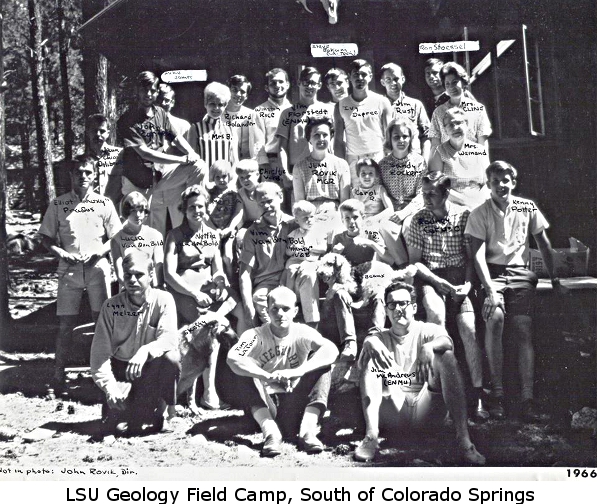
As I look back on my sophmore year, I realize how immature I was. My girlfriend Patsy Hopkins was a sweet girl and I neglected her. And she dumped me, rightly so, teaching me not to take for granted those that care for you. During the following summer (of 1966), I attended the 6 week LSU Geology Field Camp in the foothills of the Rockies, south of Pikes Peak and Colorado Springs and just west of Fort Carson. Field camp was an incredible experience for me. The exposed sediments were in hills and flat iron outcrops and were mostly Paleozoic and Mesozoic in age. We field-mapped the surface formations. We started our work each day, hiking up several hundred feet in elevation to the top of the "Saddle", and then listened to a short lecture. I loved hiking those foothills and learned the rudiments of surveying while becoming adept at using air photos with a steroscope to locate myself in the field. The latter was an essential skill (before gps became available) which I would later use when doing field work in Guatemala and Kenya. During that summer, we took off for a couple of camping field trips that took us all over the Colorado and New Mexico Rockies. I fondly remember John Rovik, the camp director, adding vermouth to omelets for us, early one morning in the Sangre de Cristo Mountains. Thinking back, I do not believe any experiences in my life have produced the emotions for me of being in the high mountains.
A decade earlier, in the 1950s, a group of (5?) LSU geology students were killed by lighting at the field camp. They apparently forgot Ben Franklin's experiments with lighting and crawled into a big metal culvert for cover during a rainstorm. But the danger was usually on the roads, not in the field. One sunny day in early July, we left the LSU Geology Field Camp to drive to Golden, Colorado, to visit the Coors Brewery. 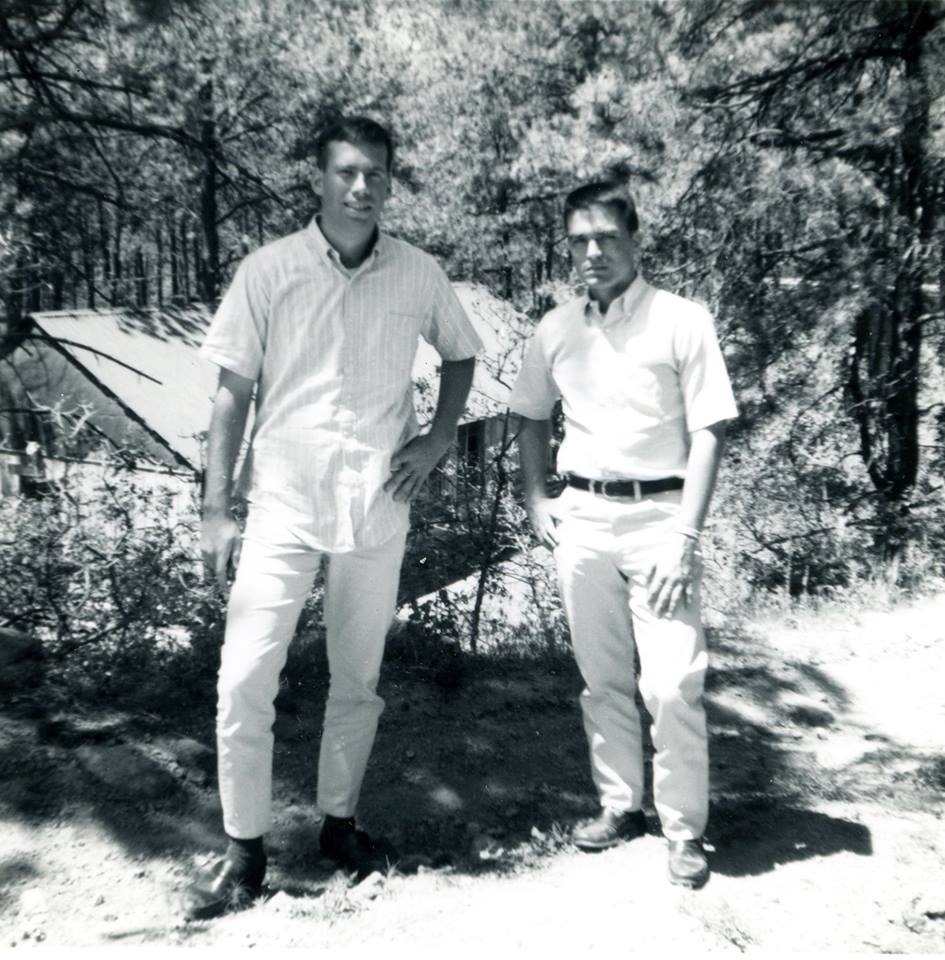
Elliot Prados was driving his red mustang and I was riding shotgun while Kenny Potter was in the back seat. We came down too fast and the mustang began to slide on the gravel road. Elliot had lost control. Back and forth the car slid but somehow staying on the road. I remember it all in slow motion. As the road followed a stream, ten to twenty feet below, on the left side, the car slid leftward over the embankment.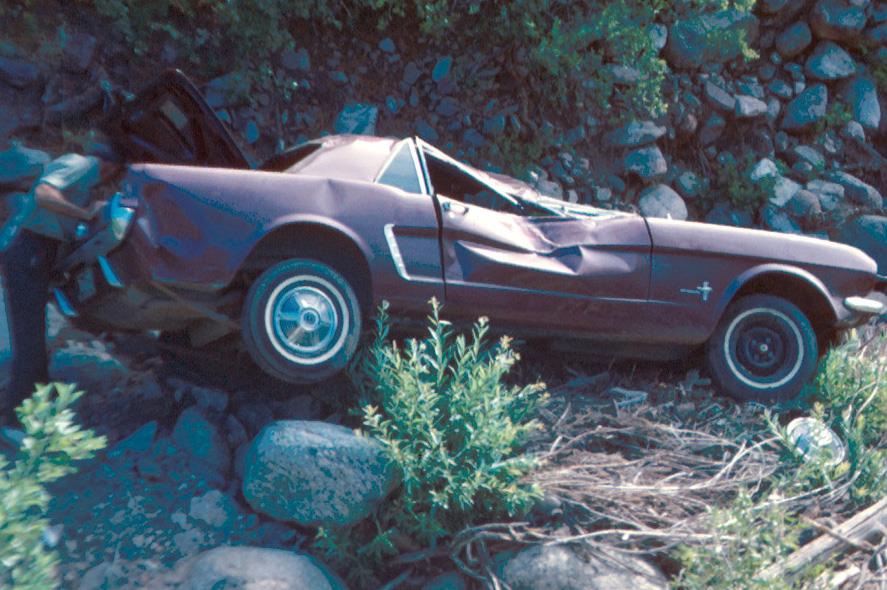
I passed out as the mustang rolled, landing right side up in the dry stream bed. When I came to, my head was through the windshield and covered in blood, and Elliot and Kenny were nowhere in sight. Elliot later told me that when he saw the blood, he thought I was already dead, so he and Ken climbed out of the wrecked car. Help came quickly and my wounds while bloody were only superficial. The Camp Managers Mr. Rovik and Dr. van den Bold put me in a hospital overnight. It was here that I thought up my mantra "Nothing 'really bad' ever happens to a Stoessell" which I have "thoughtfully" passed on to my son David. I qualified it with 'really bad' because I had missed out on an afternoon of drinking Coors beer. The picture of the wrecked mustang was taken by Tim LaTour of Ville Platte, LA, a good "Cajun" (although he says his ancestors came from France not Nova Scotia) friend throughout my life. Elliot and I are in the picture on the left. I don't know what happened to him in later years.
I worked for Union Oil Company of California in Lafayette, Louisiana, as an exploration geologist intern in the summer of 1967 between my junior and senior years at LSU. This was petroleum geology with great pay. I lived at home in Crowley and commuted each day to the Oil Center in Lafayette. Glenn Carpenter, a former LSU graduate student,and William Rogers worked at the company and mentored me. These two guys were great young geologists and good friends. They taught me the "creative," i.e., non scientific, aspects of drawing up oil prospects to sell to company management and to outside investors. At noon we would go to the Petroleum Club, drink heavily, draw up hypothetical prospects on napkins at the dining tables, and occasionally make it back to the office. Often after work, I would go to Evangeline Downs to bet on the horses. My most memorable experience was going to an offshore well platform when a well was being logged after drilling was completed. The raw excitement of being on a working oil rig is intoxicating. But being a petroleum geologist, while fun and interesting, was not intellectually satisfying enough for me to become one after graduation. Both Bill and Glenn later quit the company and became successful independent oil geologists, working up prospects and selling them to investors. I tend to think of investors in oil plays as usually being "suckers" but I think those who invested with Bill and Glen generally made their money. They were very good at finding oil.
I finished up my senior year at LSU, rooming off-campus, first wth Gene Wager (aka Raoul) and then with George Bilbe (aka Judge). The Judge and I lived at the Bon Vivant Apartments, a name I still chuckle over, remembering the Judge answering the phone in a singsong voice, saying "Bon Vivant". George had an old Ford Starliner that had character. Possibly due to divine intervention, the horn would start blowing in the middle of the night. George rarely woke up, but everyone else in the complex did, with predictable results. My girlfriend for part of my junior year had been Jeanette Duhe, whose younger brother AJ was later to be the NFL Defensive Rookie of the Year. She was a tall brunette, a beautiful, intelligent Cajun woman from Reserve, majoring in jounalism, who somehow put up with me (but not for long - lol). I remember once being with her at a wedding in Baton Rouge in the late afternoon, both of us drinking too much, and then driving afterwards on Hwy 190 that night to Mandeville. The police stopped us in Pontchatoula. I was obviously driving drunk and we were dressed in formal clothes. At the police station, they asked a few questions, laughed at us, and let us go, telling Jeanette to drive. That wouldn't happen today. Now, in my senior year, my sister Marilyn was in LSU graduate school and lived off campus with Jamie Manders, a beautiful, aspiring dental student. And I can now (50 years later) confess to unfulfilled lust, that culminated 10 years later in unnecessary dental work. Never allow your hormones to overcome common sense when a beautiful woman puts her fingers in your mouth and tells you, "Oh these aren't really bad but let's fill them anyway." (lol). As an undergraduate, Marilyn had two other roommates at LSU that later became important links in my life's journey: Pat Laird from Shreveport and Carla Pauls from Lake Charles. These ladies and Sharon Carlin, an undergraduate and secretary in the Geology Department, will forever lie gentle on my mind.
Those last two undergraduate semesters paved the way for my later career as an aqueous geochemist. New professors in their twenties had joined the department: Clyde Moore (carbonate petrologist), Ray Ferrell (clay mineralogist), Gale Billings (low-temperature geochemist), Stan Heath (theoretician), and Steve Kessler (geochemist) and their enthusiasm for research inspired me. I liked field work and also working with well logs but mapping surface outcrops or contouring subsurface formations on maps was not enough. I wanted to predict the formation of rocks, not just document their occurrence. As an elective, I took a course from Gale Billings in geochemistry, using Krauskopf's text, and learned that equilibrium thermodynamics could predict the formation of rocks, fluids, and gases. Thermodynamics fell into the general scope of physical chemistry and I only had the freshman chemistry courses. I lacked the prerequisites for physical chemistry but asked the chemistry professor to let me take the first course that dealt with thermodynamics and he agreed. I developed a life-long love of the subject. The subject evolved out of 19th century chemists trying to explain why not all of the energy input into performing work was available to do work, i.e., why the efficiency of an engine can not be 100%. The amount of unavailable energy for work is the basis for the concept of entropy. To this day, I can go to sleep at night, happily thinking of entropy and its significance.
Equilibrium thermodynamics is based on doing an overall energy balance in which the predicted assemblage of matter at a particular temperature T and pressure P is the assemblage with the lowest total energy. The prediction of this assemblage can only be done at equilibrium and ignores reaction kinetics which may make the attainment of the assemblage impossible within reasonable amounts of time. Finding the stable, equilibrium assemblage is usually done on computers by using numerical iteration to solve hundreds of non-linear equations. Under Earth surface PT conditions, equilibrium is often not obtained (except with some gases and with aqueous fluids) making the computed assemblage a limiting condition which is still useful to know. Because absolute energy values cannot be measured, energy of any form of matter is measured relative to the energy of other types of matter. Values of these relative energies have been tabulated at standard state conditions, generally at 25 degrees centigrade and 1 bar pressure and under particular circumstances, e.g., an element as a pure solid or a pure ideal gas or acting as an aqueous component in a hypothetical 1 molal solution. These "relative" energies can be used in balanced chemical reactions because the "unknown energy portions" cancel out. To use them at other PT points, they have to be modified by evaluating single and double integrals through PT space. They are further modified at the PT point of interest to account for changes in the environment from standard state conditions. I had taken 5 courses in calculus and above and enjoyed doing the integrals and solving the equations.
Over the semester break at Christmas in 1967, my parents attended a Savings and Loan Conference in San Francisco and I tagged along. San Francisco is such a unique and beautiful city, much like New Orleans. The city was the center of the hippie cultural revolution of the 1960s. I checked out Telegraph Avenue, Stanyon Street and San Francisco State College which was having a nude-in. The song "When You Come to San Francisco, Wear Flowers in Your Hair" was on the air waves. I so wanted to get out of the South with its rigid social structure and disappear into an open-minded community like the Bay community. Would it ever happen?
During the spring of 1968, Penn State offered an NSF Traineeship, starting in the fall of 1968, to research the physical chemistry of magmas for a Ph.D. in igneous petrology. I accepted, but I knew the Army would probably set back graduate school, and I subsequently never became an igneous petrologist. Igneous magmas and igneous rocks are probably the most interesting aspects of geology but the actual number of jobs available are mostly limited to the number of university departments. Getting a permanent job would have meant waiting for a professor to retire or die, not a promising future.
Return to Top
As I look back on my sophmore year, I realize how immature I was. My girlfriend Patsy Hopkins was a sweet girl and I neglected her. And she dumped me, rightly so, teaching me not to take for granted those that care for you. During the following summer (of 1966), I attended the 6 week LSU Geology Field Camp in the foothills of the Rockies, south of Pikes Peak and Colorado Springs and just west of Fort Carson. Field camp was an incredible experience for me. The exposed sediments were in hills and flat iron outcrops and were mostly Paleozoic and Mesozoic in age. We field-mapped the surface formations. We started our work each day, hiking up several hundred feet in elevation to the top of the "Saddle", and then listened to a short lecture. I loved hiking those foothills and learned the rudiments of surveying while becoming adept at using air photos with a steroscope to locate myself in the field. The latter was an essential skill (before gps became available) which I would later use when doing field work in Guatemala and Kenya. During that summer, we took off for a couple of camping field trips that took us all over the Colorado and New Mexico Rockies. I fondly remember John Rovik, the camp director, adding vermouth to omelets for us, early one morning in the Sangre de Cristo Mountains. Thinking back, I do not believe any experiences in my life have produced the emotions for me of being in the high mountains.
A decade earlier, in the 1950s, a group of (5?) LSU geology students were killed by lighting at the field camp. They apparently forgot Ben Franklin's experiments with lighting and crawled into a big metal culvert for cover during a rainstorm. But the danger was usually on the roads, not in the field. One sunny day in early July, we left the LSU Geology Field Camp to drive to Golden, Colorado, to visit the Coors Brewery.
I worked for Union Oil Company of California in Lafayette, Louisiana, as an exploration geologist intern in the summer of 1967 between my junior and senior years at LSU. This was petroleum geology with great pay. I lived at home in Crowley and commuted each day to the Oil Center in Lafayette. Glenn Carpenter, a former LSU graduate student,and William Rogers worked at the company and mentored me. These two guys were great young geologists and good friends. They taught me the "creative," i.e., non scientific, aspects of drawing up oil prospects to sell to company management and to outside investors. At noon we would go to the Petroleum Club, drink heavily, draw up hypothetical prospects on napkins at the dining tables, and occasionally make it back to the office. Often after work, I would go to Evangeline Downs to bet on the horses. My most memorable experience was going to an offshore well platform when a well was being logged after drilling was completed. The raw excitement of being on a working oil rig is intoxicating. But being a petroleum geologist, while fun and interesting, was not intellectually satisfying enough for me to become one after graduation. Both Bill and Glenn later quit the company and became successful independent oil geologists, working up prospects and selling them to investors. I tend to think of investors in oil plays as usually being "suckers" but I think those who invested with Bill and Glen generally made their money. They were very good at finding oil.
I finished up my senior year at LSU, rooming off-campus, first wth Gene Wager (aka Raoul) and then with George Bilbe (aka Judge). The Judge and I lived at the Bon Vivant Apartments, a name I still chuckle over, remembering the Judge answering the phone in a singsong voice, saying "Bon Vivant". George had an old Ford Starliner that had character. Possibly due to divine intervention, the horn would start blowing in the middle of the night. George rarely woke up, but everyone else in the complex did, with predictable results. My girlfriend for part of my junior year had been Jeanette Duhe, whose younger brother AJ was later to be the NFL Defensive Rookie of the Year. She was a tall brunette, a beautiful, intelligent Cajun woman from Reserve, majoring in jounalism, who somehow put up with me (but not for long - lol). I remember once being with her at a wedding in Baton Rouge in the late afternoon, both of us drinking too much, and then driving afterwards on Hwy 190 that night to Mandeville. The police stopped us in Pontchatoula. I was obviously driving drunk and we were dressed in formal clothes. At the police station, they asked a few questions, laughed at us, and let us go, telling Jeanette to drive. That wouldn't happen today. Now, in my senior year, my sister Marilyn was in LSU graduate school and lived off campus with Jamie Manders, a beautiful, aspiring dental student. And I can now (50 years later) confess to unfulfilled lust, that culminated 10 years later in unnecessary dental work. Never allow your hormones to overcome common sense when a beautiful woman puts her fingers in your mouth and tells you, "Oh these aren't really bad but let's fill them anyway." (lol). As an undergraduate, Marilyn had two other roommates at LSU that later became important links in my life's journey: Pat Laird from Shreveport and Carla Pauls from Lake Charles. These ladies and Sharon Carlin, an undergraduate and secretary in the Geology Department, will forever lie gentle on my mind.
Those last two undergraduate semesters paved the way for my later career as an aqueous geochemist. New professors in their twenties had joined the department: Clyde Moore (carbonate petrologist), Ray Ferrell (clay mineralogist), Gale Billings (low-temperature geochemist), Stan Heath (theoretician), and Steve Kessler (geochemist) and their enthusiasm for research inspired me. I liked field work and also working with well logs but mapping surface outcrops or contouring subsurface formations on maps was not enough. I wanted to predict the formation of rocks, not just document their occurrence. As an elective, I took a course from Gale Billings in geochemistry, using Krauskopf's text, and learned that equilibrium thermodynamics could predict the formation of rocks, fluids, and gases. Thermodynamics fell into the general scope of physical chemistry and I only had the freshman chemistry courses. I lacked the prerequisites for physical chemistry but asked the chemistry professor to let me take the first course that dealt with thermodynamics and he agreed. I developed a life-long love of the subject. The subject evolved out of 19th century chemists trying to explain why not all of the energy input into performing work was available to do work, i.e., why the efficiency of an engine can not be 100%. The amount of unavailable energy for work is the basis for the concept of entropy. To this day, I can go to sleep at night, happily thinking of entropy and its significance.
Equilibrium thermodynamics is based on doing an overall energy balance in which the predicted assemblage of matter at a particular temperature T and pressure P is the assemblage with the lowest total energy. The prediction of this assemblage can only be done at equilibrium and ignores reaction kinetics which may make the attainment of the assemblage impossible within reasonable amounts of time. Finding the stable, equilibrium assemblage is usually done on computers by using numerical iteration to solve hundreds of non-linear equations. Under Earth surface PT conditions, equilibrium is often not obtained (except with some gases and with aqueous fluids) making the computed assemblage a limiting condition which is still useful to know. Because absolute energy values cannot be measured, energy of any form of matter is measured relative to the energy of other types of matter. Values of these relative energies have been tabulated at standard state conditions, generally at 25 degrees centigrade and 1 bar pressure and under particular circumstances, e.g., an element as a pure solid or a pure ideal gas or acting as an aqueous component in a hypothetical 1 molal solution. These "relative" energies can be used in balanced chemical reactions because the "unknown energy portions" cancel out. To use them at other PT points, they have to be modified by evaluating single and double integrals through PT space. They are further modified at the PT point of interest to account for changes in the environment from standard state conditions. I had taken 5 courses in calculus and above and enjoyed doing the integrals and solving the equations.
Over the semester break at Christmas in 1967, my parents attended a Savings and Loan Conference in San Francisco and I tagged along. San Francisco is such a unique and beautiful city, much like New Orleans. The city was the center of the hippie cultural revolution of the 1960s. I checked out Telegraph Avenue, Stanyon Street and San Francisco State College which was having a nude-in. The song "When You Come to San Francisco, Wear Flowers in Your Hair" was on the air waves. I so wanted to get out of the South with its rigid social structure and disappear into an open-minded community like the Bay community. Would it ever happen?
During the spring of 1968, Penn State offered an NSF Traineeship, starting in the fall of 1968, to research the physical chemistry of magmas for a Ph.D. in igneous petrology. I accepted, but I knew the Army would probably set back graduate school, and I subsequently never became an igneous petrologist. Igneous magmas and igneous rocks are probably the most interesting aspects of geology but the actual number of jobs available are mostly limited to the number of university departments. Getting a permanent job would have meant waiting for a professor to retire or die, not a promising future.
Guatemala, Summer 1968
The Vietnam War was picking up steam when I graduated from LSU in 1968 with a BS in Geology. The Tet Offensive had occurred in January and February and the US was sending more and more troops to Nam. It was obvious to my generation that this unpopular war wasn't going to make South Vietnam a democracy. My draft deferment had ended with my undergraduate graduation. I was planning on attending graduate school at Penn State in the fall but I felt sure the Crowley draft board would draft me. I had a summer to kill so why not do something interesting. LSU Professor Steve Kessler asked if I wanted to do field geology in northern Guatemala, and I jumped at the opportunity. I went as a field assistant to Bill Josey who was mapping the Santa Barbara Quadrangle near Huehuetenango for his MS Thesis. Bill had been a Marine officer in Vietnam and had come back to school after being discharged. He was a competent guy to work with. Steve had been doing research in the area, studying the tectonic evolution of Central America and had previously had a number of graduate students working there. He was a dynamic professor.
Guatemala was a fascinating new world for me. The country sits over a subduction zone on the Pacific side and contains active conical volcanoes with numerous mountain ranges. Some of these ranges contained peaks equivalent in height to the Colorado Rockies but most were lower, reminding me of the Blue Ridge Mountains in North Carolina. Some of the scenery was spectacular such as Lake Atilan, probably the prettiest lake on the planet. Back in the 1960s, Americans were universally respected and I felt somewhat invincible. I used to imagine that if I got in trouble and a plane was overhead, all I needed to do was wave in the air and help would come (lol). I later found out that was a naive assumption.
Guatemalian society was class dominated with a large underclass of Mayan Indians, a middle class of Ladinos who were a Spanish/Indian mixture, and a Spanish upperclass. I disliked the way the Indians were pushed around, and Steve told me to keep my opinions to myself, reminding me we were guests in their country. The Indians were short people, generally thin, and incredibly tough. Their huts in the countryside lacked both chimneys and windows which made them very smokey and dark inside. To this day, the smokey smell around campfires often brings back to me images of those Guatemalian huts. The women were pretty when young but seemed to age quickly. They often wore the colorful traditional dresses of their culture. The men by contrast did not readily show their ages. They usually wore white shirts and white straw hats and always carried machetes. In villages the machetes were for show but in the field, they were just as good for chopping off the head of a fer-de-lance or bushmaster as for clearing paths.
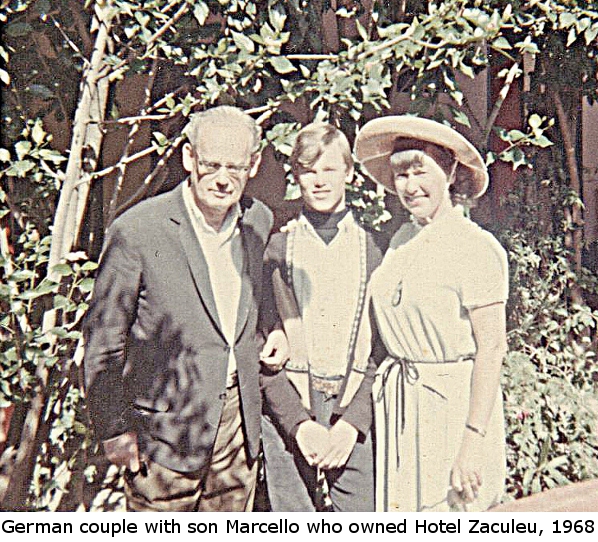
We stayed at the Hotel Zaculeu in Huehuetenango, run by a German family who had immigrated following World War II. Judy Kessler and Pat Josey, the wives of Steve and Bill, had come with us and we were like a family. I thought the hotel was a wonderful place to operate out of. 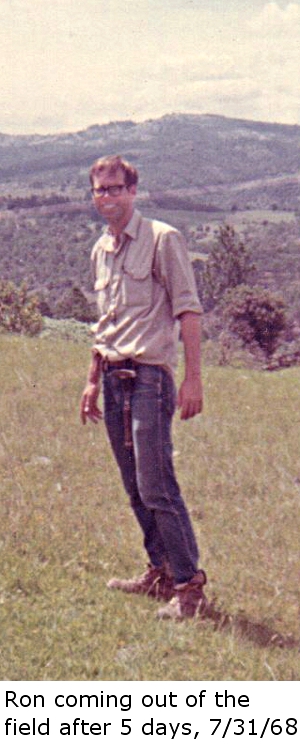
In the evening when I came in from the field, I was asked what I wanted to eat and my answer was always "todo" (everything). No matter how much I ate, my weight on a 6 ft 2&1/2 inch frame, dropped from about 185 to 160 pounds, from hiking up and down the hills.
The field work was split into 3 sessions with a break in Guatemala City between each session. In Guatemala City we stayed in a funky pension (small hotel), favored by academics and ex-patriates. It was so cool. The guy in the adjacent room had a pet ocelet. I would sit on my window ledge, high above the street bustle, soaking in the Spanish culture while eating a quart of ice cream. One day I became incredibly ill after taking a bus ride to the Pacific coast and spending the day eating donuts, drinking beer, and lying in the sun on the black sand beach. Never again would I put that combination together. I also went looking to meet Spanish girls and ended up going out on a date to a movie. We sat together with a chaperon, a new experience for me. But that changed for the better on later trips to Guatemala City after meeting Consuelo.
I met Consuelo Sanchez, my Guatemalian girlfriend, at the hotel in Huehuetenango. She was visiting with a group of girls from Guatemala City. Consuelo was so gorgeous, with the greenest eyes I have ever seen on a woman to go with her black hair and pale white complexion. Her ancestory was Castillian Spanish. My Spanish was very limited and while her English was better, we could never communicate deep thoughts. I would see her when we went to Guatemala City after field sessions. When I left, she asked me at the airport if I was ever coming back. I had to look into those beautiful eyes and truthfully answer "No." My life would have been far different if I had stayed in Guatemala to be with her. I wonder what would have happened in our relationship if my Spanish had been fluent? Would I have gone back to her? What happened to her?
The Santa Barbara Quadrangle was bordered on its eastern edge by the Pan American Highway, west of Huehuetenango in northwestern Guatemala. The field area measured about 10 by 16 miles and there were no roads into the interior, only well-worn Indian trails. We did an inital reconnaissance hike with Indian guides across the quadrangle, generally camping out in Indian huts. It was up and down hiking (1,500 ft elevation change) for 8 hours. I was so exhausted at the end of the first day that 300 feet from our destination hut, I sat down. Steve came back and said "Ron, you've got to make it for our reputation. The guides are watching." I laughed and said "Bury me here." By the end of the summer, I was in the best physical shape of my life. During the inital reconnaissance hike, we stayed one night with a Peace Corp Volunteer, and there we learned of Bobby Kennedy's assassination in Los Angeles on June 5th by short wave radio.
Once we began the field work out of Huehuetenango, we generally needed to hike 2,500 feet down in elevation to reach the bottom of the Rio Cuilo valley and its numerous tributaries that cut through the interior of the field area. So to get back, we had to make that 2,500 ft climb to the road which was a tough hike at the end of a day. 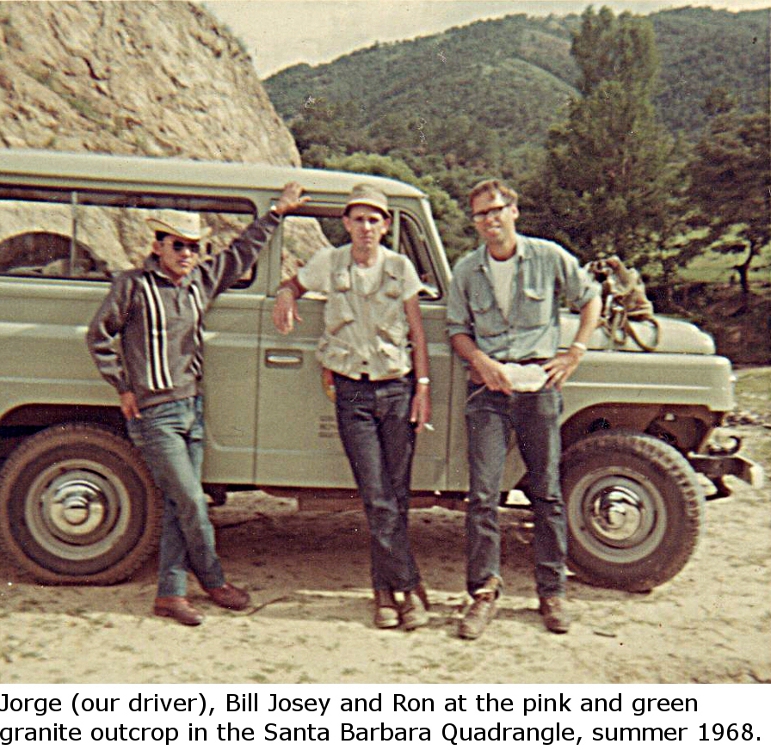
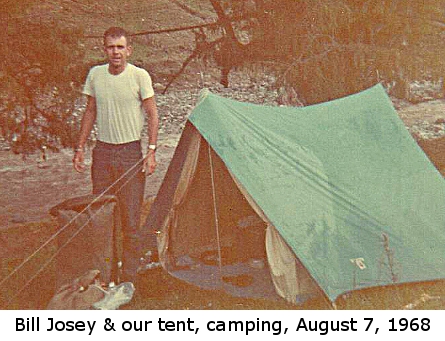
The rivers were usually crossed with rope bridges; although, we forded them if bridges were not available. To get the work done, Bill and I would often camp for several days, setting up a base camp, and splitting up each day to map the surrounding rock outcrops, record data including orientation of beds (strikes and dips), and take rock samples. Every day was an adventure for me, just rounding a bend in the trail and coming upon a waterfall was such a delight. I was often lost and would climb to the top of the nearest ridge and employ steroscopic images of aerial photos to locate myself. The feeling of competence from being able to find a precise location relative to the nearest geomorphic feature or clump of trees was exhilirating. And then there was the never ending sense of history in the area. I once hiked through an isolated village in which the inhabitants looked to be pure European Spanish, living back in the 18th century. I still wonder about the history of that village. One afternoon, I started back late and didn't finish the climb to the road (Pan American Highway) before dark, spending a sleepless, rainy night, wrapped in my pancho, by the trail. Bill was waiting for me early next morning, blowing the horn of the land cruiser, when I topped the hill. A month later, I learned what he feared could have happened to me.
In early August, Bill Josey and I had set up a base camp at a little cafe finca (coffee farm) at the intersection of two rivers. On the first morning (August 6) I was hiking up a rocky tributary stream, between two ridges that led back to the river junction where our base camp was located. While sampling rocks, I looked up at the ridge top to my right, 400 feet to 500 feet above me. There were flashes of sunlight which had to be coming off of the machetes that the local Mayan Indians carried. By early afternoon, I reached the head of the stream, took my last rock sample and wrote my field notes. It was time to hike back to the base camp to meet up with Bill Josey. It would take an extra hour to go back the way I came, so I decided to climb to the top of the ridge and hike down it. The weather was cool and it would be much easier walking on the ridge top. I reached the top of the ridge and started my hike, passing an Indian house to the right of the path. A group of about 20 Indians were out front, drinking and carrying on. These Indians were only about 5 feet tall, but tough and hardy and carrying machetes. I waved and continued on. I got maybe a hundred feet before they were all around me, asking questions in an Indian dialect which I couldn't understand. My Spanish wasn't great and neither was their Spanish. I took out my tourist visa and held it up to show them my credentials. A dozen hands grabbed it and suddenly it was in pieces.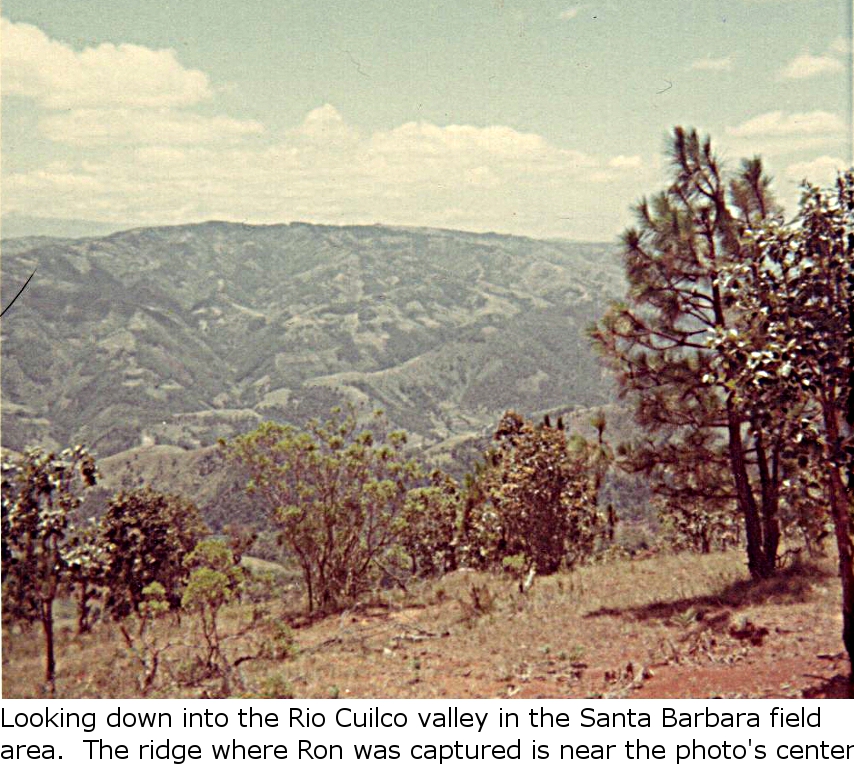
The loss of my visa was serious because I didn't have a passport. Meanwhile, the voices of the Indians rose and I turned to get out of there, moving up the path along the ridge top. But they were quickly on me, like a swarm of midgets. I was tied up with one end of a long rope and dragged down a path through cornfields that led down the ridgeside. I tried to make it clear that I would come willingly. We got about a couple of hundred feet below the ridge top to a small clearing with two whitewashed huts and a large standing stake between them. I did not want to be put in the huts because they lacked windows or a chimney and were forbodingly dark inside. Instead they tied the other end of the rope to the stake and I sat down in front of it, looking down the hillside. Sitting there, a great argument arose over what to do with me. One Indian who was really drunk and standing over me, picked up a large rock and threatened to bash my head in while another drunk Indian restrained him. Perhaps they were doing the good cop bad cop routine (lol). I didn't realize it at the time but the former, the Bad Indian, was to become the prosecuting attorney and the latter, the Good Indian, was to be my defense attorney. All I actually knew was that my future looked bleak. I worked slowly at freeing my tied hands (behind my back) as I sat, thinking I would make a run for it and let it end however it would. But after a half hour, a line of Indians slowly appeared, coming up a trail from below, on my right. One wore an elaborate headdress and must have been the local chief. The Indians untied the rope to the stake and we moved down about 20 feet where I could sit in front of the Chief. They took out my bag of rock samples and carefully went through them. Perhaps they thought I was looking for gold and possibly stealing from their territory. The arguments went back and forth between the Bad Indian on my right, the Good Indian on my left, and the Chief in front of me. Not understanding the arguments, all I could do was smile and look innocent. But by a stroke of genius, the Good Indian made a closing argument that won me my freedom. He picked out a coarse-grained gneiss, a tough metamorphic rock, opened his mouth and bit off a chunk, chewing it carefully and smiling, daring the Bad Indian to do likewise. I remember the teeth of the Good Indian were in bad shape, perhaps he had done this trick before. The Chief was impressed. He smiled broadly and stood up. Everyone stood up and my hands were untied. I gathered my things, looked into my wallet and asked "Donde esta me diecisiete quetzales?", i.e., Where is my 17 dollars? The crowd fell silent with everyone looking at each other. Whoever had taken the money had kept it for himself, and 17 quetzales was the pay for 17 days of work. A great uproar arose. I realized my money was "permanently" gone, and I needed to get out of there. So I turned, heading back up the ridgeside, through the corn fields, to the ridge top. As I walked, I heard footsteps coming up behind me, and turning around, there was was the Good Indian. We looked at each other and he reached down and grabbed an ear of corn off a stalk, handing it to me. I don't know why he worked so hard to save me but he had, and now he was telling me that he was sorry the incident had happened. I smiled back at him, took the ear of corn and shook his hand The handshake bridged our cultural differences. I turned and headed back up to the ridge top, leaving him standing in the corn field. That night I cooked the ear of corn on the campfire and ate it while telling Bill what had happened. We stayed out working that week but avoided the capture area.
The story didn't end here, because our professor Steve Kessler was worried he would have trouble there next summer. He took Bill and me to the governor's office in San Marcos and received a signed paper authorizing the arrest of the Indians (see Capture Note). Steve hired two local Chiefs to go with us and serve the warrants, and we went back in. Our Chiefs served a dual purpose because Steve paid them to also be the porters carrying our supplies. On the topographic map, the name of the location where I had been held was called El Zapote (zapote or sapote is Spanish for a native fruit similar to a mango). When we got to the two white-washed huts with the stake standing between them, on the ridgeside, they were abandoned. The Indians knew we were coming. I wish I could meet the Good Indian again and share a drink with him. And I hope he had a good life. The world is much more dangerous today than 50 years ago. Going back to El Zapote today would probably put me in the middle of a never-ending civil conflict, but I would like to go back.
Return to Top
The field work was split into 3 sessions with a break in Guatemala City between each session. In Guatemala City we stayed in a funky pension (small hotel), favored by academics and ex-patriates. It was so cool. The guy in the adjacent room had a pet ocelet. I would sit on my window ledge, high above the street bustle, soaking in the Spanish culture while eating a quart of ice cream. One day I became incredibly ill after taking a bus ride to the Pacific coast and spending the day eating donuts, drinking beer, and lying in the sun on the black sand beach. Never again would I put that combination together. I also went looking to meet Spanish girls and ended up going out on a date to a movie. We sat together with a chaperon, a new experience for me. But that changed for the better on later trips to Guatemala City after meeting Consuelo.
I met Consuelo Sanchez, my Guatemalian girlfriend, at the hotel in Huehuetenango. She was visiting with a group of girls from Guatemala City. Consuelo was so gorgeous, with the greenest eyes I have ever seen on a woman to go with her black hair and pale white complexion. Her ancestory was Castillian Spanish. My Spanish was very limited and while her English was better, we could never communicate deep thoughts. I would see her when we went to Guatemala City after field sessions. When I left, she asked me at the airport if I was ever coming back. I had to look into those beautiful eyes and truthfully answer "No." My life would have been far different if I had stayed in Guatemala to be with her. I wonder what would have happened in our relationship if my Spanish had been fluent? Would I have gone back to her? What happened to her?
The Santa Barbara Quadrangle was bordered on its eastern edge by the Pan American Highway, west of Huehuetenango in northwestern Guatemala. The field area measured about 10 by 16 miles and there were no roads into the interior, only well-worn Indian trails. We did an inital reconnaissance hike with Indian guides across the quadrangle, generally camping out in Indian huts. It was up and down hiking (1,500 ft elevation change) for 8 hours. I was so exhausted at the end of the first day that 300 feet from our destination hut, I sat down. Steve came back and said "Ron, you've got to make it for our reputation. The guides are watching." I laughed and said "Bury me here." By the end of the summer, I was in the best physical shape of my life. During the inital reconnaissance hike, we stayed one night with a Peace Corp Volunteer, and there we learned of Bobby Kennedy's assassination in Los Angeles on June 5th by short wave radio.
In early August, Bill Josey and I had set up a base camp at a little cafe finca (coffee farm) at the intersection of two rivers. On the first morning (August 6) I was hiking up a rocky tributary stream, between two ridges that led back to the river junction where our base camp was located. While sampling rocks, I looked up at the ridge top to my right, 400 feet to 500 feet above me. There were flashes of sunlight which had to be coming off of the machetes that the local Mayan Indians carried. By early afternoon, I reached the head of the stream, took my last rock sample and wrote my field notes. It was time to hike back to the base camp to meet up with Bill Josey. It would take an extra hour to go back the way I came, so I decided to climb to the top of the ridge and hike down it. The weather was cool and it would be much easier walking on the ridge top. I reached the top of the ridge and started my hike, passing an Indian house to the right of the path. A group of about 20 Indians were out front, drinking and carrying on. These Indians were only about 5 feet tall, but tough and hardy and carrying machetes. I waved and continued on. I got maybe a hundred feet before they were all around me, asking questions in an Indian dialect which I couldn't understand. My Spanish wasn't great and neither was their Spanish. I took out my tourist visa and held it up to show them my credentials. A dozen hands grabbed it and suddenly it was in pieces.
The loss of my visa was serious because I didn't have a passport. Meanwhile, the voices of the Indians rose and I turned to get out of there, moving up the path along the ridge top. But they were quickly on me, like a swarm of midgets. I was tied up with one end of a long rope and dragged down a path through cornfields that led down the ridgeside. I tried to make it clear that I would come willingly. We got about a couple of hundred feet below the ridge top to a small clearing with two whitewashed huts and a large standing stake between them. I did not want to be put in the huts because they lacked windows or a chimney and were forbodingly dark inside. Instead they tied the other end of the rope to the stake and I sat down in front of it, looking down the hillside. Sitting there, a great argument arose over what to do with me. One Indian who was really drunk and standing over me, picked up a large rock and threatened to bash my head in while another drunk Indian restrained him. Perhaps they were doing the good cop bad cop routine (lol). I didn't realize it at the time but the former, the Bad Indian, was to become the prosecuting attorney and the latter, the Good Indian, was to be my defense attorney. All I actually knew was that my future looked bleak. I worked slowly at freeing my tied hands (behind my back) as I sat, thinking I would make a run for it and let it end however it would. But after a half hour, a line of Indians slowly appeared, coming up a trail from below, on my right. One wore an elaborate headdress and must have been the local chief. The Indians untied the rope to the stake and we moved down about 20 feet where I could sit in front of the Chief. They took out my bag of rock samples and carefully went through them. Perhaps they thought I was looking for gold and possibly stealing from their territory. The arguments went back and forth between the Bad Indian on my right, the Good Indian on my left, and the Chief in front of me. Not understanding the arguments, all I could do was smile and look innocent. But by a stroke of genius, the Good Indian made a closing argument that won me my freedom. He picked out a coarse-grained gneiss, a tough metamorphic rock, opened his mouth and bit off a chunk, chewing it carefully and smiling, daring the Bad Indian to do likewise. I remember the teeth of the Good Indian were in bad shape, perhaps he had done this trick before. The Chief was impressed. He smiled broadly and stood up. Everyone stood up and my hands were untied. I gathered my things, looked into my wallet and asked "Donde esta me diecisiete quetzales?", i.e., Where is my 17 dollars? The crowd fell silent with everyone looking at each other. Whoever had taken the money had kept it for himself, and 17 quetzales was the pay for 17 days of work. A great uproar arose. I realized my money was "permanently" gone, and I needed to get out of there. So I turned, heading back up the ridgeside, through the corn fields, to the ridge top. As I walked, I heard footsteps coming up behind me, and turning around, there was was the Good Indian. We looked at each other and he reached down and grabbed an ear of corn off a stalk, handing it to me. I don't know why he worked so hard to save me but he had, and now he was telling me that he was sorry the incident had happened. I smiled back at him, took the ear of corn and shook his hand The handshake bridged our cultural differences. I turned and headed back up to the ridge top, leaving him standing in the corn field. That night I cooked the ear of corn on the campfire and ate it while telling Bill what had happened. We stayed out working that week but avoided the capture area.
The story didn't end here, because our professor Steve Kessler was worried he would have trouble there next summer. He took Bill and me to the governor's office in San Marcos and received a signed paper authorizing the arrest of the Indians (see Capture Note). Steve hired two local Chiefs to go with us and serve the warrants, and we went back in. Our Chiefs served a dual purpose because Steve paid them to also be the porters carrying our supplies. On the topographic map, the name of the location where I had been held was called El Zapote (zapote or sapote is Spanish for a native fruit similar to a mango). When we got to the two white-washed huts with the stake standing between them, on the ridgeside, they were abandoned. The Indians knew we were coming. I wish I could meet the Good Indian again and share a drink with him. And I hope he had a good life. The world is much more dangerous today than 50 years ago. Going back to El Zapote today would probably put me in the middle of a never-ending civil conflict, but I would like to go back.
Penn State, Fall 1968
At the end of the summer, I drove to State College in central Pennsylvania to start graduate school at Penn State. The campus was huge, bigger than LSU, and the girls were just as beautiful. Unlike Baton Rouge where LSU is located, State College is truly a college town, existing only because of the university. I do remember the cops were not friendly to a southern boy, and I had to remind them how they would be treated if they came South (lol, that actually happened and I didn't get arrested). I roomed with another geology graduate student in an apartment in nearby Boalsburg, overlooking a Civil War cemetery. My roommate was older and had just returned from doing field geology work in Africa. He told great stories of East Africa, inspiring me to want to visit the dark continent. He was also an incredible drinker and proud of it. The guy could drink all night without showing any effects, an attribute he impressed on me as being the "true" mark of a field geologist. If he isn't dead of alcohol consumption by now, I bet he has taken the 12 steps of AA, squealing his life story to standing ovations at their meetings.
I enjoyed the classes, particularly one dealing with crystal chemistry. My interests however were more in aqueous fluids than in igneous magmas, and Don Langmuir, their future aqueous geochemist, had yet to join the faculty. On weekends I took off and drove to the Jersey shoreline, sleeping in my car, and mulling my future while watching the waves break against the shore. I knew I was marking time. The Crowley draft board was run by Rita Nichelson, a Cajun woman with a reputation for drafting all the non-Cajun boys first. I'm sure her attitude was because of the discrimination that Cajuns had received in the past. And I was on their short list. In mid-October, just before midterms, my father called me to relay the information that I would be drafted at the end of the month. Well I wasn't about to run off to Canada. I took my midterms first and then formerly dropped out of graduate school, and drove back to Mandeville. I decided to "jump the gun" on the Draft Board and enlist for two years. Two years of service were not enough for me to pick my military job or assignment but I didn't want to enlist for 3 years and have to serve that extra year. I just wanted to get it over with. My worry about combat was coming back crippled. Other than that, I figured this would be a once in a lifetime experience, and I would "play the hand" that was dealt to me.
Return to Top
US Army, Fall 1968 - Fall 1970
I enlisted for two years in the US Army on October 18, 1968, at the Processing Center in the Old Customs Building on Canal Street in New Orleans. I remember little of that day except for the depression of knowing that for the next two years, my life would be controlled by the government. A military bus took me and the other new recruits that afternoon to Ft. Polk in Southwest Louisiana, to begin 8 weeks of Basic Training. That night, while standing outside the mess hall at Fort Polk, a company of soon-to-graduate troops from AIT, Advanced Infantry Training, came marching by, singing cadence with their rifles smartly on their shoulders. The moonlight flashed on the bayonets and they were an impressive sight. Perhaps there was more to the military than I had thought.
Basic Training in the Army is designed to make each individual an integral part of a team, to not think independently but to accept orders without question. My drill sergeant used physical training while continuously yelling at the men with the intent of breaking any independent spirit. The winter Louisiana rain and temperatures in the thirties made field training miserable. Each morning, upon waking, I would tell myself how "Short" I was, i.e., how many days left to serve in the Army. The first morning, I was 729 days Short. This was eight bad weeks but I knew that things would never be like this again while serving in the Army. No NCO or officer would dare treat his men like a drill sergeant and then try to lead them into combat.
At the end of basic training in late December, my orders came down for Advanced Infantry Training (AIT). My MOS (military occupation) was to be 31B20, a radio mechanic. I would still be a "grunt" in the field but with a better chance of survival in Nam than being a rifleman. I was being sent to Fort Benning in Columbus, GA for training. I didn't have to report there until early January, so I went home for Christmas leave. Dad was dying of cancer although luckily the family, including him, didn't know it. Thinking back, those were bitter-sweet holidays.
Fort Benning was full of "gung ho" recruits. This was the training area for jumpers, i.e., training to be paratroopers, also for Ranger School, and OCS, Officer Training School. I was told I could go through OCS if I extended my length of service to 4 years, but not a chance I would take that offer. The Army Corp of Engineers was headquartered here and I did go by to see if they wanted to use me because of my training as a geologist. They had heard that request before and laughed at me. Oh well, it didn't hurt to try.
Radio mechanic school was interesting. The BS of Basic Training was greatly diminished. My rank was a PFC when I graduated on March 24, 1969, from the school. And I remained at Ft. Benning through that summer, serving as an assistant instructor for new groups coming through. This was like a normal military assignment without any of the BS of Basic Training or AIT. In the evenings, my time was free and I took a three month Spanish Class. I had driven my car to Fort Benning so I could leave the base with a pass. One evening offbase I met Wilma Waesche, my girl friend. She was tall, beautiful and wonderful. 
Wilma was older (by about 12 years) and definitely wiser. We spent a lot of time exploring the area, from the Auburn campus in Alabama, Callaway Gardens in south Georgia, 6 Flags in Atlanta, to the white beaches in the Florida Panhandle. 
I was falling in love with her, but I knew the age difference would become a problem, and I would soon be sent away to my permanent active duty post. And during that summer, I woke up one night in the barracks with a terrible pain in my side. I had watched my father suffer through kidney stone attacks and guessed I was having one. I drove to the base hospital, checked myself in, and with enough morphine, eventually passed out. The next morning, the stone had shifted and the pain was gone. The surgeon told me the stone was too large to pass and he would have to cut it out. The surgery wasn't bad and afterwards, I went home on convalescent leave and got to see Dad again.
In September, the orders for my group of assistant instructors came down for our permanent duty stations. Wow, instead of going to fight in Viet Nam or freeze in South Korea, we were being sent to Europe. How lucky could we be! We were sent home on leave and told to report to Fort Dix in New Jersey. Hurricane Camille had just devastated South Mississippi in August. I drove through the area on my way home and had never seen damage like this, not until 36 years later when Hurricane Katrina passed through. This was the last time Dad would be healthy when I was with him.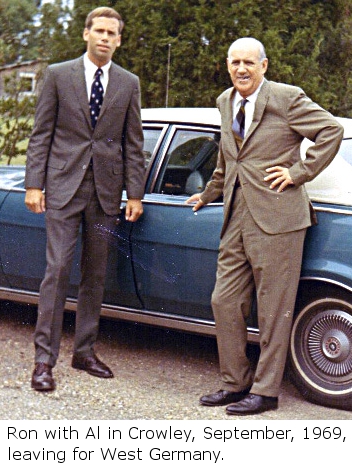
On the way to Fort Dix, I stopped to spend time with Wilma in Georgia and subsequently arrived late at Fort Dix. Everyone in my group who arrived on time was sent to Italy for duty on US Air Force bases. I was sent to Frankfort, West Germany, to be processed for duty on one of the US Army bases. Italy would have been an incredible assignment, but I would not trade it for the time spent with Wilma. She had the sweetest soul of any woman I ever met. She subsequently married Joesph Portman and lived in West Palm Beach in Florida. Sixty year later I found her online obituary. She died in 2019 from complications of a stroke suffered in 2015. Her death shook me and I cried after contacting Joe. I wished that I had been able to tell her goodbye.
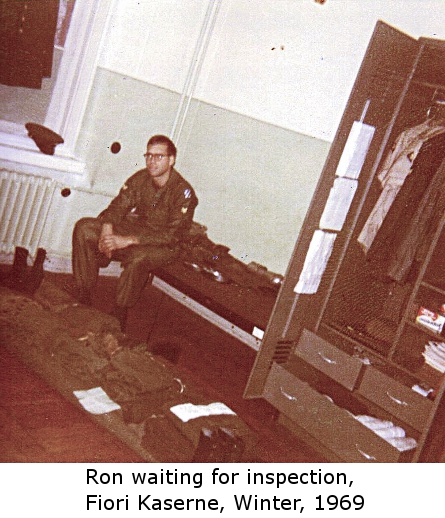
In Frankfort, I received orders to report to Headquarters Company, 1st Battalion, 4th Infantry Regiment, 3rd Infantry Division in Aschaffenburg or Aburg as we called it. Aburg was southeast of Frankfort and northwest of Wurzburg in the Main River Valley. The valley was known for its Riesling grapes and some of my more enjoyable times offbase were spent drinking goblets of white wines (Riesling, Auslase, and Spatlaser) in the local Gasthauser. My Aburg base was the Fiori Kaserne (Barracks), a pre-WWII German Army base with barracks that were better built than any I had seen in the States. In the evenings, to forget that we were in the military, the senior NCOs often drank alcohol to excess and the rest of us got stoned on weed.
I was assigned to the communications platoon and was promoted on 2/14/70 to Specialist 5 (E5 rank), equivalent to a sergeant and later served as the acting platoon leader. Instead of 3 bars on my shoulder, a Spec 5 had a patch showing an eagle under a bar, commonly called a "chicken patch." So a Spec 5 was a chicken sergeant (lol). My best friend in the platoon was William (Slant Eyes Bill) Yee, a Chinese guy, another E5, who called whites and blacks "Round Eyes", and we often explored the surrounding area together. Reginald Graf, a cool African American was the other E5 in the platoon and the three of us eventually ran the platoon. We had drivers, repairmen, linemen, jeeps, and even an armored personnel carrier (APC) for use in the field. We made sure the equipment assigned to the platoon and the general communications equipment within the battalion were maintained and ready to be used in field exercises. 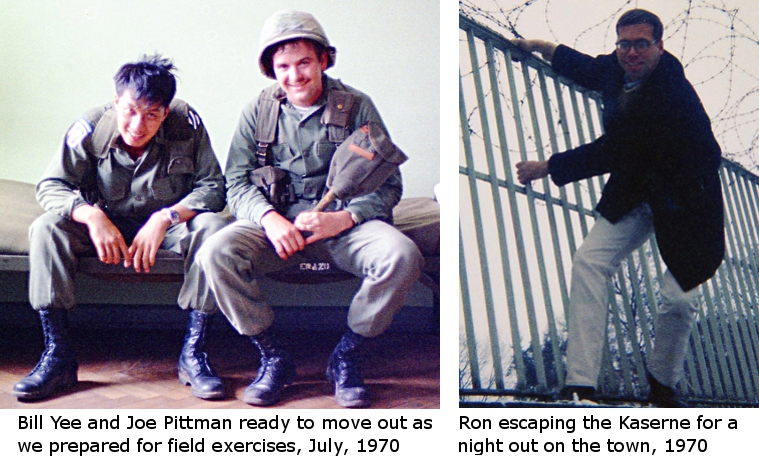
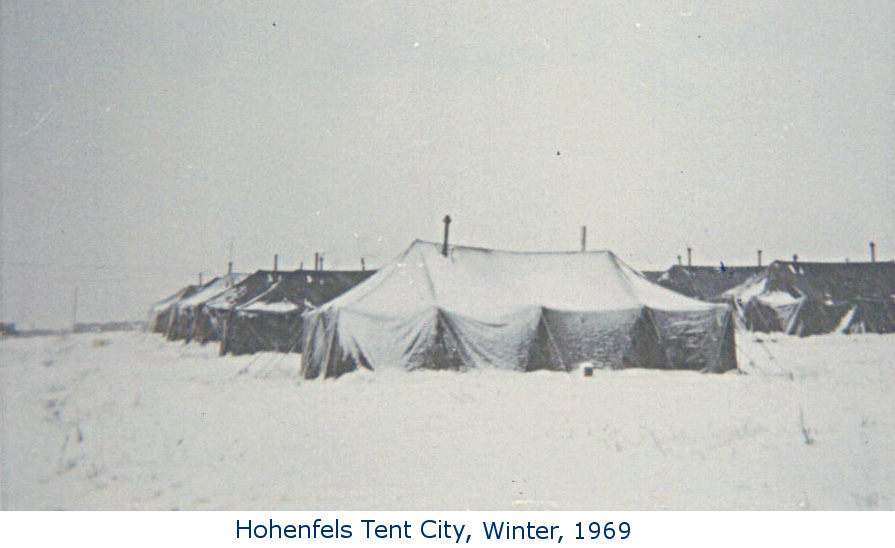
As an acting platoon sergeant, my biggest problem was weeding out incompetent people and trading them for other personnel from other platoons. This was a game of musical chairs, relying on the ignorance of other platoon sergeants as to who was worse, their incompetent soldiers or my incompetent soldiers. I remember one trade where I mistook intelligence for competence and suffered from it. Army life attracts people (lifers) who often can not make it on the outside and we had to work around them. The actual repair work of the communication equipment was fun but not difficult because the equipment was built out of modules. Find the bad modules, switch them out with good modules, and everything would be working again.
The field exercises were big deals, with long convoys of vehicles on the autobahn heading out to Wildflecken in Bavaria and to Hohenfels and Grafenwoehr near the Czech border. Once there, my platoon would set up the communication network for the battalion and then repair equipment while we camped out in tents. In the winter of 1969, the field areas were cold and muddy and life was miserable. But in other seasons, the countryside was really pretty and I enjoyed it, particulary in the fall when the cherry trees were bearing fruit.
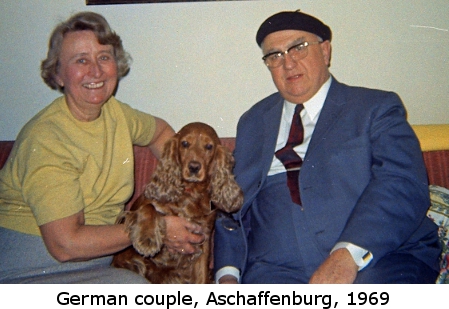
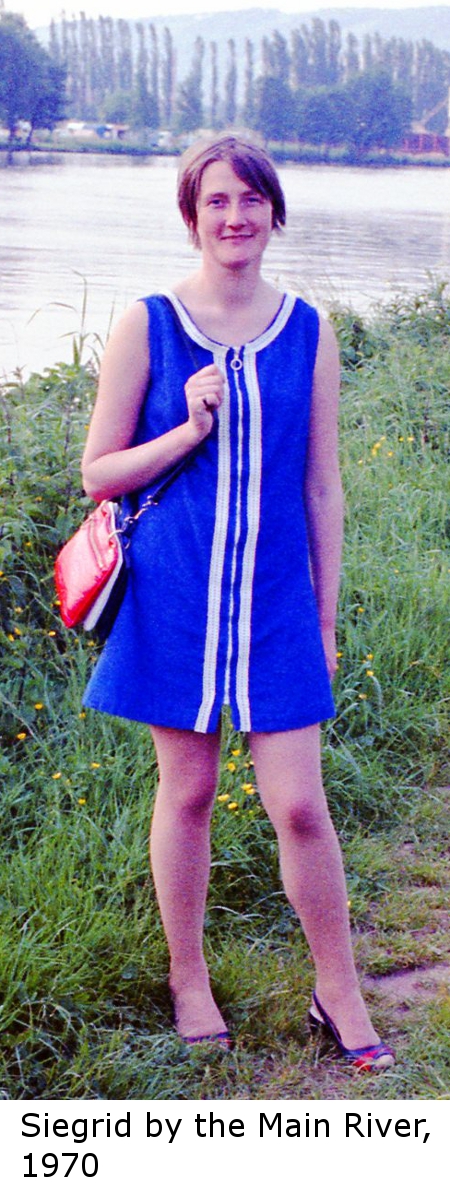
That fall, as part of a military program with the local public, a hospitable elderly German couple invited me over for dinner each week where I was introduced to such delicacies as beef tartare, i.e., raw beef. They were sweet and kind and tried to make me feel at home in a foreign land. I had previously taken a year of German at LSU and enrolled in an evening German course offered by the Army. Dorothea LaGraff, a statuesque, tall, pretty, very intelligent German blonde was the class instructor. Dorothea introduced me to Siegrid, a German English teacher in the local high school who became my girlfriend and acted as my tour guide. But there wasn't much chance of learning German from her because Siegrid's English was perfect, with the British accent taught in the local schools. Dorothea was already friends with a number of my military friends, and I often went with them in the evenings to her home. We drank wine, smoked weed, and had long discussions of politics and art. I remember the first evening asking Dorothea "Verstehen Sie memories," i.e., Do you understand memories. My good military friend Charles Taplin tapped me on the shoulder and said "Ron, She can speak better English than you." 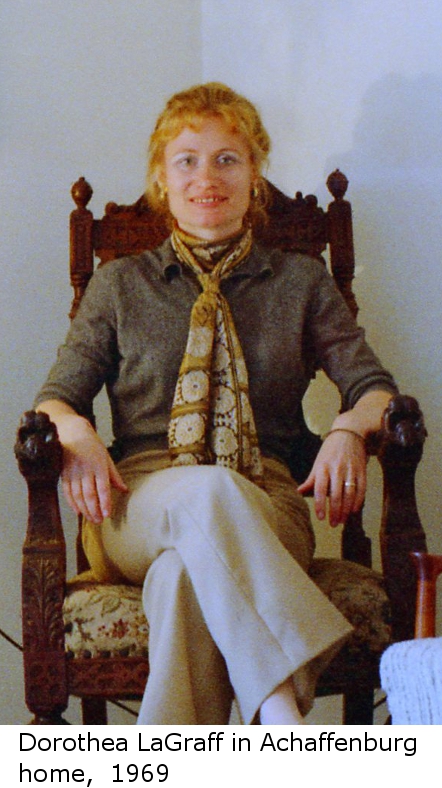
Dorothea just laughed in delight. She influenced me greatly, opening my eyes to art and German literature (Hermann Hesse, in particular) and introduced me to German girls. She was turning 33 that year, and her inquistive spirit is in me to this day, 46 years later. As a child, Dorothea had survived the fire bombing of Dresden at the end of the war when the train she was on was diverted by chance away from the City. Her father had not been a Nazi supporter and was picked by the Allies to serve as a judge after the war in some of their trials, a not popular civic duty with the German people. Like me, many of her American friends remained friends after their discharge. She was a pharmacist and her husband Dieter was a travel agent, and Dorothea traveled everywhere. For years Dorothea would fly to New York City, San Francisco, etc, to visit friends, go to plays and shop. (I never knew when she would pop up!) Her home was decorated in the Bauhaus tradition (form follows function) with Charles Eames and Barcelona chairs, an arc floor lamp, etc, complete with a zebra skin rug on the floor. I will admit to smoking considerable amounts of hash while lying on that zebra-skin, i.e., eventually the zebra would get up and gallop. On those evenings I sometimes felt like I was living "Easy Rider." 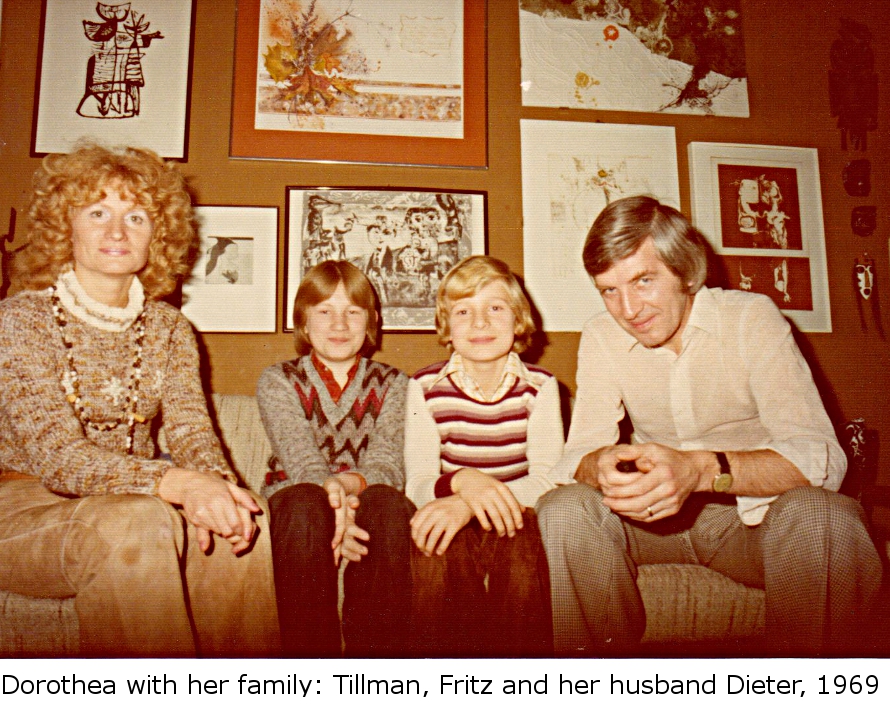
In the late night, we would make our way back to the Fiori Kaserne, climb over the high iron fence and roll into our bunks, confident that Uncle Sam would take care of us in the morning. This wasn't a bad life for a guy turning 23, almost as good as college.
That summer in 1970, my sister Marilyn married Karl Seifert, a German national. After graduation from LSU in 1967 with BA degrees in German and Spanish, Marilyn had started graduate school at LSU. She took time off to attend the University of Munich on a Deutscher Akademischer Austauschdienst Stipudiun. I think she met Karl while hiking in the Alps. Marilyn had been going back and forth to Europe since high school when she was an AFS (American Field Service) exchange student in Kitzbuhel, Austria. Usually, she always had an American boyfriend tagging along or meeting her there, but Karl was now in the picture. Marilyn came back to finish her MA degrees in Spanish and German, and Karl came to the States to meet our family. He failed to impress my parents (lol). I'm sure they realized this would eventually happen because of her attachment for Europe. They were distraught over the thought of their daughter living permanently in Europe, far away from home if she married Karl. Marilyn had received a Rotary Grant to study Spanish in Valparaisco, Chile, but turned it down to marry Karl and live in Europe. 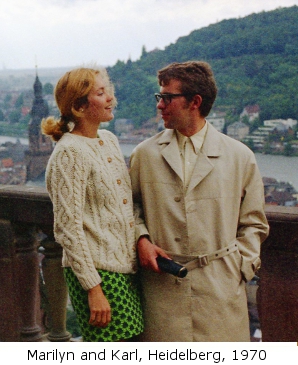
Dad had recently had a Grand Mal seizure in his office in the Acadia Savings and Loan. He was obviously ill and undergoing tests, but we didn't realize how serious his conditon was. He would live only another 5 months after their wedding. Karl and Marilyn decided to get married in West Germany near Rosenheim, Karl's hometown, in a very picturesque little Alpine community near the Austrian border where Karl's parents were building a retirement home there.
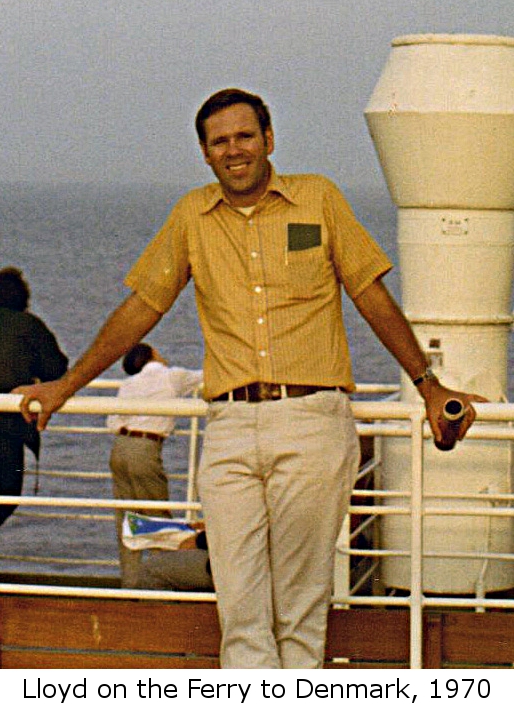
Lloyd was divorced from his first wife Carolyn Bergen and he took leave from the Air Force to fly to Europe at the end of July. I think he was a Captain at the time. I also took military leave so we could tour a few countries before ending up at Rosenheim for the wedding. I had earlier bought Hermina (think Hermann Hesse), my VW bug, from one of my buddies being discharged and that was our tour vehicle. I don't remember too much about our travels other than the French border guards forcing me to unpack Hermina when we crossed into France (typical French attitude), the beautiful Danish women in Tivoli Gardens in Copenhagen, and two American women Lloyd picked up in Denmark (that handsome devil) who later showed up at Marilyn's wedding. Lloyd reminded me that in Paris we bought French champagne for the wedding which the Germans did not appreciate. They wanted Russian champagne (lol). The wedding on August 13th was beautiful and I drank way too much French champagne. Karl's parents (Maria and Karl) and relatives were very friendly to the Amis (German slang for American soldiers). Joan Prieto, Uncle Clay's daughter was there with her military boyfriend Robert (Bob) Doolittle whom she later married. She, like her older sister Mary had previously done, was running a military service club on one of the Army bases in West Germany. A month later, Hermina threw an engine rod one night near Heidleberg on the autobahn, not too far from the base where Joan worked. Bob bought Hermina's dead body, and I hope she was buried properly.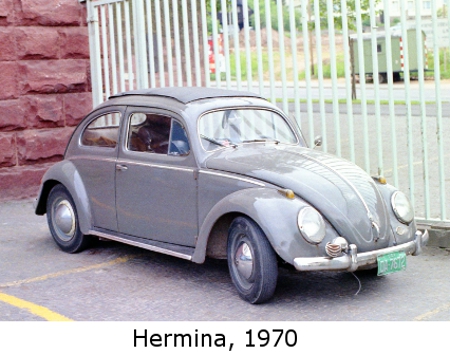
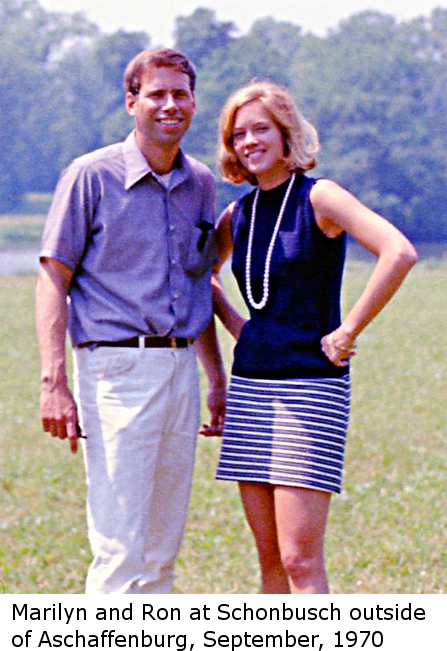
I was growing "Short." My discharge date was in October and I didn't want to go back to the "World," military slang for the States. I wanted to take an European out. My plans included applying to an European University for graduate school. Where that would have led me was a question, but fate took that choice out of my hands! One September morning word came to me from headquarters that the the Red Cross was pulling me home. My father was at the MD Anderson Cancer Center in Houston and had been diagnosed with terminal lung cancer that had spread to his brain causing seizures. I said goodby to my army buddies and friends, collected my things and within a couple of days, was on my way to Houston. Lloyd and Cellie were waitng for me in a hotel room in Houston near the medical center. Lloyd said "Glad you're here. Well, I've got to go now!" And he was gone. My mother and I were emotional wrecks but we pulled ourselves together. Dad was never told that it was terminal, and I think he still had hope until his final days. That fall I regularly drove him to Lafayette for cancer treatments and afterward we would sometimes go to Evangeline Downs to bet on the horses. Al enjoyed doing that, and he was still managing the Acadia Savings and Loan.
On October 14th, I reported to Fort Polk for my military discharge, effective October 16th, 1970, a copy of which can be found in Ron's Military Papers. While there, I ran into Buck Buchanon my former freshman roommate at LSU. Buck was just starting basic training and had two years to go. I felt sorry for him and great relief with my Army discharge. I had survived the US Army! Never again would I surrender control of my life to government bureaucrats.
Return to Top
Wilma was older (by about 12 years) and definitely wiser. We spent a lot of time exploring the area, from the Auburn campus in Alabama, Callaway Gardens in south Georgia, 6 Flags in Atlanta, to the white beaches in the Florida Panhandle.
In September, the orders for my group of assistant instructors came down for our permanent duty stations. Wow, instead of going to fight in Viet Nam or freeze in South Korea, we were being sent to Europe. How lucky could we be! We were sent home on leave and told to report to Fort Dix in New Jersey. Hurricane Camille had just devastated South Mississippi in August. I drove through the area on my way home and had never seen damage like this, not until 36 years later when Hurricane Katrina passed through. This was the last time Dad would be healthy when I was with him.
In Frankfort, I received orders to report to Headquarters Company, 1st Battalion, 4th Infantry Regiment, 3rd Infantry Division in Aschaffenburg or Aburg as we called it. Aburg was southeast of Frankfort and northwest of Wurzburg in the Main River Valley. The valley was known for its Riesling grapes and some of my more enjoyable times offbase were spent drinking goblets of white wines (Riesling, Auslase, and Spatlaser) in the local Gasthauser. My Aburg base was the Fiori Kaserne (Barracks), a pre-WWII German Army base with barracks that were better built than any I had seen in the States. In the evenings, to forget that we were in the military, the senior NCOs often drank alcohol to excess and the rest of us got stoned on weed.
I was assigned to the communications platoon and was promoted on 2/14/70 to Specialist 5 (E5 rank), equivalent to a sergeant and later served as the acting platoon leader. Instead of 3 bars on my shoulder, a Spec 5 had a patch showing an eagle under a bar, commonly called a "chicken patch." So a Spec 5 was a chicken sergeant (lol). My best friend in the platoon was William (Slant Eyes Bill) Yee, a Chinese guy, another E5, who called whites and blacks "Round Eyes", and we often explored the surrounding area together. Reginald Graf, a cool African American was the other E5 in the platoon and the three of us eventually ran the platoon. We had drivers, repairmen, linemen, jeeps, and even an armored personnel carrier (APC) for use in the field. We made sure the equipment assigned to the platoon and the general communications equipment within the battalion were maintained and ready to be used in field exercises.
The field exercises were big deals, with long convoys of vehicles on the autobahn heading out to Wildflecken in Bavaria and to Hohenfels and Grafenwoehr near the Czech border. Once there, my platoon would set up the communication network for the battalion and then repair equipment while we camped out in tents. In the winter of 1969, the field areas were cold and muddy and life was miserable. But in other seasons, the countryside was really pretty and I enjoyed it, particulary in the fall when the cherry trees were bearing fruit.
That summer in 1970, my sister Marilyn married Karl Seifert, a German national. After graduation from LSU in 1967 with BA degrees in German and Spanish, Marilyn had started graduate school at LSU. She took time off to attend the University of Munich on a Deutscher Akademischer Austauschdienst Stipudiun. I think she met Karl while hiking in the Alps. Marilyn had been going back and forth to Europe since high school when she was an AFS (American Field Service) exchange student in Kitzbuhel, Austria. Usually, she always had an American boyfriend tagging along or meeting her there, but Karl was now in the picture. Marilyn came back to finish her MA degrees in Spanish and German, and Karl came to the States to meet our family. He failed to impress my parents (lol). I'm sure they realized this would eventually happen because of her attachment for Europe. They were distraught over the thought of their daughter living permanently in Europe, far away from home if she married Karl. Marilyn had received a Rotary Grant to study Spanish in Valparaisco, Chile, but turned it down to marry Karl and live in Europe.
Lloyd was divorced from his first wife Carolyn Bergen and he took leave from the Air Force to fly to Europe at the end of July. I think he was a Captain at the time. I also took military leave so we could tour a few countries before ending up at Rosenheim for the wedding. I had earlier bought Hermina (think Hermann Hesse), my VW bug, from one of my buddies being discharged and that was our tour vehicle. I don't remember too much about our travels other than the French border guards forcing me to unpack Hermina when we crossed into France (typical French attitude), the beautiful Danish women in Tivoli Gardens in Copenhagen, and two American women Lloyd picked up in Denmark (that handsome devil) who later showed up at Marilyn's wedding. Lloyd reminded me that in Paris we bought French champagne for the wedding which the Germans did not appreciate. They wanted Russian champagne (lol). The wedding on August 13th was beautiful and I drank way too much French champagne. Karl's parents (Maria and Karl) and relatives were very friendly to the Amis (German slang for American soldiers). Joan Prieto, Uncle Clay's daughter was there with her military boyfriend Robert (Bob) Doolittle whom she later married. She, like her older sister Mary had previously done, was running a military service club on one of the Army bases in West Germany. A month later, Hermina threw an engine rod one night near Heidleberg on the autobahn, not too far from the base where Joan worked. Bob bought Hermina's dead body, and I hope she was buried properly.
I was growing "Short." My discharge date was in October and I didn't want to go back to the "World," military slang for the States. I wanted to take an European out. My plans included applying to an European University for graduate school. Where that would have led me was a question, but fate took that choice out of my hands! One September morning word came to me from headquarters that the the Red Cross was pulling me home. My father was at the MD Anderson Cancer Center in Houston and had been diagnosed with terminal lung cancer that had spread to his brain causing seizures. I said goodby to my army buddies and friends, collected my things and within a couple of days, was on my way to Houston. Lloyd and Cellie were waitng for me in a hotel room in Houston near the medical center. Lloyd said "Glad you're here. Well, I've got to go now!" And he was gone. My mother and I were emotional wrecks but we pulled ourselves together. Dad was never told that it was terminal, and I think he still had hope until his final days. That fall I regularly drove him to Lafayette for cancer treatments and afterward we would sometimes go to Evangeline Downs to bet on the horses. Al enjoyed doing that, and he was still managing the Acadia Savings and Loan.
On October 14th, I reported to Fort Polk for my military discharge, effective October 16th, 1970, a copy of which can be found in Ron's Military Papers. While there, I ran into Buck Buchanon my former freshman roommate at LSU. Buck was just starting basic training and had two years to go. I felt sorry for him and great relief with my Army discharge. I had survived the US Army! Never again would I surrender control of my life to government bureaucrats.