Ron's Story
UNO, Mandeville, Yucatan: 1992 through Hurricanes Katrina and Rita in 2005
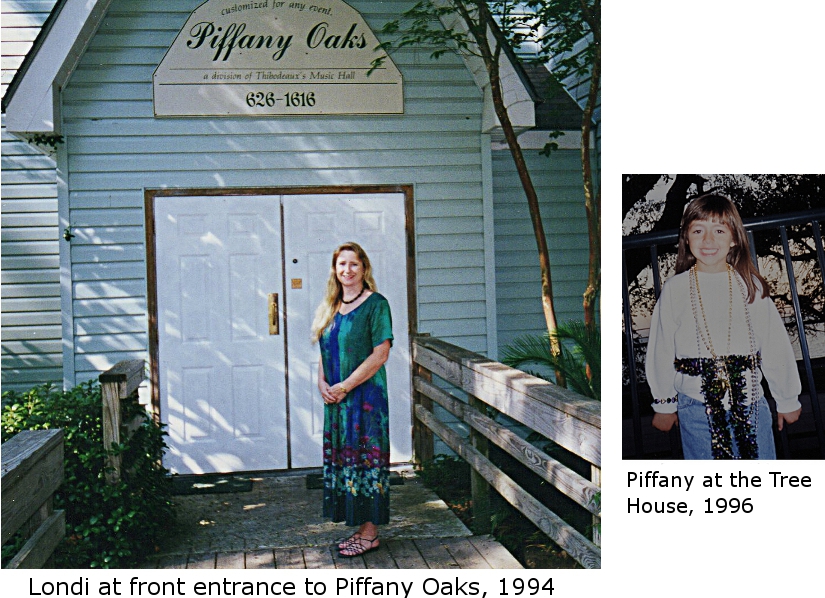
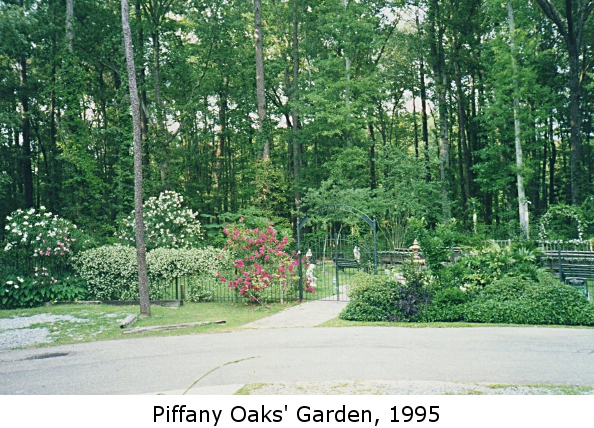
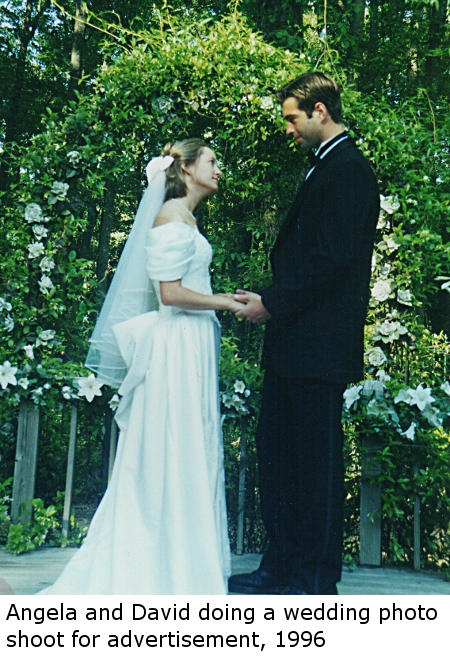
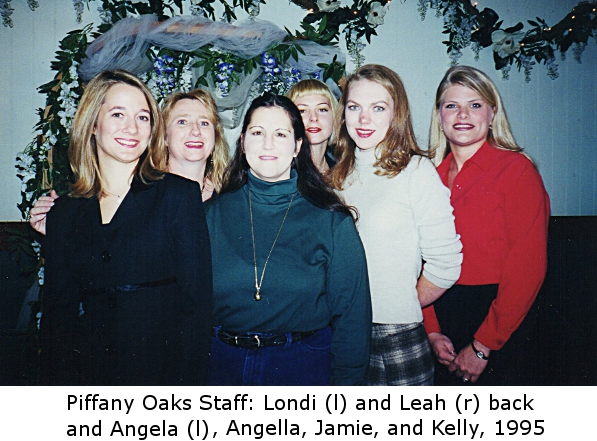
Thibodeaux's Music Hall and Piffany Oaks Wedding and Reception Hall
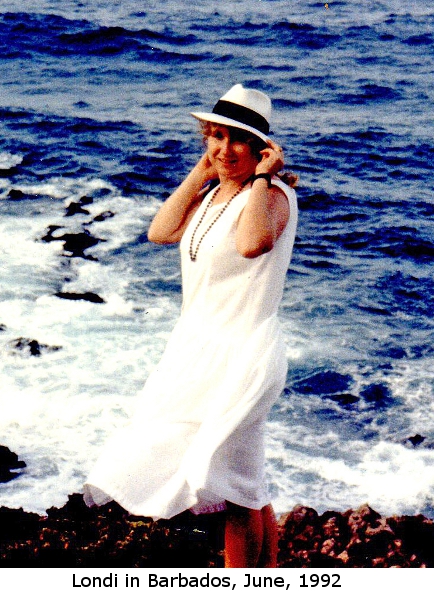
In the previous year Louise and I had divorced in January, Cellie had died in March, and Londi and I had married in December. We had moved into Cellie's former rent house at 1623 Lakeshore Dr (built in the 1930s by my grandfather Ernest) which I had purchased from Lloyd and Marilyn. Louise was still working as a psychologist at Southeast Louisiana Hospital and living in our old Lakeshore house a block way. Louise soon gave me primary custody of David, saying he couldn't be trusted not to sneak out of her house at night. Londi became his surrogate mother for his teenage years. I was now 45, transforming some of my research from pure science to applied science and branching out into some business pursuits (described later). I was still working in the Yucatan and would take Londi with me. However, she was working at URS and (later) for herself and these trips soon became a vacation for her. Like Louise before her, she became a beach bunny, enjoying the Carribean while I would go out to take samples in the cenotes and come back to do field analyses. We would rent a villa or a condo for a week and generally stayed at Akumal on Half Moon Bay but sometimes at Playa del Carmen on the coast.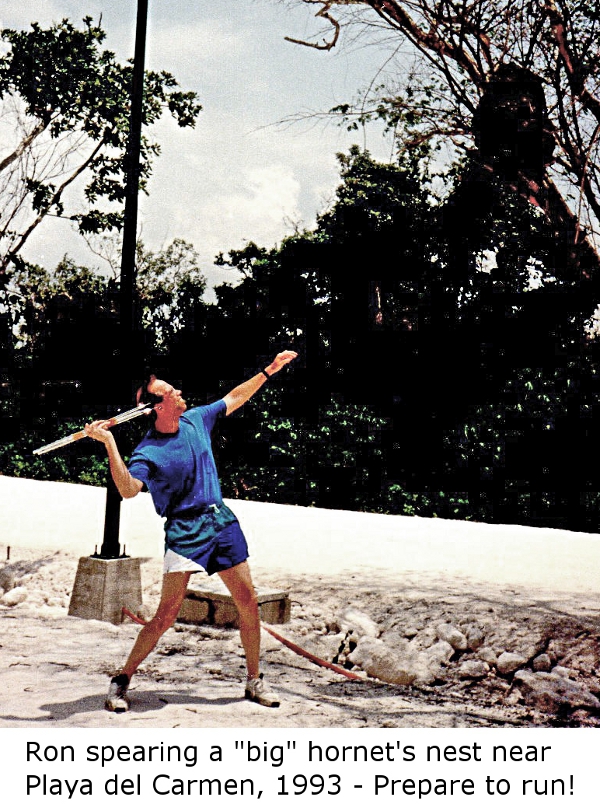
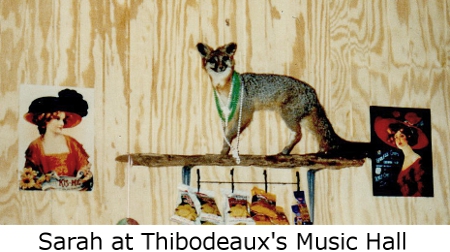
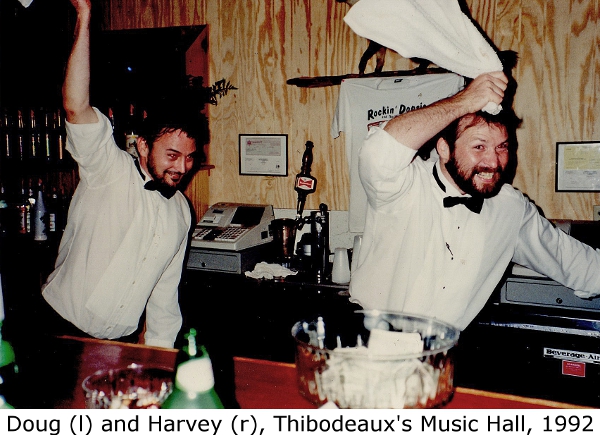
A funny incident occurred when we opened Thibodeaux's which I have to relate. One morning, I was driving on the 24 mile Pontchartrain Causeway across Lake Pontchartrain to UNO to teach and as usual, reviewing my notes propped on the steering wheel. I happened to look up and then to my left and there was a police car with a cop staring at me. He turned on his lights and siren and over a loudspeaker tells me to pull in the next crossover. Oh hell, I was going to get a ticket for reading while driving. What a way to start the day. As he was writing the ticket, cars were streaming past at a faster clip than the 55 mile an hour speed limit. So I asked him why he wasn't ticketing them and he said he wanted to give them a break. I replied "Why not give me a break." which seemed to irritate him. The next morning, I'm driving on the causeway again and looking across a hundred feet of water at the adjacent bridge for drivers going in the opposite direction. I'm still irritated by getting a ticket the previous day and here comes a police car going in the opposite direction. I rolled down my window and yelled a few curse words, confident that the cop couldn't hear me. Just then I passed a crossover between the two bridges. I watched through my rearview mirror in horror as the cop pulled into the crossover, entering my bridge, and pulled behind me with his siren and lights on. Oh hell, he must have heard me curse him out. This time I was probably going to jail! I pulled in at the next crossover and got out to talk to him. It was the same guy that had given me the ticket. He said "Are you the Ron Stoessell opening a music hall in Mandeville?" "Well, Yes", I replied. Well give me the ticket I gave you yesterday." And he tore it up. Wow! What was going on? He said "You asked me yesterday to give you a break and I've done that. Now I need a favor. I play the guitar and I need a gig at your music hall." Hmm, not to tuen down a fixed ticket - "OK", I replied and he gave me his business card. I told my class that day what had happened and we laughed about this dishonest cop who would never get a returned call from us for a gig.

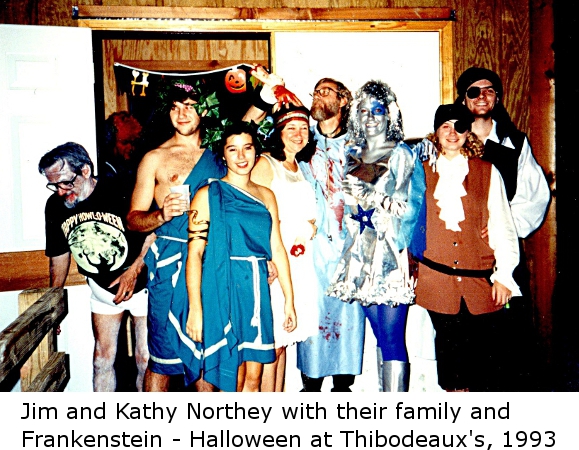
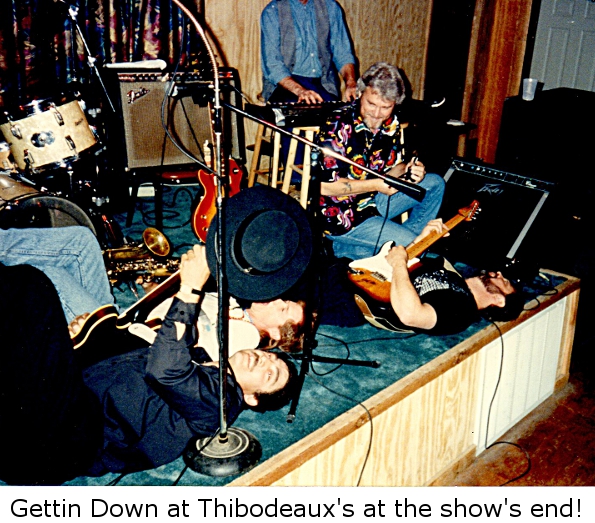
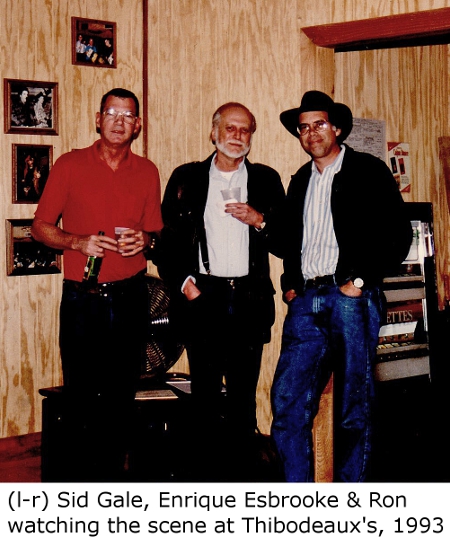
I did the outside landscaping for Thibs, often collected cover, and had the fun of visiting Big Easy establishments, like Checkpoint Charlie, the Howlin' Wolf, the Rocking Bowl, the Maple Leaf, and Carrollton Station, looking for good bands in all the "right" places. The Big Easy bands and performers that played at Thibodeaux's were legendary (to me): Walter Wolfman Washington, Irene and the Mikes, Sunpie, Mary Serpas, Cowboy Mouth, Evangeline, Marsha Ball, Anders Osborne with Theresa Andersson, Rockin (David) Dopsie Jr. with his Dad (the King of Zydeco), The Radiators, Irma Thomas, Allen Tousiant, Charmaine Neville, Gatemouth Brown, Percy Sledge, Marva Wright and the list goes on. 
Return to Top
Cellie's IRS Audit
Londi was running Thibodeaux's Music Hall one night in late 1992 when I received the depressing irs letter saying Cellie's estate was being audited. The band and patrons finally left, and she and I sat at the bar, drank heavily and tried to figure out what to do. Any increased valuation in the estate by the irs would be taxed at greater than 55%. Our estate lawyers and appraisers told us to be prepared to double the inheritance taxes that we had paid in the estate filing. But Londi had been previously married to an irs agent and she proposed a different approach. Let the estate lawyers go. In the end the audit would come down to agreeing on land values. The agents would be more sympathetic looking at us over the table and not at hired guns. The irs letter said to bring all financial records for the last 3 months of her life up to the present along with real estate appraisals. We decided to overwhelm them with records. Londi spent a month putting the financial records together with copies of every check and monthly report from every financial account, along with a copy of every real estate appraisal used in the original estate filing and our information supporting the appraised values. We arrived at the New Orleans irs building with boxes of records, arranged in binders, to meet our agent. He was a nice, elderly guy who was pleased that we were providing information in an orderly fashion. And Londi established a good rapport with him. But there was so much information, it would take him months to go over it. Eventually he retired before finishing the audit, turning us over to a second agent who also retired before finishing the audit. Finally the third agent promised me he would finish the audit before retiring, which he did and then retired. (We were a retirement force to be reckoned with!)
The agents didn't do much with the voluminous financial records except to make sure that a check had been written for every claimed estate expense. That only produced one problem. At Marsha Higbee's suggestion, we had inflated her legal bills in the estate filing to show more estate expenses. Marsha had guided me through the estate process at little cost and this did not even bring her fees up to what they could have been. But now I had to cut her a family check for the difference. Marilyn was angry that Cousin Marsha didn't return the money after deducting for her income taxes (LOL), destroying that family relationship, a personal loss for me that I regret to this day. But the real hangup was establishing reasonable real estate values. Cellie died during a recession so real estate values were depressed (lucky for us) and there were few comparable sales to establish property values. Citing the lack of comparable land sales, the irs wanted to use sales up to a year after Cellie died, and these values were higher since the recession had ended. Our argument against this was the values were supposed to be the actual market values at the time of her death? In addition, the 1,500 estate acres would have crashed the local real estate market if they were all put up for sale at one time. So that discount in value had to be agreed to and included in the appraisals. And finally what discount should be made for wetlands. There was, in general no standing water on the land but it was pine savannah, much of it falling under the Army Corp of Engineers definition of wetlands, i.e., land classified as "Waters of the US". Wetland delineations were needed to establish wetland acreage. We had already received written offers from developers to buy some of our property for subdivisions and they had invariably requested that the wetlands would be free (lol). So what value would the irs accept for wetlands? We, of course, had done our best to undervalue the properties relative to the recession market values in the estate filing, and the irs had expected this. So our goal was to come to an agreement that made the irs happy but was still below the recession market values at the time of her death. Neither side wanted to go to court, so the negotiations were to become a poker game.
First we needed to get the wetland delineations quickly done. Who to use? We needed a private consultant whose work was trusted by the USACE (Army Corp of Engineers) so the irs would accept their delineations. Londi and I visited the USACE headquarters in New Orleans to talk with the head honcho who oversaw issuing the "infamous" 404 wetland permits. We asked him who to hire that they thought was competent. Well, federal employees cannot recommend private contractors to the public and he had the most unfriendly assistant with him. (As described later, I had to interact with that assistant, and he was a pain in the ass, dishonest bureaucrat.) Several days later, a letter came in the mail with no return address, citing an anonymous federal employee in an anonymous federal agency telling us to hire Barbara P. who worked with J.V. Burkes, an engineering firm in Slidell. (Hmm - Wonder who sent that letter?) Barbara was JV's daughter and was a self-taught wetland delineator. (I think she had an art degree. She was also beautiful and fun to follow around in the field.) Her father's civil engineering firm also did surveying, essential to mapping the delineated wetland boundaries. The mapping was supervised by her brother Sean, a civil engineer. It was a great move for us. Wetlands are delineated based on 3 criteria: the presence of hydric (wetland) plants; indicators on the average location of the water table; and the oxidation states of the soil layers as shown by their colors. The first criteria included identifying grasses which was and is a bitch. But the second criteria was actually hydrology, Londi's field as a geohydrologist, and the third criteria was soil chemistry, my field as a geochemist. So Londi and I tagged along with Barbara in the field while she flagged the boundaries. And we successfully argued (lol) for more wetlands whenever we could in order to maximize our wetland discount with the irs. I think we were their only clients who hoped to find nothing but wetlands. It would have been a disaster if the irs had made us actually file those reports with the USACE, because we would then have had to live with the delineations in later land sales. But they didn't, and the delineations were never used and subsequently forgotten.
We hired Charlie O'Brien from Covington to fine-tuned the land appraisals. He was a well-respected appraiser, a trusting grandfatherly figure. We thought the irs would be hesitant to challenge his appraisals in court, an opinion later verbally verified to me by our irs agent. Then we began having meetings. There was this young irs agent who attended the meetings and wanted to make his reputation by forcing us to agree to higher land values, actually reasonable values, which was an unreasonble expectation from our point of view. At one point he told us that CLECO (Central Louisiana Electric Cooperative) officials had informed him that they had made an offer to us for some of our property for a line station at a given acreage price. This would establish a value for property in that area. But he was lying. We knew the CLECO management and they verified that they had not made any offer. To me, he had crossed a moral line. As a loyal American and military veteran, I considered it OK to lie to the irs but inconceiveable they would lie to me. (LOL) The most memorable moment for me occurred listening to the young irs agent and Londi arguing about the additional value to place for timber on 10 acres out in the boondocks. But I knew the property had been clear-cut so there was no timber. However, they both agreed there was an auto dump on the adjacent property because they had confused two different properties. And the irs agent had decreased the property value far below the actual value due to the presence of the "imaginary" dump. So I just sat there stone-faced and accepted their compromise value. I thought it was hilareous. Eventually, one afternoon, we met around my grandfather's round cross-cut oak dining table in my Mandeville home. Huey Long had sat at this same table for dinner with my grandparents. At this final meeting, the senior irs agent had had enough. He wanted to retire. The younger agent was not willing to compromise more. The senior agent asked everybody to leave accept me. And the two of us worked out a compromise in about 15 minutes that my family and the irs could live with. And that was it! The audit was over! The agent got to retire! - End of story.
Return to Top
Clearing Titles & Prieto Problems
Starting in 1992, concurrently with the irs audit of Cellie's estate, I began to clear titles on her various properties as her executor. Ten years earlier I had asked Cellie to begin this process, but she had laughed and said it would be part of our reward in inheriting property. Cousin David Moore recommended using Bob Anderson, their family lawyer who handled his mother's estate (Aunt Marion). I called Bob to talk with him about being our famiy lawyer. He told me his first case in St. Tammany Parish was to successfully sue Cousin Ernest for damages for beating up his client, a plumber who Ernest said had done shoddy work for his mother-in-law. Hmm, I knew we would need someone willing to take on Cousin Ernest in court, so he sounded OK to me. Londi and I hired him and began a long friendship and fortuitous relationship with him, his wife Betty, and their daughter Julie. Both Betty and Julie were also abstractors and Betty had previously been a researcher working with the Tulane Primate Center. She was the gracious southern lady who handled our business affairs with both grace and charm. The title problems were in numerous lots that were in undeveloped subdivisions my Grandfather Ernest had obtained title to, after the developers pulled out pre-1930. These were sell-out lots that had been previously bought but taxes never paid on them by absentee landowners and the titles reverted to the state or parish. Some of these lots had then been sold at subsequent tax sales to new owners. Each parcel of lots was abstracted and any title defects found. We then filed mostly "uncontested" lawsuits against long-dead owners of the lots and their descendants. We also purchased lots that had been bought by others at tax sales. Only once did we go to court to obtain title by possession against a multiple lot owner who had title through a valid tax sale purchase. We never found actual decendants of original lot owners. Bob hired Ed Murphy, an attorney with a Ph.D. in Philosophy from Tulane, to represent the absent and deceased owners and their unknown descendants. It certainly helps to hire lawyers to handle both sides of a legal dispute, ensuring the lack of any legal dissent from the other side. The law moves in "not so mysterious" ways. Sadly, Bob died around 2000 and Betty passed a few years later in 2003. I miss them both. Dr. Ed Murphy has since served as our family lawyer. He is both a fine attorney and a good philosophical friend.
This actually happened to us when dealing with the parish on tax sales. In the past when property taxes were not paid, title reverted to the state who was then responsible for putting the land up for tax sale. If they weren't sold at the tax sale, then the title stayed with the state and you could either ask the state to include them in the next tax sale or redeem them through legal action against the last owner and also pay the taxes due. However, several of our problem lots now had their title in the parish, not the state. Apparently, now(?) if you do not pay the property taxes, the title goes to the parish. My sister Marilyn went to the parish to ask them to put some of these problem lots in Square 134 up for tax sale. She talked to Robert Barnett, a parish attorney who worked for the parish president Kevin Davis. He told her she was wasting her time because in the event of a parish tax sale someone else would buy the lots at the sale, i.e., a parish employee conducts the sale and determines who can bid on those lots and it wouldn't be her. "Why not?" she asked. Well (LOL) - it was because he was the one who had actually purchased these lots at a state tax sale (to a shell corporation) and then didn't pay the taxes so that the title could sit in the parish. Apparently this was a ploy to not have to pay property taxes until he was ready to sell them. What a crook! I had a meeting with Kevin Davis to tell him what was going on. The guy is still a parish attorney (who says crime doesn't pay) but the parish did publically announce it would starting holding tax sales on all lots held by the parish. Meanwhile, we just gave up on those lots. In Louisiana, there is no illusion that the government operates for the public.
With the death of Cellie and her siblings, there was a lot of heartache dealing with Cousins Ernest, Mary, and Clay. In the name of preserving family harmony, Uncle Preston and Aunt Marion's families would acquiesce to their demands. And through real estate commissions, legal fees and other fees, e.g. for handling sign rentals and hunting and trapping leases, these three had exploited the family relationships while pretending to look after family interests. As Cellie's executor, I wanted to divide up all remaining joint Prieto properties. These 3 cousins were, in general, opposed to this division, realizing they would lose control together with real estate commissions and legal fees. I did not feel I initially had much support from my brother and sister. They were not living in Mandeville and were not eager to acknowledge the internal Prieto family problems. Consequently, they thought I was just being difficult to deal with.
One of the multiple lot holders within property owned by my mother was Dennis Drury, a local landsman who delved in tax sales and whose property research had initiated the Arnett lawsuit against the Prieto family. I purchased 8 lots from Dennis in Square 123 for my family and, against all odds, we became friends. Dennis was not a fan of Cousin Clay who was trying to collect a real estate commission on a house Dennis sold after dropping Clay as the realtor. Dennis told me that Cousin Ernest had formed a corporation named Circuit Inc years earlier with Oliver Carriere and bought some "sell out" lots in squares owned by my mother at tax sales. Oliver was an attorney who both disliked the Stoessell family (I suppose due to Cousin Ernest) and was the father-in-law of a granddaughter of my paternal Aunt Margaret Evans. Everybody, somehow, seems to be related in the South. (lol) The corporation had hid Cousin Ernest's ownership in these lots from my family. I swallowed my pride and bought back lots for my family, some in Glendale Heights from Cousin Ernest's daughter Malise and other lots in Jackson Lane Squares from his partner Oliver in their corporation. Our final break occurred in 1994 when Cousin Ernest profoundly stated to me that just because my family was entitled by Louisiana law to legal access on an old family road through their 300 acre property to our 440 acres (north of Lacombe), his legal connections would prevent us from prevailing in court. (Ernest was holding out for the Stoessells to pay for a new road across their property to help them develop their land.) I began to view him as the family Vulture.
In that same decade (1990s), in an attempt to gain property in the infamous "War of the Fence," Cousin Ernest's sister (Cousin Mary) had her two sons tear down a barbwire fence marking part of our common boundary (between the N/2 and S/2 of the S/2 of the section) on our 160 acres of land fronting Hwy 59, north of I12. This was the same fence that David and I installed the previous year, following a Carey Smith survey of the boundary. I had been warned a year earlier by Carey that Cousin Ernest was using an old inaccurate survey by Ned Wilson to claim some of our property. Because of its location on Hwy 59 near I12, I knew the commercial land value was multiple dollars a square foot. Cousin Ernest offered a $1 a square foot for the contested property. Another family member, Cousin Tommy said I should accept Ernest's offer in the interest of family harmony. (Strangely enough, I didn't feel the family love!) The boundary dispute tied up the entire section, preventing any sales. Eventually, after the other three Prieto family branches agreed, Cousins Ernest and Mary were forced to accept a boundary agreement. But they were not happy with an equal partition. Cousin Mary was also a real estate agent and later broke her word on selling Londi and me some of their Helenbirg lots at a set price in exchange for my agreeing to a joint family lot sale to Tommy D'Luca. It turns out Tommy D'Luca had offered her a higher price. Interestingly enough, Tommy D'Luca was not aware of the situation and when he found out, sold Londi and me four lots for Londi to build two "spec" houses on and partially reimbursed us for my loss by paying me a "finder's fee" in the lot sale. Unlike Cousin Mary, Tommy D'Luca had a code of honor. When I asked Cousin Mary to return my share of her real estate commission on the family sale, she said "I never give anything back!" I took that statement to be her personal mantra that she took to her grave.
Those cousins had a sense of entitlement because of the Prieto's family's long history in Mandeville and St. Tammany Parish. Their actions and those of Cousin Ernest's son, Cousin Clay, eventually resulted in a family lawsuit. The Prieto family had given Tommy D'Luca in 2002 a two year purchase option on more Helenbirg lots at a low price, in a deal handled by realtor Cousin Clay. The deal involved a significant non-refundable deposit which of course was spent immediately by the Prieto family. (We don't waste any time with non-refundable deposits.) At the end of two years the option should have expired. Cousin Clay, in an effort to extend the option, apparently switched the front page on the signed document in his possession, making the start of the two years when the Prieto family received permits from the Army Corps of Engineers. Because the option had gone through many changes and had been signed on separate signature pages sent around to family members, the rest of the family did not have an actual copy of the final document, possessed only by Cousin Clay, the realtor in the deal. When confronted with the new front page, the family met and agreed the conditions were not what we had agreed to. However, Aunt Marion's side of the family was wedded to Cousin Clay through his close relationship with Cousin David. They were worried about Clay losing his realtor's license. Cousin Mary, a realtor, worked closely with Clay and had to know what he was doing. But I do not know what her role was in the fraud.
My sister Marilyn had finally begun to believe me that Cousin Clay was not to be trusted. While checking filed court records, she discovered Clay received $40,000 for a quitclaim from one of D'Luca's corporations for Clay's ownership in a parcel of "unclaimed" property, i.e., property not on the tax rolls with no record of ownership. (Don't mess with Marilyn!) Londi and I knew Tommy D'Luca well. He and I had walked the Helenbirg property together when the wetlands delineation was done and I had grown to like him. He was from New Jersey and the Prieto family naturally assumed Mafia connections were the source of his funds and they did not want to cross him. I asked Tommy D'Luca why he paid Clay $40,000 when Clay had no ownership in the "unclaimed" property. He replied that Clay happened to walk through the door when he needed a legal document to start a possessory action to gain title. LOL. That's usually a $100 quitclaim for someone with no actual ownership. Tommy D'Luca was generous with Clay in an obvious payoff but he wasted his money. The "changed" option lacked a valid closing date for a contract. D'Luca could see the handwriting on the wall and sold his interest in the option to the Blossman family, a wealthy and politically powerful family in the parish and state who had been recently involved in the First National bank failure (by making unsecured loans) in St. Tammany Parish. (My grandfather Ernest Prieto originally helped start the precursor to this bank, and Richard Blossman's actions made our bank stock worthless.) The Blossman family brought in a firm of high-powered New Orleans attornies to enforce the option. Losing was not the normal option for them and local realtor Dale Stram, the son of Hank Stram the former New Orleans Saints head coach, met with me one evening to pressure me to drop my opposition. Cousin Clay became increasingly angry, culminating with a dead copperhead being placed on my back-staircase to scare Londi who has heart problems. One Wednesday evening, I met with Uncle Preston's family to try to persuade them to join the Stoessells in getting the option declared invalid. We drank whiskey and discussed the situation. They did not want to destroy the family harmony and did not want Cousin Clay to lose his realtor's license. Then someone asked Cousin Don's girlfriend and later wife for her opinion. She was a pretty, feisty Spanish lady who worked as a local realtor. She bluntly said something like "Your cousins are stealing from you." Wow! They heard it from someone other than me and that settled it. (I had become too controversal in family relations for them to accept my word at face value! lol).
The Stoessells with Uncle Preston's family funded the lawsuit which also represented, strangely enough, half of Uncle Clay's side of the family: Cousin Clay's sister and brother (Malise and Ernie) and his Aunt Joan's family. Not surprisingly, representing them turned out to be a "pro-bono exercise." Actually, by that time Clay's father Cousin Ernest had expressed his distrust of his son to Marilyn. The rest of the family (Cousins Mary, Clay and Aunt Marion's family) supported the "changed" option and were included as defendants in the lawsuit. Tensions were high. One Wednesday evening at Uncle Preston's old home, Cousin Tommy pulled me aside to warn me "to watch my back" because he thought Clay was angry enough to shoot me. And to add to Clay's chagrin, we hired Alex Peragine, an incredibly competent contract lawyer in 2005 who won in court on a Summary Judgment in 2006 in the 22nd District Judical Court and then on Appeal. I wanted Cousin Clay to also lose his realtor's license, but that was not the court issue, just the lack of a valid contract closing date. In Prieto family emails, Cousin Clay slandered our lawyer Alex Peragine (as a mercenary jewish attorney while Alex was actually a competent gentile attorney) and called the Stoessell family the Prietos with "Bad Blood" which I took to mean that we were not suitable prey for the family Vampire (LOL), i.e., Clay. Not long after, Clay confronted me in public on the Mandeville Lakefront with his wife and his lawyer Bill Jones closely watching from Rips Restaurant across Lakefront Drive. We stood there, yelling at each other, each daring the other to strike first - much like two circling roosters with sharp talons. (LOL) Eventually, his wife or attorney persuaded him to retire to the restaurant. With increasing age, I admit to missing those wild times in the Prieto family.
But this was not the end of the story. Unknown to the Stoessells, Uncle Clay's family ignored the signed and filed boundary agreement (previously discussed) and sold property, using the inaccurate Ned Wilson survey, that included several acres of my brother Lloyd's interior land to a third party. I think they thought we would not find out before the ten year prescription period for good faith possession by the buyers had passed. They hadn't counted on Marilyn closely examining the published joint boundary description when the new owners put their purchased property up for sale. (Once again - Don't mess with Marilyn!) Cousins Ernest and Mary said they forgot about the boundary agreement, blaming the surveyer and title company for missing it in the courthouse documents. (I'm not sure how Cousin Ernest persuaded an abstractor to miss the filed boundary agreement but he must have been very persuasive - lol.) Under threat of a lawsuit with Alex Peragine as his attorney, Lloyd forced the buyers to relinquish their claim. They were left to fight it out with Uncle Clay's family, the surveyor's insurance company, and the title company for recovering money paid for property that the sellers did not own. I assume there will be other pieces of property that they have intervened on that we, as yet, do not know about. Looking back now, our extended family relationships were both hilareous and very difficult. Cousins Ernest, Mary, and Clay are now "sadly" deceased. I outlived them (LOL)! Perhaps that will end the family problems. Death does tend to even things out.
Return to Top
Costa Rica
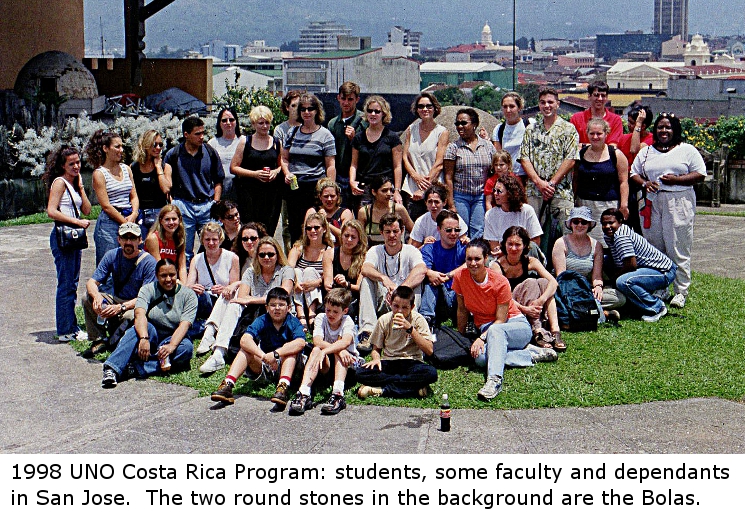
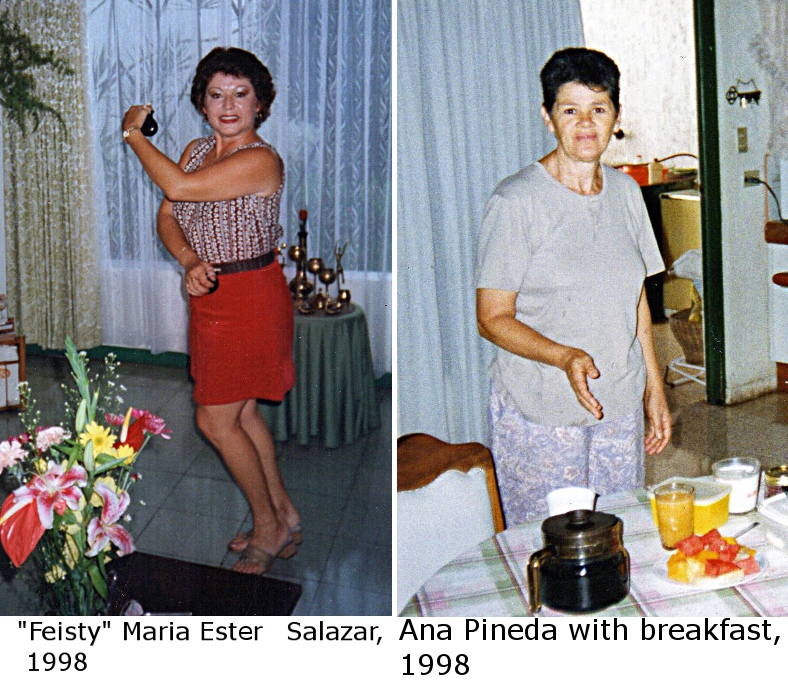

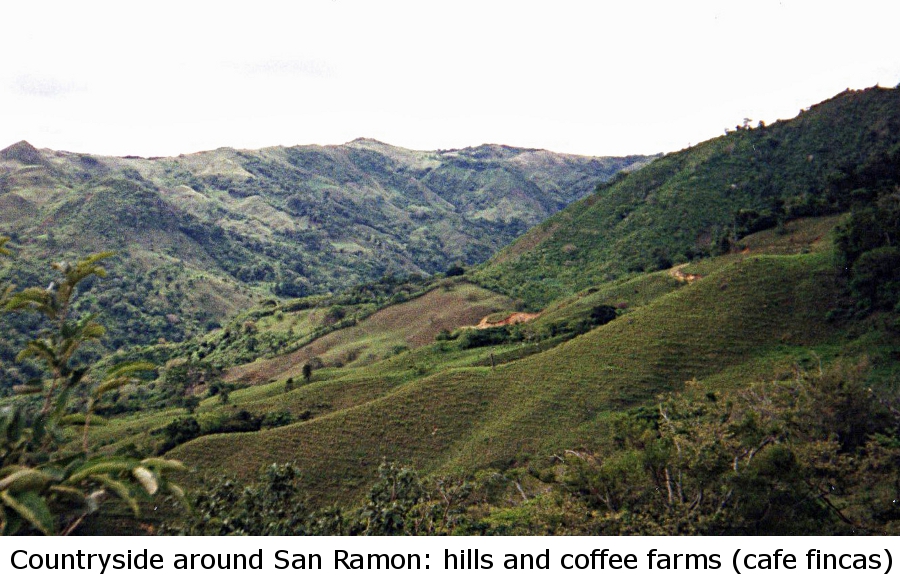
The UNO summer program in San Ramon is not as expensive as the one in Innsbruch, so there were a higher percentage of UNO students, probably 50% of the group. The informality of the program and Marie's laid-back method of running it appealed to me. She was there at the start of the program, then left to take students to France for a short program, returning near the end. While she was gone I felt free to be the independent academic. I happily tried to drive her second-in-command, either Stephanie Lyman (English professor) or Elaine Brooks (Spanish professor), nuts. The faculty were remarkably open about themselves. The last summer I taught, an English professor was part of the faculty. He had weird mannerisms I thought, so one night while drinking beer, I asked him. "Are you gay?" To which he replied. "I'm an English professor. What do you think?" Wow - talk about sterotypes. (LOL). Another faculty member, Michael Huelschoff, a political science professor, was convinced my dislike of authority stemmed from a genetic disorder aggravated by my German ancestors (serfs) not being being beaten enough by his German ancestors (lords) - LOL. The comaraderie made it fun to be there: teaching, chugging guaro with the students, and interacting with the local families. Guaro is the national drink, made from sugar cane. It is described as having a sweet taste; however, I think it tastes like furniture polish but goes down better - like ouzo.
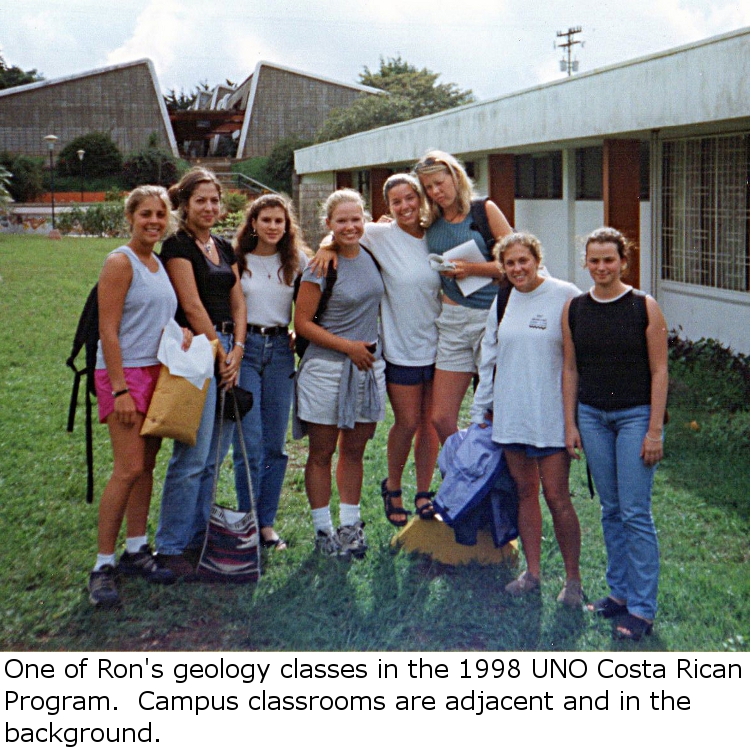
Each summer the students would do a zip line trip in the mountains and go on a whitewater rafting trip on the Rio Pacuare in the eastern portion of the country. This was real jungle country and we saw brightly colored parrots and toucans (with their orange beaks) along the river's banks. On my first rafting trip, the raft tilted in a big rapid (class 4 or 5) and I was thrown out. Naturally, I yelled "Pura Vida" and grabbed hold of the student sitting next to me and he came with me. As he slid out, he grabbed another student and in a chain reaction we all ended up in the water. This incident made me into an instant celebrity. After that, the students were hesitant about sitting next to me in a raft (LOL).
On one long weekend in 1999, Jeff ?, (a Fine Arts professor) and I went touring the "hippy" northwest Pacific coast in Guanacaste. This was a cool wilderness experience, complete with a "crooked" cop, beautiful white sand beaches and shallow streams that our rental car could ford. The cop, according to his uniform, was actually a pistol-carrying member of the local waterworks municipality. He pulled us over and told us our vehicle lacked a permit and to pay him a fine or go to jail. We told him we knew he wasn't a real policeman and to bug off (LOL). And Wow - He did. The success of that verbal exchange was due to Jeff's fluent Spanish. I thought we were in big trouble. Later that trip, an American expatriate in a bar told us he had been constantly stopped and forced to pay a bribe to keep his old motorcycle. This continued until one day, he climbed off the motorcycle and told the cop to take it and started to walk away. The cop replied he didn't want the damn motorcycle. And they stopped harassing him after that.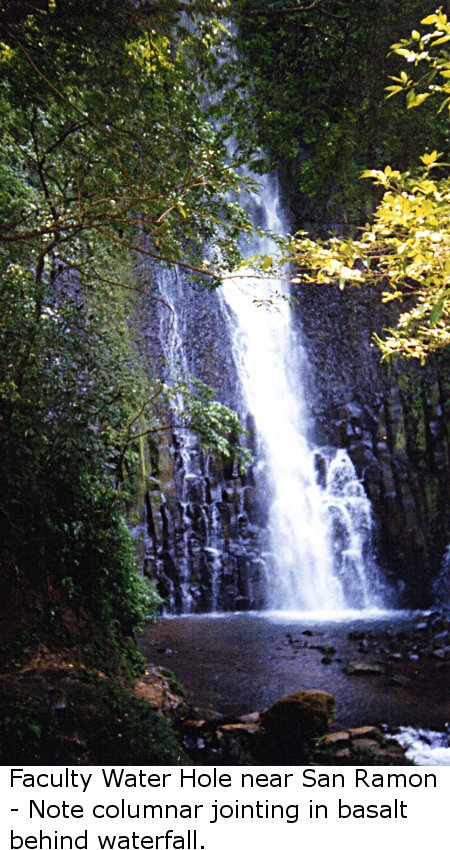
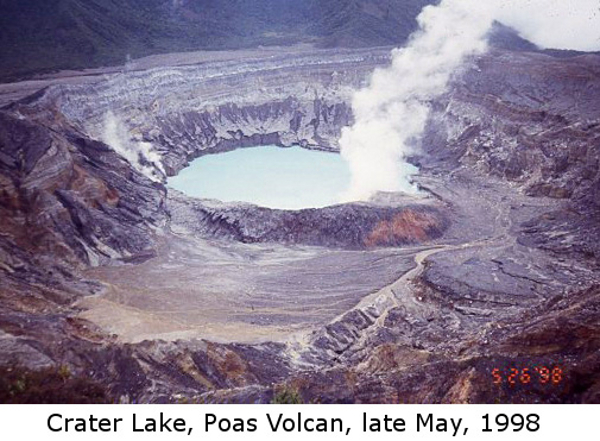
The faculty also went together on day trips on the weekend, exploring a local waterfall and visiting wildlife preserves through Marie's connections. We once went to a Costa Rican University reception at a fancy resort (former presidential house) in a wildlife preserve where we had a buffet lunch. I was serving myself in line and reached out to snag a tasty treat from a dish only to tip the dish over, spilling its contents. There was a gasp of horror among the kitchen staff, racing around to pick up the food off the floor. I politely asked for a new dish with clean food (LOL). (How did Marie put up with me?) Once on a trip to the waterfall, I tossed a stream pebble in the direction of Maria Ester's maid. Upon examination, the pebble was heart shaped, which Maria Ester said meant a wedding proposal. Luckily for both of us, I was already married. I learned to be careful of tossing pebbles at Ticas! It was a fun time.
The students went on a one day excursion to Volcan Poas, a beautiful active volcanoe with a road up to the rim, allowing us to look deep into an enormous crater with a light blue lake. There were big yellow clouds of sulfer dioxide rising from geyser vents near the lake, much as you see in Yellowstone, which would blow over the edge of the crater, engulfing us in its rotten egg smell. I always somehow managed to control myself and not toss a student in as a tribute to a Mayan God - but I did think seriously about doing so. 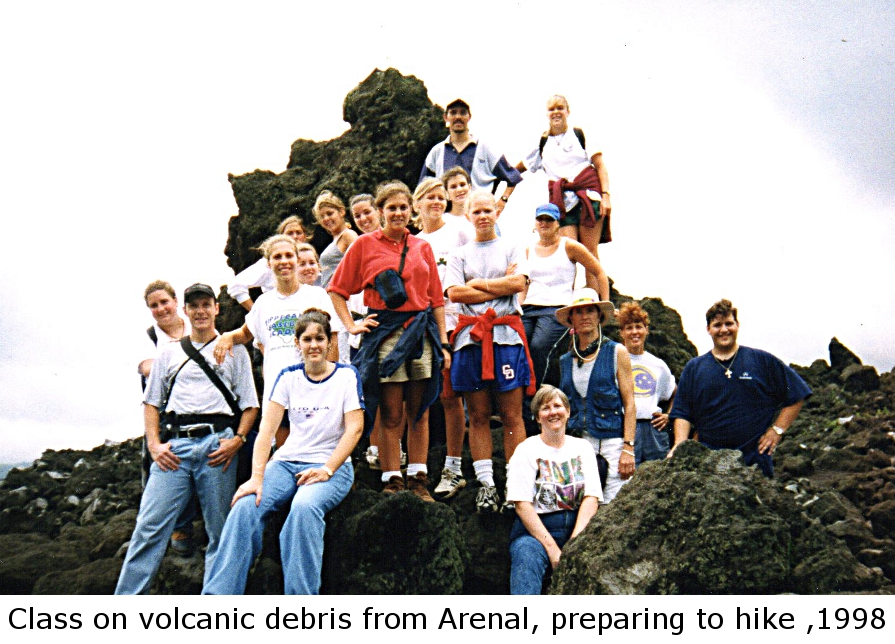
We also usually had a fun day in San Jose visiting the big city market as well as to meet the president and have a guided tour of the presidental palace. Marie had connections wiht the persident through her husband's business dealings! In one of the buildings, there were these magnificent rooms with the portraits of past presidents (leaders) of Costa Rica. I examined the paintings carefully and noted there wasn't one of William Walker (a "hated" American adventurer and ex-Confederate soldier who invaded and partially conquered Costa Rica after the American Civil War). So I innocently asked our guide where his portrait was. The class was probably not invited back the next year! I could never figure out why Marie put up with me.
But the big weekend field trip was to Quepos and Manuel Antonio National Park on the Pacific. We drove south to Quepos down the coast, crossing rickty wooden bridges overlooking big, fat, lazy crocodiles sunning themselves. For amusement, the locals would throw an occassional chicken (or unfortunate tourist) off the bridges down to the crocs. Manual Antonio is a small headland sticking out into the ocean, isolated at high tide. This is a beautiful area to hike in and to swim and body surf on the adjacent beaches. Nearby Quepos is an international playground, full of energy and vibrance, complete with an European-style "gay" beaches. Londi came in 2002 and we stayed at the Hotel La Mariposa (The Butterfly Hotel) in Quepos, probably the prettiest hotel I've ever stayed in. At the time I had Ramona (a rescued dog from San Ramon with us, renamed Josey) and had to sneak her in and out of our room under my shirt - the hotel staff knew what we were doing and ignored our transgressions. It was somewhat like a second honeymoon - although we actually didn't have a honeymoon after we married. The trip to Europe where I proposed to Londi at Zermatt was the honeymoon.
In (2001?), Londi's brother Scott Harrington was developing "the Farm" a residential project near Quepos. When I think of Scott, I think of Jimmy Buffet's song: "A Pirate Looks at Forty". He had moved to Costa Rica from Isle Mirada in the Florida Keys where he ran an excursion business with boats and an ultralight plane. Scott had previously been a crop-duster pilot and survived his share of crashes.
Yes I am a pirate, two hundred years too late
The cannons don't thunder, there's nothing to plunder
I'm an over-forty victim of fate
Arriving too late, arriving too late
I've done a bit of smuggling, I've run my share of grass
I made enough money to buy Miami, but I pissed it away so fast
Never meant to last, never meant to last
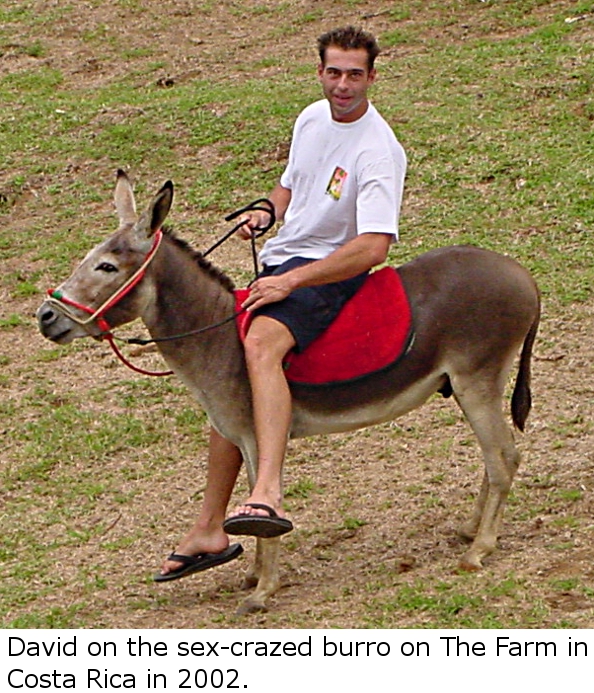
Like all pirates, Scott had a checkered past but with a charismatic way about him. I figured that (like William Walker) his goal was to plunder Costa Rica (LOL). A group of wealthy American investors backed his project, and in 2001?, Londi and I went down to check out buying a lot in his development (called The Farm). To the east of the project were high mountains, up to 12,000 feet, and nearby to the west was the Pacific Ocean, but both were out of sight of the development. Our trip began with Scott, Tanya (his beautiful Brazilian girlfriend and later wife), Londi, and I crossing the Talamanca mountains from the east and driving down a nearly impassable road to reach the development. We saw several quetzales, those beautiful, purple and green chicken-size birds that the national currency of Guatemala is named for. The trip took two days and overnight we got sauteed (with alcohol) in a hot tub that had been dug into the side of a hill. The floor of the hot tub was the top of a metal barbecue pit used to heat it - very ingenious. Scott's development was hilly, covered with flowering plants, bordering a good-size river, and featured nature preservation areas. He and Tanya had built this really cool "raised" house with a stable underneath it for horses and a burro. The burro was sex-addicted to the horses - horny little fella. There was also this great bar on the other side of the river, and Scott joked about setting up a zip line over the river to reach it. I wasn't sure how we would get back across the river but after a night of drinking, it probably wasn't important. So of course we ended up buying a lot for $50,000 on a small hill. Owning land in Costa Rica was complicated. You have to set up a corporation that is controlled by Costa Ricans so our ownership always seemed questionable to me, but then, so is life.
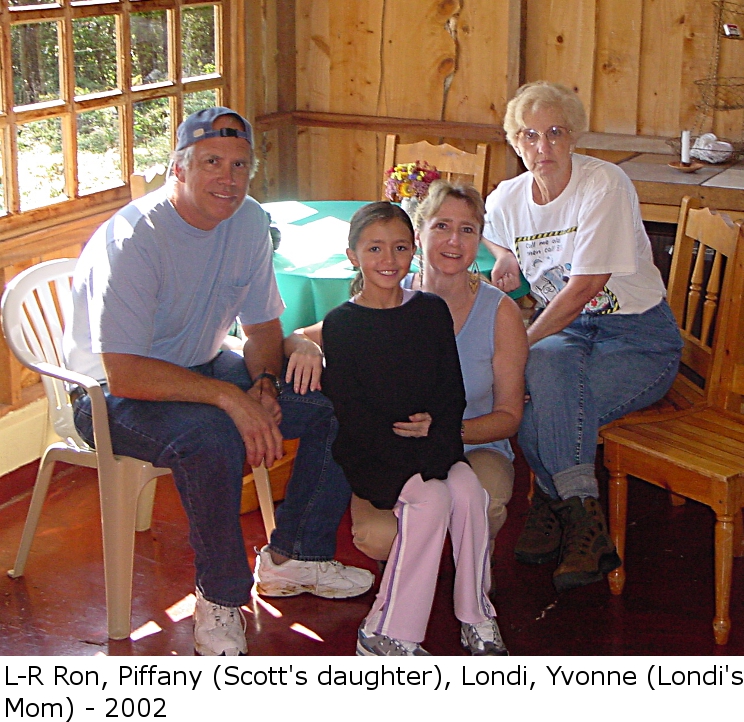
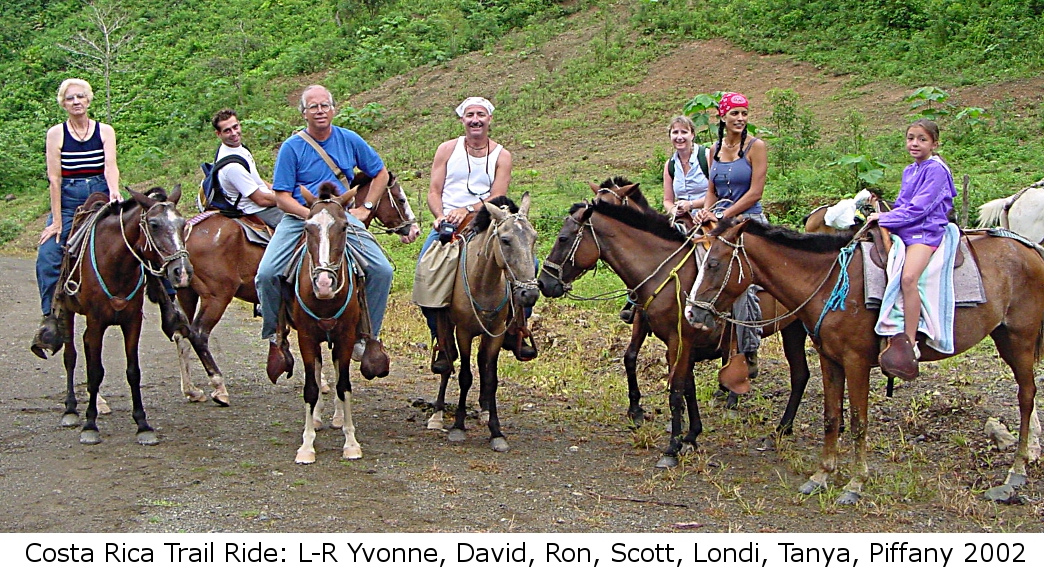
 Somewhat later (2003) Londi and I with Piffany and David went to Costa Rica and met up with Londi's mother Yvonne at The Farm. It was a family reunion, complete with a barbecue, parties, and lots of tequila! At the development, we checked out our lot (It was still there.) while David harrased the sex-addicted burro, riding it around! And the entire family went on a horseback trail ride and did the obligatory zip line tour in the rain forest. This was Costa Rica at its best.
Return to Top
Wetlands' Research in Pine Savannah
A little background information needs to be presented. I used to think of wetlands as being areas such as swamps and marshes. But this mindset changed after dealing with the Army Corps of Engineers while handling land inherited from Cellie. The vast majority of wetlands overseen by the US Army Corps of Engineers (USAEC) are not marshes and swamps but forests without permanent standing water, e.g., pine savannah in Louisiana. They have a ground-water table near the earth's surface which causes flooding after heavy rainfall. The actual depth to the ground-water table changes with the season, the amount and type of vegetation, and rainfall amounts. In the summer when photosynthesis is at a maximum, plants draw enough ground water to significantly lower the depth to the ground-water table. The reverse occurs in winter. Trees are most effective in lowering the ground water table, so clear cut areas are more likely to be classified as wetlands than heavily forested area.
In theory, wetland areas should be delineated by the ground-water table of an area. But because of fairly rapid temporal movements of the ground-water table, the location would have to be monitored for a couple of years to get an accurate average depth. So because these forested areas are often not flooded and appear dry, The USAEC uses indicators to decide if an area classifies as a wetland. The indicators are of three types: (1) the presence of a majority of hydric (wetland) plants, (2) remanents (drift lines, etc) on the ground surface showing that surface flooding occurred; and (3) soil morphology criteria indicating the soil was saturated near the surface. Most wetland delineations are done by biologists and they are heavily dependent upon the use of plants. However, many plants grow in both wetlands and in non-wetland areas, which often makes the delineation unreliable and results in more areas being classified as wetlands. The hydrology indicators for flooding are often absent so they are the most unreliable for indicating an area is non-wetlands. The soil criteria is based on water-saturated soil being anoxic which drives certain chemical reactions such as the reduction of iron and manganese, causing changes in soil color (brown to black). These indicators are reliable but take many years to develop. I think the USACE emphasizes using plants because more areas are delineated as wetlands with this criteria.
My interests in environmental issues drove me to develop a research program in wetland delineation. I decided to monitor the ground-water table over a two year period on two 30 acre plots of family property and compare the delineation from the location of the water table to those delineated by the USAEC with their use of indicators. To develop my background, I took several LSU field course in wetland delineation and met Arville Touchet who became my mentor. We would drill shallow (3 ft) boreholes and do the soil morphology. He was like Sherlock Holmes, being able to determine from the soil structure if heavy equipment had disturbed an area in the past 25 year. Arville was the former federal soil scientist for Louisiana and is the epitomy of a Louisiana Cajun, telling stories of his work in soil science all over the world in his unique accent. The Corps didn't like the fact that his good reputation made it difficult to challenge his delineations. Arville speaks fluent Cajun French and he and his wife Annie often visited us in Mandeville. I once persuaded him to give a talk at UNO on soil development in South Louisiana. Londi loved Arville and Annie. They lived on Cow Island near Abbeville and grew up in that area. My family's duck hunting lease on Money Island (near Pecan Island) was south of Cow Island and I know the area well. Arville did all the family wetland delinations in land development, and I so enjoyed those times when we worked together. Londi tells me that Annie and Arville are now living in Florida in their retirement (2018). I never thoguht he would leave South Louisiana.
I set up my research program with the help of David, Bobby Malanders (Chief), and Miles Gautreaux (Robin's husband). We cut a grid of straight lines through the woods on both plots, and set every hundred feet a vertical hole for a pvc pipe to measure the depth to the water table. Working with Chief in the woods was particularly interesting. He was a combat veteran from Viet Nam and sometimes prone (as he put it) to having flashbacks. I never knew as I worked along the path if Bobby might think I was a "gook" coming up on him. But he was always sane, just pulling my leg, a Choctaw jokester.
Over the next two years, I monitored the depths to the water table on a weekly basis and kept track of temperature and rainfall (with rain gauges). The wetland delineations done from the measured water table data didn't show a precise correlation with my delineations using the USAEC indicators. Journal editors in wetlands research were biologists and they didn't trust my plant identifications used in my delineations with the USAEC indicators. I must admit, with my background as a geologist and geochemist, one species of grass, sedge, or reed often looks like another species of grass, sedge, or reed to me. I needed official delineations from the Corps to compare with my delineations from water table data. By federal policy stemming from law, the Corps is supposed to do delineations on private plots less than 40 acres within a few months. However, the Corps supervisors in New Orleans knew I was a scientist doing research with unknown results (to them) and didn't cooperate. As good bureaucrats, they hunkered down and did nothing. It would have taken years of effort, filing a lawsuit, to get them to follow the law, and that was too much time to waste. So the data was never published. But I loved working in the woods, and the practical knowledge of understanding wetland delineations proved invaluable when dealing with land developers.
This incident actually happened and explains my low opinion of the US Army Corps of Engineers. The law does not require a landowner obtain a wetlands permit to harvest timber in any fashion, i.e., clearcut or selectively-cut timber. Accordingly, I had contracted out to selectiveley-cut the timber on 120 acres of family land bordering Hwy 59. We were also trying to decide what to do with the property and thinking about future development. Soon after the cutting began, I discovered a 5 acre cypress swamp in the interior. Not wanting the cypress trees cut, I asked the timber company to exchange pines in a swath down the center to replace cutting in the swamp. My reasoning was the pine trees would be cut in the center for access in any future development. The family then hired Arville Touchet to do a wetland delineation and subsequently, Arville and I met the Corps representative (a real asshole) in the field to check Arville's delineation. By this time, the family had decided not to do any development so nothing was planned for the property. The Corps representative asked me why pines were clearcut down the center. I explained I was trying to save the cypress trees in the swamp and the pine trees in the center would have to be cut in any future development. The representative went besonkers, saying I was going to prison and my family would be fined because I had cut without a permit "in anticipation of development." Apparently, that is a real No No! I was mad as hell. Here I was saving a swamp that I was legally allowed to clearcut (not some quasi-wetlands like pine savannah), and this bureaucrat was going to punish me. I replied that since there was no development taking place, he couldn't prove in court that it was done in "anticipation of development." He replied that he would keep his notes and if we ever developed the property, he would bring charges against us. Hmm, years later, my sister received the front 20 acres in a partition of the property, did a new wetland delineation and started her industrial development. The Corps did not harrass her.
Arville had watched my interaction with the representative without any comment. After the man left, he told me a story about this guy. Arville had done a wetland delineation nearby for a landowner in north Tangipahoa Parish who was going to build a subdivision. This Corp representative came out to check the wetland delineation. And he verbally requested one of the lots, in exchange for approving the delineation. The landowner was not impressed and threatened to report him to the authorities. Out of fear of exposure, the representative classified all of the land as drylands, including a lake on the property. Arville laughed and said he personally asked the landowner not to fill in the lake. Perhaps the reason the representative backed off on taking us to court was because he knew Arville was aware of his past transactions.
Return to Top
Mandeville Life and David Growing Up
These were different years from my first ten years in Mandeville. I was spending more time with Londi on Mandeville projects (Thibodeaux's Music Hall, Sq 74 rental houses, Old Mandeville Woods, doing wetland delineations, family partitions, clearing property titles, etc) and less time at UNO. I now had more time to windsurf on the lake. Our good friend Jim Northey added on two large rooms to the back of our house along with a back porch. Than in the summer of 1995, a train of thunderstorms moved up from the Gulf over our area. The train lasted two weeks and my rain gauges measured over 40 inches. The lakefront flooded as water flowed overland into Lake Pontchartrain. One evening, Londi asked me if she should move her car and I said it wasn't necessary. Damn - The next morning the water was up to her car seats. Hmm - She didn't ask me that again. So, as a consequence of the flooding and the ongoing threat of hurricanes we decided to raise the house 12 feet. The house sat on brick piers so we were not raising a concrete slab. Fortunately, I was teaching at UNO the day it was jacked up while Londi remained in the house. When I got home that afternoon, she was trapped 12 feet up in the air with no way to get down to get to an operating bathroom. That Little Nipper was not happy. (During our marriage, Londi would sometimes get angry at me and drive off but have to come back to use the bathroom (LOL). Never underestimate the attraction of a clean bathroom for a woman!) Regardless, raising the house was a good idea - cost about $20,000 to raise it and (LOL) another $80,000 to repair the damage from raising it while putting a concrete slab below, placing two additional "break-away" rooms on the slab, building a staircase to the back deck, putting a hot tube under the house, and a "cool" circular metal staircase in the front with a front deck. We call it the "The Tree House" and I filled up the front yard with about 15,000 pounds of really large novaculite boulders that I brought in from several trailer trips to Arkansas. The raised house (not the "break-away" rooms) later withstood Hurricane Katrina, only needing a new roof, while the 4 nearby unraised houses in the block ended up smashed and in pieces back in the swamp behind us. Never underestimate the power of a storm surge but even that surge of water didn't move those white novaculite boulders!
Fishing was in Londi's background from growing up in Houma, and she loved to fish. We fixed up the old 13 foot Barnett family "runabout" fishing boat that I had used with Dad for duck hunting in the marsh near Rockerfeller Refuge. This little wooden boat is so cool, built in 1945, older than me, and we fitted it with an old 30 hp Evinrude outboard. I named the boat the "Little Nipper" after Londi and she has it to this day. We also bought a Cape Horn with a 70 hp motor so we could fish near the Gulf coast. In the mornings we sometimes fished for "small" white trout and croakers in the Little Nipper on Bayou Lacombe. Inland, the bayou borders cypress swamps and then marshes where it splits the Big Branch Marsh National Wildlife Refuge and empties into Lake Pontchartain. On weekends we occasionally rented a raised cabin at Grande Isle and with friends fished for speckled trout and red fish in the Cape Horn in the coastal marshes. Grande Isle reminds me of an upscale Holly Beach in which the seawater isn't as brown with sediment and the beach lacks the noisy bands of wild pigs. The Grande Isle trips were party times to drink and eat our catch with friends Bobby Malanders, his (then) wife Peggy Daigle, Robin Nash and her husband Miles Gautreaux, and June Meyer. June was a true hippy woman who was at home on a Harley with her husband Jimmy. She worked on and off for Londi in her various enterprises. Our adventures were not limited to fishing trips. Londi had once owned a convenience store in Brevard, before we were married, and loved the surrounding mountains in the Pisgah National Forest. My Uncle Preston's side of the Prieto family owned a cabin on Chubby Hill near Brevard, and they let us rent it for a week in the summers. Our friends would go with us to hike the mountains and slide down the waterfalls. Those were good times.
Back in Mandeville, we partied with good friends John and Roz Ryder and Wayne McClendon and his girlfriend Libby. The former couple lived next door to us in a house rented from Uncle Preston's side of the family and had a daughter Leah who later worked for Londi at Piffany Oaks. As a senior in high school, Leah lived for awhile in one of the breakaway rooms under the Tree House with us. At that time, she had obvious artistic talent along with purple hair with all the trappings, and I thought she would never grow up. But today she is a remarkable woman who runs a large organic farm in northern California after a stint as a successful costume designer in Hollywood. Wayne and Libby are an intriguing couple that we partied with at Ruby's Roadhouse and elsewhere. I had met Wayne years earlier when his son Ryan and David attended the same private school in Covington. We spent the Turn of the Millennium in a condo at Perdito Beach with them and Wayne's kids, Ryan and his sister. Londi was also good friends with Mary Grace Knapp, a local attorney who threw great parties at her home. Londi went on trips with Mary Grace to the Florida Keys and once to St. Martin in the Caribbean. While gambling on St. Martin, Londi drew her only royal flush in poker. As the betting intensified, Mary Grace walked by, drunk as a skunk, looked at Londi's hand and gasped. Because of that interference, her royal flush was disallowed. Mary Grace could screw things up in her own delightful way. But she was always fun to be around.
David was growing up and going through his rebellious years, eventually doing everything we hoped he wouldn't do, i.e., less studying, more partying, and more drugs. However, he maintained his easy-going disposition and likeable personality. As punishment for his behavior at St. Martin's Episcopal School in New Orleans, he had gone to St. Stanislaus Catholic School in Bay St. Louis for his freshman year, so the monks (Brothers?) could teach him discipline. He then went to Mandeville High School for three years. These were sometime tough times for him. I remember finding him in bed one morning, clearly beaten up. A high school redneck gang from Abita Springs had attacked the Mandeville boys at the harbor, a block away. They used baseball bats and David said he laid facedown on the ground with his hands over his head to protect it. One boy had major brain damage and the police did an investigation, followed with lawsuits. Turned out these attacks by the Abita Springs teenage gangs were a local redneck tradition and had been going on for years. Another time, I hired David and his "partner in crime" Ryan McClendon (Wayne' son) to haul cinder blocks where we were building rental houses on Sq. 74. I was amazed at their high energy. Years later David told me they were high on LSD. Mandeville High School was full of rich kids, many of whom were unused to work and turned out to be "losers" in life. David needed to learn discipline and this was not the place for him to get it.
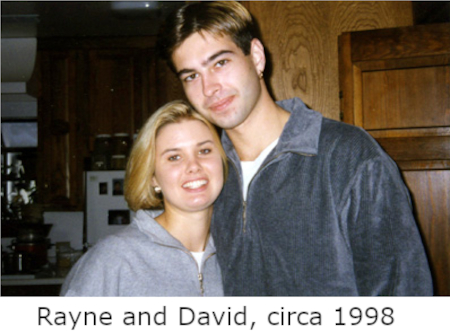
During this time, David had become close friends with a beautiful highschool girl, Rayne Osborne, who we called Rainbow. She was one of these southern girls with the impossibly thin figure that you occasionally see. (Remember Daisy Duke in the Dukes of Hazzard.) In my mind I always thought she was going to be our daughter-in-law. Her family was highly disfunctional, and one day Rainbow came home with David. Her Mom had beaten her up and she needed a refuge. That night the police showed up to take her home while Rayne hid in the swamp behind our house. Rayne's mother promised criminal charges against us if we sheltered her. It was obvious to the cops that she did not want to go with them. The police did not force her to do so, and no charges were ever filed. Eventually, she reconciled with her mother; however, she lived with us until she graduated and then went to live in Texas with her extended family and the promise of a job. Londi and I put the down payment on a car for her and Rainbow drove off. Unfortunately, the necessity of making monthly payments on the car did not sink in to her, and it was repossessed a few months later. Rayne eventually matured, married, and now has a wonderful family. She is a sweet, beautiful woman, and I am glad we were part of her life at that stage.
David was sent to Lackland Air Force Base in San Antonio, TX for basic training. Londi and I, with his Mom Louise, went to his graduation. I was amazed, basic training had instilled discipline (born of survival perhaps, remembering my own basic training experience). The kid was following all the rules. He might survive after all, but I assumed the discipline would not last once he completed advanced training and was assigned to a permanent unit. David finished out his service time as a F15 crew chief at Seymour Johnson Air Force Base in Goldsboro, NC. I visited him there and the discipline had largely evaporated but he was doing well and was happy, looking forward to getting out at the end of his tour. He still partied hard but also took after-hour courses at a nearby junior college to get an associate degree. He now had goals and wanted to raise his undergraduate college GPA to help be admitted into a good college for an engineering degree. David said he realized that to live a great life, he would need a great income, and was now willing to work to get the proper credentials. I can honestly say that the Air Force turned him around in his work ethic for success. Years later David told me that my statement about cutting him off from any inheritance, was what forced him to change his ways. (LOL) Regardless, David had become a man and later I would depend upon him.
David completed his Air Force tour in March, 2000 and enrolled in December in Austin at the University of Texas. David liked what Londi and I had done in developing Old Mandeville Woods and her building spec. houses. Eventually, he wanted to work in land development. His Mom Louise and her mother Lou generously funded those UT undergraduate years, and he returned the favor by doing well. He loved Austin, still loved to party, picking up the nickname "Downtown Dave" and a host of friends. Londi, Louise, Lou and Wally, and I went to his graduation in December, 2003, to receive his BS in Architectural Engineering (considered a degree in Civil Engineering). So now what would he do with his life? He wanted to be a land developer and wanted to stay in Austin. But to make money he would first have to turn to engineering, get his PE (Professional Engineering License) and a MBA in Business Administration. As you might guess, his first wife to-be, Isis Romero, a beautiful Spanish TV reporter and anchor woman in Corpus Christi, picked him up in an Austin bar. But these are stories for the next chapter.
Return to Top
Land Development, Square 74, Spec. Houses, Old Mandeville Woods
Cellie had held on to nearly all of her woodlands throughout her life. I loved the woods, having seen the deer and turkeys, and hated to see it developed. And Mandeville was such a picturesque community, much like Sausalito across the bay from San Francisco. Imagine how the beauty of Sausalito would be destroyed (probably has) if half of San Francisco's poppulation moved north across the Golden Gate Bridge. That is the future for Mandeville. The New Orleans area (the South Side of Lake Pontchartrain) is on the old Mississippi delta and sinking and flooding. The only dry land to build on are the Pleistocene terraces, north of Lake Pontchartrain of which Mandeville is the closest. More and more people were (are) moving north from New Orleans, Metairie, and Chalmette to escape the hustle and crime of Big Easy. There is so much money in development that it can't be held back. Eventually, our woods were going to be developed into homesites, destroying the natural environment that we all loved. I realized, all I could do was hold out for moderate lot sizes and get agreements not to clear-cut the trees.
Developers were eager to approach us to buy land from us for subdivisions. Naturally, most of them wanted to jam as many houses as possible to maximize their profits (i.e., because of their fiduciary responsibility to themselves - LOL). They wanted wetlands given to them (as part of the sale) for free even though the cost at that time to mitigate the wetlands was only 1/10th to 1/20th the cost of the dry land. They wanted you to go to bat for them with the parish to get the necessary zoning for small lots. We were harassed constantly by developers. But on the other side were the people who had already moved into nearby subdivisions and wanted to stop all future developments by asking for zoning lot sizes to be 5 acres, making future subdivisions unprofitable, i.e., the NIMBYs (not in my back yard). The parish officials wanted the votes of the new residents and always sided with them, once telling me at a meeting that the land-owning families were greedy parasites. There were always threats of lawsuits to the parish not to change the rules for land owners and for developers to follow the rules. In the end, developers made the necessary payoffs to parish slush-fund accounts, supposedly for drainage improvements, etc and sometimes under the table to parish officials for the necessary zoning. As a land owner I began to distrust nearly everyone when it came to development.
The property the developers most wanted for a subdivision was a 160 acre quarter section bordering Hwy 1088 and Soult Street. This was where the "Old Place" had been, the Family Barn, pasture and woods where we had riden horses as children and hunted. I would often take off in the afternoon to walk those woods to be in spiritual touch with Cellie and my Grandfather who died before I was born. My family's blood was in that land and it was a personal tragedy to destroy those woods with houses. But it was inevitable, given its close location, within a mile, to Mandevile.
In the 80s, Rogers Smith, a local developer had used 20 acres of joint Prieto property to develop Fox Run, a beautiful, small subdivision off Sharp Road. My family did not want to sell its 5 acre share and Rogers had gone along with us, cutting out 5 acres and building the subdivision around it. Eventually we sold our property to him at twice what we would have gotten in the original offer. His wife Harriet was a licensed contractor and built the houses and they made good money off of Fox Run. Rogers, a marine architect and engineer, had flown fighter Air Force planes in the 1950s. He was an honest man who could do a deal on a handshake. We had many interesting conversations and over the years walked a lot of woods, building up a friendship that lasted til his death in 2014. Rogers was the one developer I wanted to work with, but he didn't have the resources to develop a quarter section. Gary Intravia and Kelly McHugh were also local developers who operated on a larger scale, having developed Quail Creek on adjacent property purchased from my Uncle Clay. Gary and Kelly brought in Rogers as a partner to convince me to sell to them. They agreed to use larger lot sizes (90x140 feet) than in Quail Creek (80x100 feet), preserve trees if possible, and named the subdivision "The Woodlands". Over the next several years, 373 homes were built in The Woodlands. My 1/3rd share of the land proceeds gave me the independence to not have to play politics at UNO, funded much of my research, our Lakeshore lifestyle, and various businesses interests that Londi and I became involved in. I am profoundly grateful to my grandfather John Ernest Prieto for his land accumulations for future generations! He was the family entrepreneur.
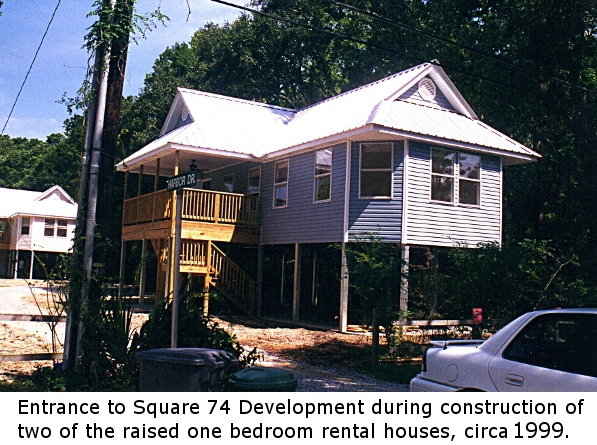
In early 2000, Londi formed a partnership (Chateau Nouveau, LLC) with local builder and licensed contractor Lloyd (Guy) Songe to build 2 spec houses in the Helenbirg area and 2 along Soult Street. Throughout all this time, her Piffany Oaks manager Angela stayed with her to help manage Chateau Nouveau, LLC. Londi was full of energy and as one of our carpenters put it "She could keep an army of carpenters busy." In 2003, she used her share of the proceeds from selling Piffany Oaks to finance her share of a partnership with Guy and me to develop Old Mandeville Woods, a heavily wooded subdivision on three of my squares along the west side of Soult Street between Labarre and Preval Streets. The inspiration for Old Mandeville Woods is expressed in my poem below.
Have you worked in the heat of the summer sun in south Louisiana -
When far away, there's the sound of thunder and the storm clouds begin to roll.
The cool wet wind sweeps away the summer heat and brings the rain.
It's just another south Louisiana rainstorm.
In the old days, homes were built in the woods to escape the summer heat.
The pines and oaks sheltered the land and cooled the surface below.
But times changed and the woods were cut
and replaced with lawns and concrete and black tar.
And now the summer heat is broken
only when thunder rolls and brings the summer rain.
Old Mandeville Woods is a remembrance of an earlier time.
We've surrounded each house and lawn with green woods
to cool the land like the summer rain on a hot summer day.
Come and see what we've done in the coolness of the woods.
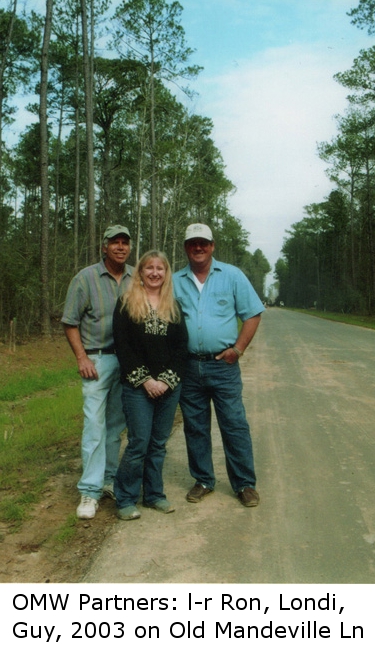
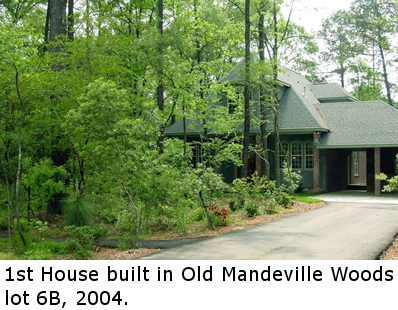
Developers hate homeowner associations because they often become political and try to force concessions out of the developer. To prevent having to deal with this scenario, we incorporated the land into Mandeville so the city would eventually have the responsibility of enforcing the wildlife restrictions. To do that, the parish had to agree to the city taking in the land. This involved paying a negotiated amount into a fund to pay for any future drainage problems from the development. In reality, we knew this to be a slush fund and if the money went for drainage, it was usually used to correct drainage problems elsewhere. We negotiated the amount with Joe Impastato, a parish councilman who went to prison several years later for taking kickbacks on FEMA debris-removal contracts. I considered the negotiations to be a shakedown.
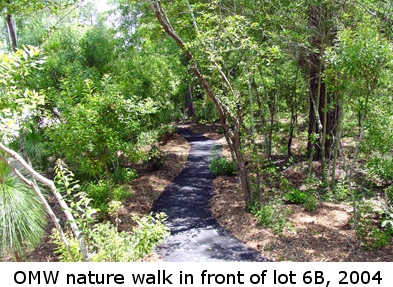
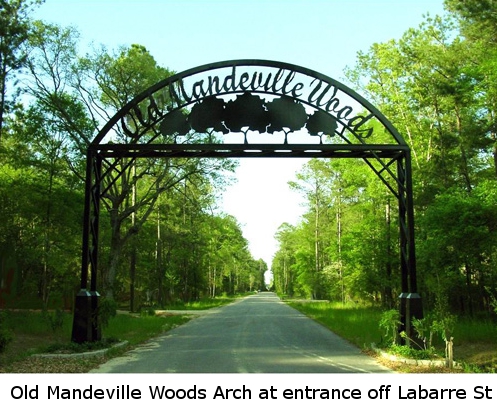
Our responsibilities were finally finished with Old Mandeville Woods. We had tried to create something that would bind the homeowners to nature but they had begun ignoring the wildlife easements as soon as the City of Mandeville (for political reasons) stopped enforcing them. Even our likeable civil engineer David Scalfano, who drew up the subdivision plat with the easements, ignored them when building his home. I felt betrayed. Soon the other homeowners began following his example. Today, it is certainly the most wooded subdivision in Mandeville; but looking back, I wouldn't try to do it again. People enjoy talking about their love for trees and nature but at least 90% want to live in houses with manicured lawns.
Return to Top
Hydrology Research in Yucatan and South Louisiana Research
Each year I was making one or two geochemical and hydrology research trips to the Caribbean Coast of the Yucatan. Londi and David would sometimes come with me, Londi to party on the beach and David, primarily for underage drinking. Londi had graduated and her days of research were apparently a thing of the past. Meanwhile, David was introduced to scuba diving. A UNO MS graduate student, Laurie Marcella, took more aqueous data in the interior sinkholes. We were measuring the changes in water composition moving inland from the coastal sinkholes, evaluating the dolomitization potential in the halocline. One of these sinkholes was Cenote Angelita, a jungle sinkhole with the halocline at about 100 feet in depth, located 20 km south of Tulum and about 5 km inland. Jim Coke had introduced me several years earlier to this sinkhole. With scuba tanks we (Jim, myself, and a Mandeville friend Jim Northey) dove in the sinkhole. This was the most incredible diving experience of my life. As we descended, red colors were largely filtered out, and we were in a blue world. At 80 feet depth, I looked down and below me appeared the skeletons of standing dead trees with white clouds in their branches on a white sand island sticking out above a red sea, The top of the red sea was the contact of the halocline with the overlying blue freshwater. It was like being in an airplane coming down for a landing on an oceanic atoll. The red sea of the halocline was stained deep red with sulfate-reducing bacteria. The white clouds were sulfide-oxidizing bacteria hanging in the dead tree branches. The island was once the land surface which had collapsed into the sinkhole. By chance the top of the old land surface extended above the halolcine, forming an island. As we sank slowly through the halocline, I could smell hydrogen sulfide through my mask and the water went opaque, filled with dark masses of sulfate-reducing bacteria. Fish following us through the halocline were gasping for oxygen in this anaerobic environment. The underlying seawater was a dark blackness, completely devoid of light down to the bottom of the sinkhole at about 120 feet. Years later, Laurie did the water chemistry in the water column. I remember her dropping the collection tubes on a line to take samples when this old armed man showed up with a younger companion. Turns out he was the land owner and wanted to know who gave us permission. His weapon looked like a gun from the 18th century with a flared barrel. I gave him money as a collection fee (standard gringo practice), but he was actually pacified by taking a picture of him with Laurie (a very beautiful gringo) and our promise to send him the photo. He was a nice guy but I'm not sure he got a copy of the photo. (LOL) Wish I could find it!

In all of our measurements in the sinkholes, the halocline was usually very sharp, a meter in thickness separating the freshwater lens and the warmer, underlying seawater (from the Caribbean Sea), so only limited mixing was occurring between the two water bodies. However, the freshwater lens in each cenote was only borderline fresh with a constant salinity with depth, meaning the freshwater lenses was well-mixed. The freshwater lens generally increased in salinity approaching the coast, consistent with the addition of more salt from the underlying seawater as the freshwater moved coastward. In addition, the water temperature was constant with depth to the halocline and then often increased rapidly (with depth) by several degrees centigrade at the top of the halocline before decreasing back to a constant value in the underlying seawater. This thermal anomaly at the halocline decreased approaching the coast, suggesting thermal diffuion was occurring as the groundwater moved coastward. MY goal was to explain this pattern.
One day back in Mandeville, while drinking at the Yacht Club, Jeff Waters, asked me the obvious question. What is the source of heat for the thermal anomaly? Hmm - Would that also explain the complete mixing in the freshwater lens? Londi's MS work had shown through hydraulic heads that the freshwater and adjacent underlying seawater were both moving towards the Caribbean coast, crossing the cenotes within 24 hours. With greater depth, we (and others) had hypothesized that the seawater was moving inward under the Yucatan Peninsula through the porous limestone, hence there was a large convection cell underlying the freshwater lens. I used a continuous recording temperature and conductivity probe to show that the temperature anomaly at the halocline in the cenotes did not disappear or change at night, This meant the anomaly wasn't due to a light-dependent biological reaction in the halocline. In a memorable 2002 field trip to cenotes across the Yucatan from Akumal to Celestun (with Jim Coke and Arville Touchet), I measured the same temperature anomalies in their haloclines, approaching the Gulf of Campeche. So how to explain these observations?
My explanation is that warm seawater from the Caribbean Sea, enters at depth the porous limestone underlying the Yucatan. Fractured tubes of limestone, occur below the cenotes, the result of halocline dissolution when sealevel was lower during Ice Ages. When the warm seawater crosses these fractured tubes of limestone below the cenotes, warm seawater rises by buoyancy to the halocline. The upward movement stops because while the freshwater has less salt content, it is also colder, resulting in nearly the same density. However, heat diffusion into the bottom of the freshwater lens causes convection within this lens that results in mixing and nearly constant vertical salinity within the freshwater lens. As the underlying seawater and the freshwater move coastward, thermal diffusion and salt diffusion, reduce the halocline heat anomaly and increase the salt content of the freshwater lens. I used finite difference algorithms to modeled this and publish it in Journals of Groundwater and the Gulf Coast Association of Geologial Sciences: Localized Thermal Anomalies in Haloclines of Coastal Yucatan Sinkholes and An Explanation for the Lack of a Dilute Freshwater Lens in Unconfined Tropical Coastal Aquifers: Yucatan Example. The latter marked the end of my Yucatan research efforts.
I had begun doing geochemical research on (1) removing nutrients (nitrates and phosphates) from waste waters, (2) examining tree tissue for pollutants to see if this method could be used to track pollutants from pollution sites, and (3) determining the origin of dissolved salts in saltwater intrusion in freshwater aquifers in South Louisiana. Phosphates and nitrates need to be removed in waste waters to prevent harmful algae bloooms in areas draining septic tanks and wastewater treatment plants. Wastewater experiments were run using aluminum stearate as a carbon source. The nitrates were completely denitrified but only minor phosphate removal occurred, see Denitrification and Phosphate Removal in Experiments using Aluminum Stearate. The results were used to obtain a provisional US patent (US Serial Number 60/205,158 on 5/18/2000) on the process to remove nitrates. During this time several graduate students worked on nutrient removal problems using both lab experiments (Gordon Yamazaki) and data taken at the Mandeville waste water plant (Jennifer Miller), in local streams (Andrea Bourgeois-Calvin), and in the marsh at Davis Pond (Anna Strimas). These were great students, wonderful to work with. Gordon, Andrea, and Anna went on to work in the environmental field but trajedy struck Jennifer Miller during her studies. Her story haunts me to this day. I saw her one morning around 10 AM (Friday the 13th, July, 2001) at my house in Mandeville where she mentioned having a headache. She had been taking samples at the local waste water treatment plant and then drove back to New Orleans. At her apartment, she suffered a seizure, becoming temporarily paralyzed, calling a friend Becky Bogel who called an ambulance and stayed with her. An ambulance took her to a local hospital where after more than an hour wait in the emergency room, she suffered a brain aneurysm. Jennifer was taken off life support on Sunday. I was not notified until she was already dead. Her death was caused by the hospital staff not taking her illness seriously and investigating. It was their malfeasance and they eventually made a moderate payment to her family after a lawsuit was filed. I can close my eyes and see Jennifer looking at me in the geochemistry lab, smiling while she ran analyses on the liquid ion chromograph. She was a wonderful girl, the daughter that I never had. My God, I miss her smile and presence!
We used geochemical tracers to work out the origin of the salt in saltwater intrusion. This intrusion in the freshwater aquifers in Louisiana is an ongoing threat to drinking water and waters used in industrial plants and for crop irrigation. In general, all sedimentary sediments are deposited with seawater in their pores and in Louisiana, as elsewhere, freshwater aquifers at depths greater than several thousand feet naturally have salt water as their pore fluids. The near-surface freshwater is the result of flushing the salty pore fluids by groundwater moving downdip under pressure from recharge areas at the surface. Saltwater intrusion comes later. Was the salt in the saltwater intrusion from downdip rock-modified seawater within the rock pores or did it come from dissolution of an underlying salt domes or perhaps from industrial pollution of surface ponds or from salt water disposal in subsurface injection wells. Then, was the saltwater intrusion process simply salty fluids moving updip from depth (under pressure from withdrawal of the freshwater) in an aquifer or were they moving up old leaky oil well bores and/or up fault planes from much deeper aquifers or from downward movement of dense brines from polluted surface ponds? Many questions need to be answered.
Return to Top
Cameron, Logan and SFAS
It was my fate that sooner or later, I would become a dog rescuer. In 2000, Londi decided she wanted a dog and a local vet had a pair of champion King Charles Cavalier Spaniels that had been left at his clinic. Their English owner had gone back to England and died and his estate refused to pay the vet bills. Hence, the vet kept them as a breeding pair. Londi and I went to his house one evening and there was this adorable pile of fluff rolling around the floor, being used as a bowling ball by his parents. Too cute to pass up, I purchased him as a gift to Londi and we named him Cameron. Cameron re-awakened my love of dogs that I had consciously suppressed since the passing of Freckles, my boyhood dog. If there is a more handsome and cuddly dog than a blenheim (chestnut and white) King Charles Cavalier, I have yet to see one. Cameron was our kid now that David had left the roost. He liked to jump on the bed and then bounce up in the air, do a complete flip, and land on his feet back on the bed.
Londi wanted to get Cameron fixed but I resisted. Like any red-blooded American male, I wanted him to experience sex and I was also hoping for a puppy to keep him company. Londi eventually capitulated, and she found someone in Slidel with a receptive female King Charles Cavalier. The deal was reached and the deed was done in late 2001! And in the spring of 2002, we picked the runt of the litter to keep, another blenheim, naming him Logan. Logan was just as cute as Cameron, but more like a little elf. He was a "chick" magnet and very mischievous who loved to guard his food bowl, leaving it out to temp Cameron and Josey, so he could chase them away. Josey was the "sly" chunky, small (feist-like) mixed breed, stray puppy that I had brought back from Costa Rica in the summer of 2002, after teaching in San Ramon. Londi liked to say Josey was a senorita from Cuba who followed her nose onto a taco ship to Costa Rica. So now we had three dogs, and each morning I would take them walking along Lake Pontchartrain down Lake Shore Drive. They were known locally as the Lakeside Dogs. And in the office we had a 4th dog Diva, a Yorkiepoo, that belonged to Angela, Londi's secretary, who joined the pack of small dogs during the day.
I was beginning to attempt to find home for stray dogs, and I funded a spay and neuter program for the City of Mandeville. I hooked up with Pam and her daughter Heidi who lived in Abita Springs and were attempting to start a dog and cat sanctuary in southern Mississippi, called St. Francis Animal Sanctuary. They were trying to find funds to pay off the land that they had put a down payment on, and I gave them the money. I didn't want to get too closely involved because I assumed it would emotionally destroy me. But for the next ten years, Londi oversaw building various buildings and I worked putting up fences on the weekends. and cutting up trees from torndo damage, etc. Overall, we put a half million dollars into Saint Francis to help them. Heidi died of cancer in a few years but the sanctuary is still going strong. I learned a lot of practical veterinarian care of dogs from Pam which helped me later in rescue work. And I learned to beware of rescuers who say they're doing something because "It's all for the animals." I also occasionally brought strays to the sanctuary and once brought in a beautiful rough coat collie, a stray from New Orleans. I promised that dog I would come back for him and did so 5 years later. We named him Sundance and he died in 2017. Sundance was a character. I once tried to discipline him and raised my hand to hit him. He grabbed my hand in his jaws and looked at me intently. I subsequently reached an agreement with him that I would not threaten him if he released my hand - which he did. Diplomacy is better than war! (LOL)
Then there was the bad news. A young vet and his wife had rented one of Londi's houses on Square 74 in 2002. One afternoon, while visiting us, the vet listened to Cameron's heart. He diagnosed him with a signifiant heart murmor and said Cameron probably would only live several years. The vet was at the Tulane National Primate Research Center and was trained at the University of California at San Diago. I researched and discovered that King Charles Cavaliers were bred from a small group of individual dogs. The inbreeding resulted in genetic mitral valve problems, and they usually died of heart congestion by 10 years of age. We were devastated. But ultrasound tests and a second opinion from a board-certified vet said that Cameron did not have a heart murmur. Who was right? Well, Cameron did have a heart murmur and died from heart congestion when he was 10 in 2010. Logan died from an auto accident (sadly, due to my fault) in 2008 when he was 6, and Josey lived on until 2018 when she was 17. They were wonderful beings.
Return to Top
Hurricanes Katrina and Rita
During August of 2005, Londi and I had taken a cruise ship trip to Alaska. Seeing the glaciers in the fjords was a trememndous experience for us. After returning, we were looking forward to the fall but the news was full of the approaching Category 5 Hurricane Katrina. Satelite photos showed the storm filling the entire Gulf of Mexico. On the first (and only) day of UNO fall classes, August 26, I told my physical geology class that New Orleans and the land south of the Mississippi River would be under water in a few years due to continued land subsidence and rise in sea level from global warning. I advised against buying land in this area. I doubt they took me seriously. Then Hurricane Katrina, hit New Orleans and Mandeville on Monday, August 29th. Hurricane Katrina eventually eliminated UNO as a first class university (due to state politics driven by LSU) and eventually caused us to leave Mandeville after Hurrican Rita hit Cameron Parish less than a month later. This power of wind and water was truly phenomenal. It was a life-changing experience for us.
Our Lakeshore home had been raised about 13 feet above the ground that was only 3 feet above sealevel. I had never evacuated before for a hurricane but this was obviously the storm of the century. We were not sure the Lakefront house would survive. So the day before Katrina, we moved from our Lakeshore home to sanctuary in a house a mile north in our Old Mandeville Woods Subdivision, sitting on ground 20 feet above sea level. The subdivision had 36 half acre lots with about 5 built homes built by Londi and her business partner Guy Songy. This house was empty, having only been recently built as a spec house. Londi had just sold the house to a former employee who gave us permission. We took our three dogs, a few papers, guns, my Stiehl 460 chainsaw, and blankets, etc to camp in the house. Our housekeeper, June Myer and her husband Jimmy with their little dog left their home near Pearl River and moved in with us. That night was party time but we were apprehensive of what was coming. I remember sleeping on the floor with the dogs around me, listening to the wind when I woke. The wind started up slowly and then came with a roar, howling for hours through the pines. The tall tree tops whipped around in a circle until the trunks splintered vertically at the base and came down around us. When the storm passed, no trees had fallen on the house but they littered the ground and the streets, making them impassable. It was a disaster zone. And what had happened to our house on Lakefront? Was the house washed away in the storm surge?
That afternoon, I wanted to reach the Lakefront to see if our home was standing. A group of guys had gathered at the corner of Labarre and Soult Streets. Large oak and pine trees had fallen aross the street, making it impassable, even for foot traffic to the south. It seemed there was a fallen tree every three feet. We wanted to open the road to reach Hwy 190 to the south which was 6 blocks away. We could wait for the govenment or try to clear it ourselves. The group decided that waiting for the government was useless, and started cutting and moving trees with chainsaws. After an hour, we gave up trying to clear a path wide enough for a car and reversed directions, trying to reach Highway 1060 to the north, going through The Woodlands Subdivision. The big trees had been cut there in building the subdivision so there would be less to cut. The streets were partially flooded and I discovered that cutting through wood in water immediately dulled chainsaw blades. When we reached Hwy 1060, it was blocked by fallen steel pylongs carrying electical transmission lines. So again we reversed course, going back down Soult Street to cut just a foot path to Hwy 190. And we made it! From there, I walked to the lakefront, going down Jackson Avenue. I held my breath, rounding the corner onto Lakeshore Drive. Would our house still be standing? It was! Then I realized there had previously been 5 unraised houses blocking the view. They were now gone, swept by the storm surge into the swamp behind them, leaving piles of bricks and debris. All four raised houses in my block were still standing; however, my unraised Mother's home (now owned by my sister Marilyn) was folded like an accordian and broken into two large pieces. Water marks showed the storm surge had reached 9 feet above the concrete slab holding my house columns. The surge had swept away the breakaway structures built under the house into the swamp behind us. And the yard was stacked several feet deep with debris along with a large overturned motor boat in the back. With no electricity, gas, phone service, etc, cleanup was going to be hell. I walked back to tell Londi the news.
We stayed for a few days in the house in Old Mandeville Woods. The subdivision still had running water and we used inverters on our car batteries to keep the utilities working until we got a generator. The lift pumps in the sewer lines had no electricity to pump so the fluid levels in the lifts were monitored to see how close we were to having sewage backing up in the houses. The lack of electricity for gasoline station pumps meant leaving the area for gasoline. Londi drove to North Louisiana to get a 55 gallon drum and hand pump from her stepfather Gaston Tyson that she filled with gasoline. She came back by the back roads to avoid the state police roadbacks where gasoline was being confiscated for use by the local government. On Old Mandeville Lane, locals needed to be driven off from dumping trash and debris picked from their yards. There were gun shots at night and rumors were full of looters. I woke the first morning to see a group of African American men climbing out of vehicles a block away on Old Mandeville Lane. I took my 38, openly carrying it, to see what was going on. Turned out, they were a group of workers contracted to dig a new house foundation slab for Londi and Guy. I felt foolish and told them that the job would have to be done later. A group of Mexican workers took over an empty house in the subdivision and I evicted them. Then there was the endless cutting up of fallen trees and picking up debris. My most vivid memory is sitting on the steps each morning, sharpening chainsaw blades with a hand file. I cut up trees in Old Mandeville Woods, at the Lakefront House, and our little development of 5 raised houses in Square 74 off Jackson Avenue. Trees had fallen against one of the raised houses in Square 74. Kevin McDaniel, a good friend who did the roadwork, etc in Old Mandeville Woods, picked them off the house with a big backhoe and laid them down. The actual physical damage from Katrina was roof damage on the houses and the lost of breakaway structures under our raised home and garage. In addition the house had been racked (twisted) by the wind. After 10 days we moved back to the Lakeshore House. There I hired crews to help remove the debris. We got electricity back and reconnected with the world to see the devastation and deaths from flooding in New Orleans. One afternoon while moving debris, a CBS reporter came by and asked if they could film our reaction to a speech to be made by President Bush. So that evening, we all sat together watching the TV in our living room. Bush was talking and we listened intently. Suddenly, the sound of loud snoring broke through, startling us and the film crew. Cameron, our King Charles Cavalier was stretched out, sleeping on a sofa, snoring in unison with Bush's speech. Hilareous. I don't think that clip was ever aired on TV.
The depth of destruction from Katrina was mentally devastating. About ten days after the storm I walked down Lakeshore Drive to the home of Libby and Wayne McClendon. Libby's parents lived in New Orleans in Old Metairie and were rescued from flooding and sent to Mandeville to be with her. But health needs dedicated they be sent on to a facility to be treated. As I stood there, talking with Wayne, a high water National Guard Truck with an open flat bed turned in. I watched Libby's parents be lifted up in chairs which were then tied down to the flat bed. They spoke not a word, each with a deadpan expression on their face, as though hypnotized. Both died a few weeks later. Older people under stress sometimes seemed to give up from depression after Katrina, dying from suicide or natural death.
Nearing the end of September, Mandeville was recovering. Then along came Rita, another massive category 5 hurricane. Rita crossed southwest Louisiana on September 24, 200 miles from Mandeville. I assumed, at that distance there would be little damage in Mandeville and flooding would be minimal. Earlier, I promised Londi I would come up with a plan if needed. Now, prior to the storm, we had purchased a large, heavy natural gas generator (weighing hundreds of pounds). I had built a wooden platform 12 feet off the ground but had not enough time to find a hoist to lift it 12 feet. The generator sat on the slab and with the help of a friend, Miles Gautreaux, we used chains to lift it and hang it from a 12 inch steel I Beam. The bottom of the generator was more than 3 feet above the slab and unfortunately (spoiler alert) also over a gas line. The storm landed in Cameron Parish, bringing low hurricane winds to Mandeville but massive flooding along the lakefront. The core of the house was about 70 years old and it was doing a slow fox trot with the wind. Below, the lake had risen and water covered the slab and was rising. When the water level was 3 feet above the slab, Londi said "OK - What's your plan?" ?" Admitting negligence, I replied with a grin "My plan is no plan!" (LOL). But I was worried because if the generator came crashing down on the gas line, there might be an explosion. (This is actually part of Louisiana hurricane folklore.) When the generator started rolling with the waves under the house, I decided we needed to go. I carried the three dogs, one at a time, with water nearly up to my shoulders in the street to a raised house of a good friend in our Square 74 development. This area, being a block off lakeshore, was higher with only minor flooding. Our friend took the dogs in and told me to bring Londi to spend the night. Back in the house, Londi was not happy! She said "My Daddy always said - don't leave a standing house in the middle of a hurricane". But I wasn't listening. Londi emptied her safe of valuables (mostly cash she had squirreled away) and put them into two styrofoam chests which she tied together with ropes and then to herself and to me. She was only 5 feet two and the water would probably be over her head in the street. Out we went! We must have been a sight with her dog-paddling behind me with the trailing styrofoam containers. We made it OK to Square 74 and spent the night. The next day Londi said "I've had it with these hurricanes. I'm going to find us a new home where it doesn't flood." She drove off towards North Carolina. Londi always had a soft spot for the Carolina mountains, having once lived in Brevard and her goal was to find a safe place, as close to Louisiana as possible. I was also depressed, since the hurricane cleanup had to be repeated again. Things were only going to be worse in the future with continued sea level rise and global warming producing stronger hurricanes. At age 58, near retirement at UNO, I no longer had the energy for these cleanups and maybe it was time to move inland!
Return to Top
Cellie's IRS Audit
Clearing Titles & Prieto Problems
The cannons don't thunder, there's nothing to plunder
I'm an over-forty victim of fate
Arriving too late, arriving too late
I've done a bit of smuggling, I've run my share of grass
I made enough money to buy Miami, but I pissed it away so fast
Never meant to last, never meant to last
When far away, there's the sound of thunder and the storm clouds begin to roll.
The cool wet wind sweeps away the summer heat and brings the rain.
It's just another south Louisiana rainstorm.
In the old days, homes were built in the woods to escape the summer heat.
The pines and oaks sheltered the land and cooled the surface below.
But times changed and the woods were cut
and replaced with lawns and concrete and black tar.
And now the summer heat is broken
only when thunder rolls and brings the summer rain.
Old Mandeville Woods is a remembrance of an earlier time.
We've surrounded each house and lawn with green woods
to cool the land like the summer rain on a hot summer day.
Come and see what we've done in the coolness of the woods.